

Centro Historico del Cusco and its layered stone streets
Published on 08/25/2026 at 17:43 | Editorial responsibility: Rafael Müller, Editor-in-Chief AD HOC NEWS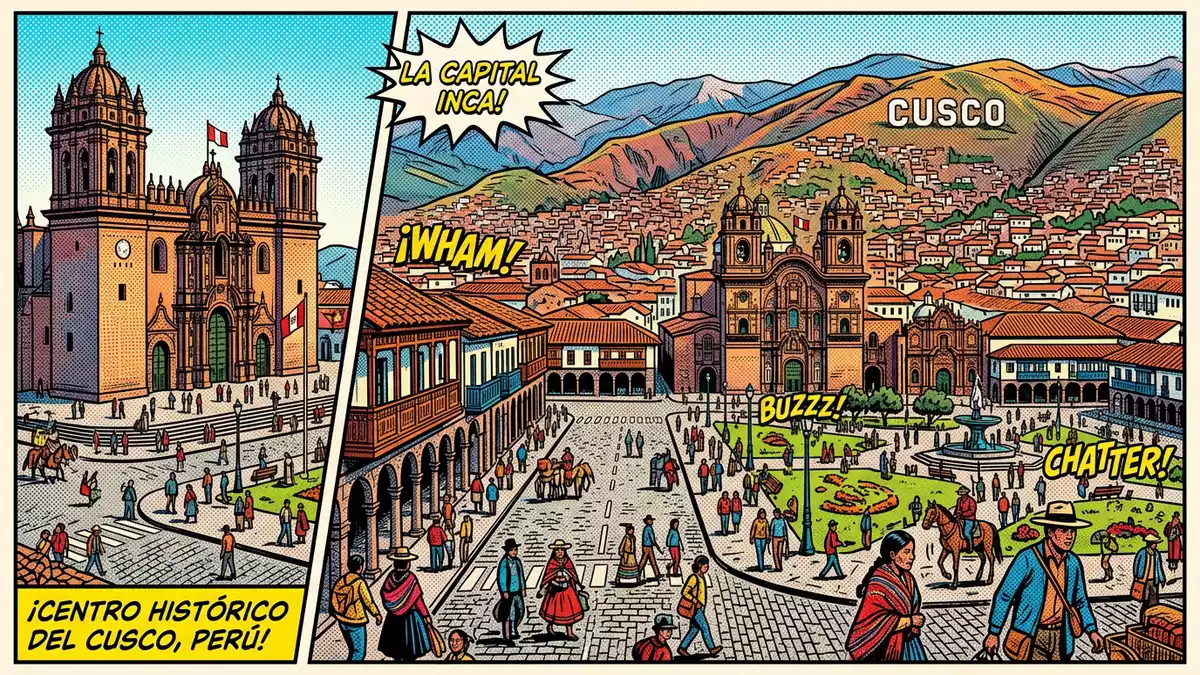
Centro Historico del Cusco is the historic centre of Cusco in southern Peru, a high?Andean city that once served as the capital of the Inca Empire. Its streets and plazas bring together finely dressed Inca masonry and Spanish colonial churches within a compact basin framed by surrounding hills.
From Inca capital to UNESCO-listed historic centre
The historic centre occupies the core of Cusco, which functioned as the political and ceremonial heart of the Inca Empire before the Spanish conquest in the sixteenth century.historic centre of the Peruvian city The grid of streets follows much of the Inca layout, yet many of the visible façades belong to colonial buildings raised after 1533.
The Peruvian state recognised this concentration of monuments as a Monumental Area in 1972 under Supreme Resolution 2900-72-ED, defining a protected zone that covers the oldest streets and plazas.Monumental Area in accordance with Supreme Resolution Nº 2900 In 1983 UNESCO inscribed the City of Cuzco as a World Heritage Site, with a central area that coincides with Centro Historico del Cusco and an adjoining buffer zone.World Heritage Site by UNESCO in 1983
Plaza de Armas and the great stone churches
At the heart of Centro Historico del Cusco lies Plaza de Armas, a large rectangular square that traces part of an earlier Inca ceremonial space and serves as the main urban stage for the city.Plaza de Armas Cusco is the historic heart Stone paths run around manicured planting beds, while colonial arcades line the edges with galleries and balconies.
Two major churches dominate the plaza and anchor its skyline. On one side stands the Cathedral of Cusco, a large Roman Catholic church whose construction began in 1559 and continued until 1654.Construction of the Cusco Cathedral began in 1559 On another side rises the Church of La Compañía de Jesús, a Jesuit church in a baroque style that forms a second monumental façade on the square.the Cathedral and La Compañía de Jesús
Inca walls, colonial courtyards and Andean altitude
Walking away from Plaza de Armas, the layered stonework that defines Centro Historico del Cusco appears in street after street. Many colonial houses and convents sit on top of Inca walls, where precisely cut stones fit together without mortar and form the lower courses of the structures.finely worked Inca stone and Spanish colonial façades In places such as Hatunrumiyoc Street, individual stones with multiple angles, including the well?known twelve?angled stone, mark the base of later façades.Twelve-Angled Stone and Hatunrumiyoc
Within the district stands Qorikancha, once the most important Inca temple in Cusco and now partially enclosed by the Church and Convent of Santo Domingo.Qorikancha/Santo Domingo The site combines thick Inca walls, inner courtyards and a cloistered church, illustrating how religious architecture from different periods occupies the same plot.
Centro Historico del Cusco sits at an elevation of about 3,400 m (11,150 ft), which shapes the experience of walking its sloping streets and climbing staircases that link lower and higher quarters.Altitud 3,400 m / 11,150 ft Neighbourhoods such as San Blas rise above the central plazas, with narrow lanes and small squares that look back across the roofs of the old city.
Visiting Centro Historico del Cusco: what travellers from Western Europe should know
- Centro Historico del Cusco occupies the central basin of Cusco in southern Peru and is reached by road from Alejandro Velasco Astete International Airport on the south-eastern edge of the city.
- The historic centre lies at high altitude, around 3,400 m (11,150 ft), and many streets climb steeply with stone steps and narrow pavements.
- Plaza de Armas forms the main reference point within the district, with most major churches, museums and streets radiating from this square.
- Spanish is the main language used in Cusco and the national currency is the Peruvian sol.
- Entry requirements depend on your nationality; UK travellers can check the FCDO travel advice at gov.uk/foreign-travel-advice, Irish travellers the Department of Foreign Affairs at ireland.ie.
Searching for Centro Historico del Cusco on social platforms
These links open searches for Centro Historico del Cusco on each platform.
Frequently asked questions about Centro Historico del Cusco
Where is Centro Historico del Cusco?
Centro Historico del Cusco is the historic centre of Cusco, a city in the southern highlands of Peru that formed the capital of the Inca Empire.
What can visitors expect in the historic centre?
Visitors encounter a dense network of streets, plazas, churches and houses where Inca stone foundations support Spanish colonial buildings and later urban additions.
What makes Centro Historico del Cusco distinctive?
The district combines pre?Hispanic Inca urban planning, colonial religious architecture, high?altitude topography and recognition as part of the UNESCO World Heritage City of Cuzco.


