Centro Historico del Cusco and its layered Inca and colonial stone city
Published on 08/29/2026 at 07:30 | Editorial responsibility: Rafael Müller, Editor-in-Chief AD HOC NEWS
Centro Historico del Cusco is the historic centre of Cusco in Peru, where finely cut Inca stone and ornate Spanish colonial façades share the same streets, squares and slopes in the high Andes. Rising at about 3,400 m (11,155 ft) above sea level in southern Peru, this compact district preserves the former capital of the Inca Empire beneath, around and inside a later Spanish city recognised as a Monumental Area of national heritage from 1972 and as part of the UNESCO World Heritage listing “City of Cuzco” from 1983.UNESCO City of Cuzco
Stone on stone: Inca foundations and colonial façades
The core character of Centro Historico del Cusco is visible at ground level, in the way imperial Inca masonry supports and frames colonial churches, mansions and arcades. Along streets such as Hatunrumiyoc, long walls of tightly fitted and irregularly shaped andesite blocks run for many metres, their joints so clean that no mortar is visible, and above them rise lime-rendered upper storeys with wooden balconies and tiled roofs.Hatunrumiyoc street stonework Many of these walls once belonged to palaces of Inca rulers such as Inca Roca and Viracocha, and excavations beneath the Cathedral and other churches have revealed substantial Inca stonework in their foundations, confirming that Spanish religious architecture sits directly on earlier elite residences.Cathedral on Inca foundations
At the Convent of Santo Domingo, the relationship between eras becomes even more explicit, as the cloisters and church occupy the terraces of Qorikancha, the Inca Temple of the Sun, whose precisely aligned outer walls still define the lower levels of the complex.Qorikancha convent complex The Peruvian government defined this concentration of Inca foundations and colonial structures as a Monumental Area in 1972 under Supreme Resolution 2900-72-ED, a designation later expanded in 1974 and 1991 to cover more streets and squares in the historic centre.Monumental Area of Cusco
Plaza de Armas: layered ceremonial heart of the city
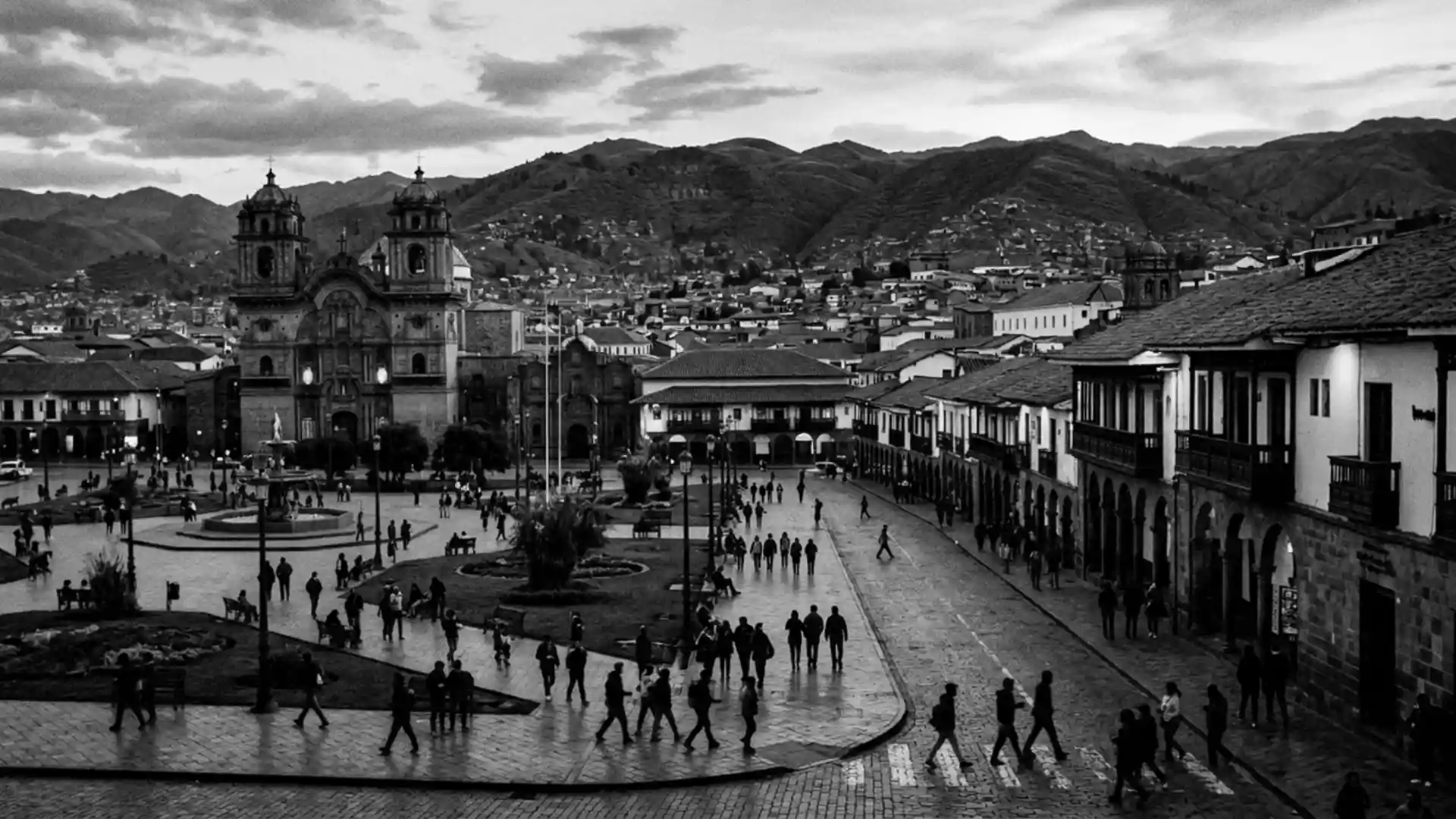
The Plaza de Armas of Cusco forms the spatial and symbolic centre of Centro Historico del Cusco, occupying part of the area once known in Quechua as Haukaypata, a great Inca square used for ceremonies and imperial gatherings.Haukaypata Inca square Spanish intervention in the sixteenth century reshaped its surface and edges, introducing stone arcades around the perimeter and constructing major churches on its flanks, yet the square’s role as a civic focus endured as power shifted from Inca administration to colonial rule.Plaza de Armas history
On the north-eastern side of the plaza stands the Cusco Cathedral, formally the Basílica Catedral de la Virgen de la Asunción, begun around 1559 and completed in the mid-seventeenth century, its heavy stone façade and twin towers rising from a platform that once held the palace of Inca Viracocha.Cusco Cathedral chronology Facing it diagonally across the square is the Church of La Compañía de Jesús, whose elaborate front marks the presence of the Jesuit order and adds another layer of European religious architecture to the former imperial centre.La Compañía de Jesús Between these anchors, the plaza itself is laid out as an open, planted space with a central fountain and broad paved paths leading under arcades that shelter shops and restaurants, illustrating how a ceremonial core has adapted to commercial and social uses while retaining its historic outlines.Plaza de Armas layout
Urban fabric, altitude and the World Heritage designation
Beyond the main square, Centro Historico del Cusco extends across a network of narrow streets, side plazas and sloping lanes that reflect both Inca planning and colonial restructuring. The Monumental Area and the UNESCO World Heritage core together cover more than 140 ha, with an additional buffer zone bringing the protected ensemble to nearly 290 ha, an area within which buildings of heritage interest are marked and regulated.Historic Centre of Cusco extent Many of these streets follow alignments laid out in the fifteenth century under the Inca ruler Pachacuti, retaining axes that connect the former ceremonial centre to surrounding quarters such as San Blas, even as their façades show later timber balconies, stucco and plastered walls above older stone bases.Street grid of Pachacuti
The entire district lies at high altitude in the Andes, with the Plaza de Armas itself recorded at around 3,399 m (11,152 ft) above sea level, a figure that shapes how visitors experience the climb between levels and the rhythm of movement along stepped alleyways.Plaza de Armas elevation In recognition of its combination of Inca urban layout, colonial architecture and continuing occupation, UNESCO inscribed the City of Cuzco on the World Heritage List in 1983 under cultural criteria iii and iv, a decision that anchored Centro Historico del Cusco within an international framework for conservation and helped define formal boundaries and buffer zones for its protection.World Heritage inscription details
Visiting Centro Historico del Cusco: what travellers from Western Europe should know
- Centro Historico del Cusco occupies the central part of Cusco in southern Peru, and is reached by road from Alejandro Velasco Astete International Airport and by intercity highways that connect the city to other Andean destinations.
- The historic centre sits at around 3,400 m (11,155 ft), and many streets between the Plaza de Armas, San Blas and Qorikancha climb on noticeable gradients with stepped lanes and uneven cobbles.
- Several prominent churches and convents in the district, including the Cathedral, La Compañía de Jesús and Santo Domingo, have interiors with stone floors and side chapels reached by short flights of steps.
- The official language is Spanish and the currency is the Peruvian sol.
- Entry requirements depend on your nationality; UK travellers can check the FCDO travel advice at gov.uk/foreign-travel-advice, Irish travellers the Department of Foreign Affairs at ireland.ie.
Searching for Centro Historico del Cusco on social platforms
These links open searches for Centro Historico del Cusco on each platform.
Frequently asked questions about Centro Historico del Cusco
Where is Centro Historico del Cusco located?
Centro Historico del Cusco is the historic centre of Cusco, a city in the southern Peruvian Andes, forming part of the UNESCO World Heritage listing for the City of Cuzco.
What can visitors expect on a visit to Centro Historico del Cusco?
Visitors encounter streets and squares where finely worked Inca stone foundations support colonial churches, arcades and houses, with the Plaza de Armas and Qorikancha among the most recognisable ensembles.
What makes Centro Historico del Cusco distinctive among historic city centres?
Its distinction lies in the visible layering of an Inca imperial capital and a Spanish colonial city, preserved together within a defined Monumental Area and World Heritage core at high altitude.