
Centro Historico de Quito and its layered stone streets
Published on 09/23/2026 at 12:15 | Editorial responsibility: Rafael Müller, Editor-in-Chief AD HOC NEWS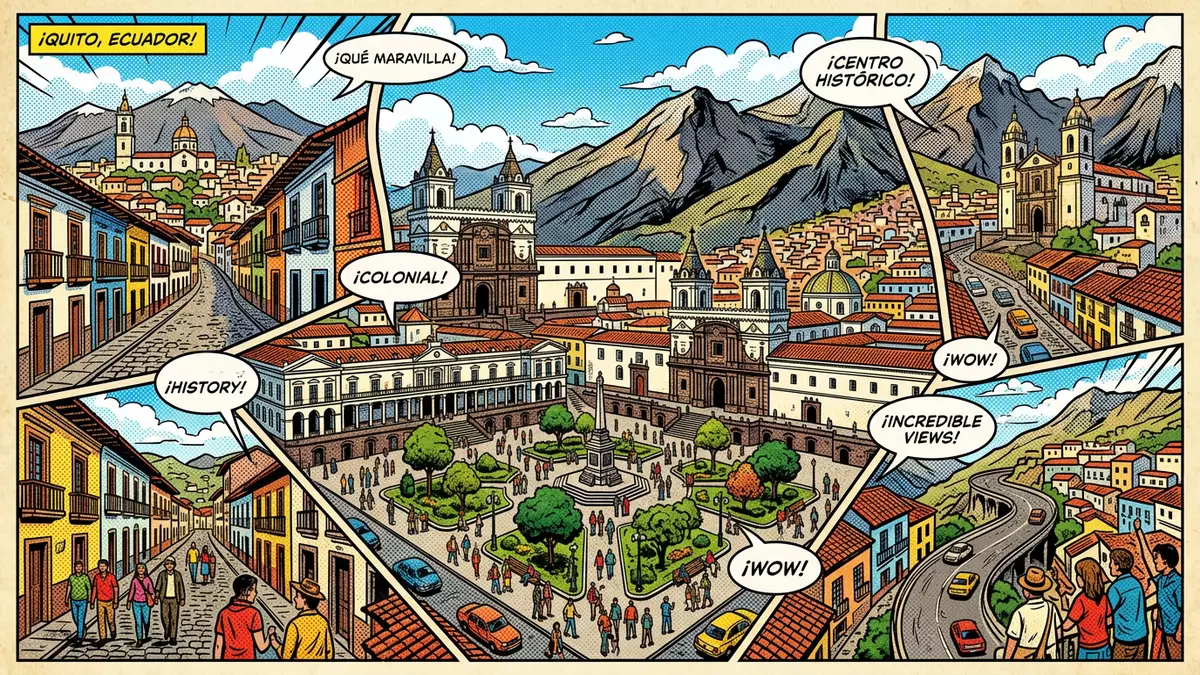
Centro Historico de Quito brings churches, plazas and narrow stone streets together on the southern side of Quito. Colonial masonry, carved façades and Andean views appear within a historic district inscribed on the UNESCO World Heritage List in 1978.
Stone streets and colonial façades in Quito
The district is arranged around streets and squares that connect religious buildings, civic architecture and residential façades. Many buildings use masonry walls, timber balconies and tiled roofs, creating a continuous streetscape rather than isolated monuments. The paving, walls and rooflines give Centro Historico de Quito a strongly material character.
Its architectural language belongs to several periods. Baroque, Renaissance, Mannerist and Neoclassical forms appear across churches and civic buildings, while the Quito School brought together European artistic traditions and indigenous knowledge. The result is visible in carved stone, painted interiors, sculpture and decorative details. the Quito School tradition remains closely associated with the historic centre.
Plaza Grande, San Francisco and La Compañía
Plaza de la Independencia, also called Plaza Grande, forms a central civic space in Centro Historico de Quito. The Metropolitan Cathedral, the Presidential Palace and other historic buildings face the square, placing religious and governmental architecture within one urban setting.
Plaza de San Francisco is associated with the Church and Monastery of San Francisco, whose complex occupies a prominent position within the old city. La Compañía de Jesús presents another major architectural focus, with a Baroque interior richly decorated with gold leaf. These places show how the district’s identity is carried through both public squares and enclosed interiors.
The Teatro Sucre adds a Neoclassical layer to the historic centre. Completed in 1886, it belongs to the nineteenth-century phase of Quito’s urban development. Teatro Sucre’s 1886 completion places the theatre among the district’s later historic landmarks.
Quito’s Andean historic ensemble
Centro Historico de Quito occupies the centre-south of the Ecuadorian capital, at an elevation of about 2,850 metres (9,350 ft). The surrounding Andean geography appears at the ends of streets and above rooflines, giving the old centre a setting of slopes and distant volcanic horizons.
The district covers about 375 hectares and contains around 130 monumental buildings, alongside a much larger inventory of protected properties. Churches, convents, houses, plazas and streets form a connected urban ensemble. the district’s recorded dimensions describe a historic area extending beyond its best-known churches.
Quito’s World Heritage inscription dates from 8 September 1978. The designation recognises the relationship between the historic urban fabric, colonial architecture, artistic production and the Andean landscape. the 1978 World Heritage inscription remains a defining historical anchor for the district.
Visiting Centro Historico de Quito: what travellers from Western Europe should know
- Centro Historico de Quito lies in the centre-south of Quito. It is connected with the wider city by Quito’s public transport network, including the Metro and urban bus services.
- The district sits at about 2,850 metres (9,350 ft) above sea level. Streets, plazas and buildings occupy an elevated Andean setting.
- Walking routes include stone paving, steps and sloping streets. Churches, convents, civic buildings and plazas are distributed across the historic urban fabric.
- The official language is Spanish and the currency is the US dollar.
Searching for Centro Historico de Quito on social platforms
These links open searches for Centro Historico de Quito on each platform.
Frequently asked questions about Centro Historico de Quito
Where is Centro Historico de Quito?
Centro Historico de Quito is in the centre-south of Quito, Ecuador. It occupies an elevated Andean setting within the capital.
What can visitors expect in the historic centre?
Visitors encounter stone-paved streets, historic plazas, churches, convents, civic buildings and residential façades. Plaza Grande, Plaza de San Francisco, La Compañía de Jesús and Teatro Sucre are notable landmarks.
What makes Centro Historico de Quito distinctive?
Its identity comes from the combination of colonial urban form, religious and civic architecture, Quito School art and an Andean setting. The district’s World Heritage inscription dates from 1978.


