
Centro Historico de Quito and its layered colonial streets
Published on 09/18/2026 at 09:10 | Editorial responsibility: Rafael Müller, Editor-in-Chief AD HOC NEWS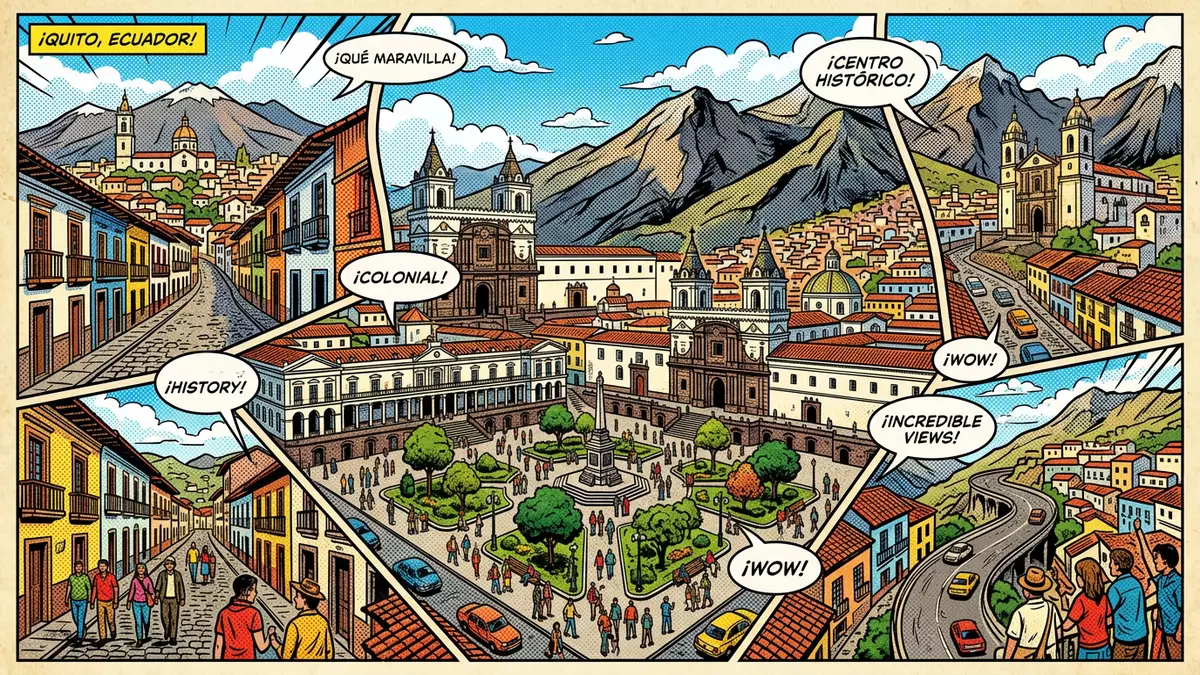
Centro Historico de Quito is the historic core of Quito, Ecuador’s capital, a dense district of stone streets, plazas and churches laid out on the eastern slopes of the Andes. It forms the city’s old centre, where Spanish colonial town planning from the sixteenth century still structures daily life around long-established squares and religious complexes.
Spanish foundations on Andean ground
The historic centre took form after the Spanish founded Quito in 1534 on the site of an earlier Inca city, giving the area a colonial grid threaded over Andean terrain.Founded by the Spanish in 1534 This layout, created under the rule of the Spanish Empire in the sixteenth century, still organises the streets into rectangular blocks that climb and fall with the contours of the hillside. Within this framework stand churches, convents and town houses in styles that span three centuries of colonial architecture.
Quito’s Centro Historico occupies a protected area measured in hundreds of hectares and is regarded as one of Latin America’s least altered historic centres, where colonial streets and building lines remain largely intact.surface of 375.2 hectares The district lies to the south of the city’s more recent commercial core, and its streets rise towards surrounding hills that frame the old town with views of Andean peaks.
Churches, plazas and dense urban fabric
Within Centro Historico de Quito, colonial religious architecture shapes many of the key spaces, with monumental churches and convents lining plazas and narrow streets.about 130 monumental buildings These buildings host a wide range of religious art and sculpture, created across different schools and styles during the seventeenth and eighteenth centuries. Their interiors often combine carved wooden elements with painted decoration and gilded surfaces, reflecting the baroque and other European influences adapted in the Andes.
The urban fabric is compact, with thousands of properties inventoried as heritage buildings, many of them town houses and smaller structures that form continuous street fronts.around 4,286 heritage properties Stone paving, kerbs and steps give the streets a layered appearance, while the plazas open out between them as gathering spaces bordered by civic and religious buildings. In several squares, historical events linked to colonial government and independence struggles took place, and the surrounding façades still give a sense of those periods.
UNESCO recognition and historic status
Centro Historico de Quito forms part of the “City of Quito” listing that became one of the first urban World Heritage inscriptions when UNESCO recognised the city in 1978.World Heritage Site designated in 1978 In the same year, Quito and Kraków were recorded as the initial World Cultural Heritage Sites, highlighting the extent and preservation of Quito’s historic centre. This status reflects the survival of the sixteenth- to eighteenth-century urban structure despite seismic events in the twentieth century.
Local and national heritage bodies in Ecuador have also designated the historic centre as cultural heritage of the state, adding further layers of protection to the area’s colonial and republican buildings.Quito Declaration declaring the Historic Centre These frameworks support conservation work on streets, façades and public spaces, helping maintain the character of the district while the wider metropolis grows beyond its original bounds.
Visiting Centro Historico de Quito: what travellers from Western Europe should know
- Centro Historico de Quito lies in central Quito on the Andean plateau of northern Ecuador, to the south of the city’s modern commercial centre.
- The terrain shifts noticeably inside the historic centre, with several streets climbing steeply and long flights of stone steps linking different levels.
- Mariscal Sucre International Airport, listed under the code UIO, serves Quito and lies to the east of the city; travellers reach the historic centre by road from there.
- The official language is Spanish and the currency is the US dollar.
- Entry requirements depend on your nationality; UK travellers can check the FCDO travel advice at gov.uk/foreign-travel-advice, Irish travellers the Department of Foreign Affairs at ireland.ie.
Searching for Centro Historico de Quito on social platforms
These links open searches for Centro Historico de Quito on each platform.
Frequently asked questions about Centro Historico de Quito
Where is Centro Historico de Quito located?
Centro Historico de Quito forms the historic centre of Quito, Ecuador, in the city’s southern core on the Andean plateau.
What can visitors expect in Centro Historico de Quito?
Visitors encounter colonial streets, plazas and churches, with a dense concentration of heritage buildings and religious art spanning several centuries.
What makes Centro Historico de Quito distinctive among historic centres?
Its extensive, well-preserved colonial layout and early UNESCO World Heritage recognition give it a rare continuity of urban fabric and protected status.


