
Centro Historico de Quito and its layered colonial skyline
Published on 09/03/2026 at 19:44 | Editorial responsibility: Rafael Müller, Editor-in-Chief AD HOC NEWS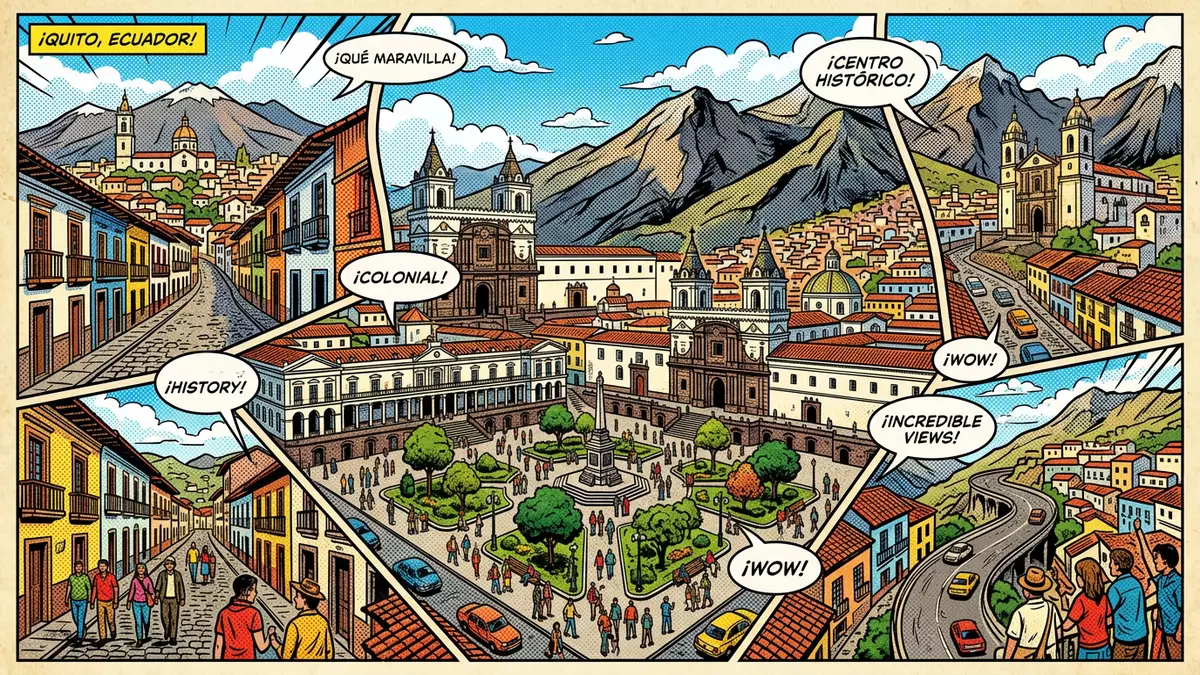
Centro Historico de Quito is the historic heart of Quito, the capital of Ecuador, laid out on Andean slopes and dense with churches, convents and civic buildings from the colonial era. Its core fabric dates back to the sixteenth century, when the Spanish founded the city on the site of an earlier settlement in the highlands, and it later became one of the earliest urban ensembles recognised on the UNESCO World Heritage List in 1978.UNESCO inscription in 1978
Terraced streets and an Andean setting
Centro Historico de Quito occupies the centre-south of Quito on a hillside rising towards the flanks of the Pichincha volcano, so its streets run along and across the slope in a tight urban grid.location on the centre-south hillside The area extends over several hundred hectares, forming a continuous urban fabric where plazas, religious complexes and townhouses sit close together, often with views up to higher ridges and down to newer districts beyond the historic core.extent of the historic centre
The altitude of Quito is around 2,850 m (9,350 ft), so Centro Historico de Quito stands in thinner highland air than most European cities, with streets and squares framed by distant mountain outlines.Andean altitude of the city The historic centre lies to the south of the city’s modern commercial axis, and the contrast between the dense colonial blocks and the wider avenues of later districts is visible from many vantage points in and around the old town.relation to the wider city
Religious architecture and the Quito School
Religious buildings dominate the skyline of Centro Historico de Quito, with monasteries, convents and parish churches occupying prominent blocks around major plazas. Complexes such as San Francisco and Santo Domingo, and the Church and Jesuit College of La Compañía, are associated with a local Baroque tradition known as the Quito School, which blends Spanish and Italian forms with Moorish details, Flemish influences and indigenous motifs in sculpture, painting and carved decoration.Baroque School of Quito Inside these churches, gilded altarpieces, polychrome statuary and painted ceilings stand alongside cloistered courtyards and attached monastic buildings.
Across the historic centre there are around 130 monumental edifices housing a wide range of religious art and sculpture, and thousands of further properties classed as heritage by municipal authorities, from grand townhouses to smaller dwellings and commercial frontages.monumental buildings and heritage properties Many churches and convents preserve fabric from the colonial period, and their architectural details show how European design patterns were adapted to local materials and craftsmanship in the Andes.colonial-period architecture in Quito
Plazas, civic power and urban continuity
Public squares structure Centro Historico de Quito, with Plaza de la Independencia — often called Plaza Grande — forming a central civic space surrounded by key institutions such as the presidential palace, the cathedral and the archbishop’s residence.central plaza and civic buildings Other plazas, including those fronting major convents and churches, provide open areas where religious and civic life intersect, and where the façades of neighbouring buildings can be read as a sequence of stylistic periods.
The Spanish foundation of Quito in 1534 established the grid that underlies much of the current street plan, and nineteenth- and twentieth-century architecture later added new layers without erasing the older fabric, so visitors encounter Renaissance elements beside Baroque forms and Neoclassical additions within the same neighbourhood.sequence of architectural periods The historic centre was protected by municipal ordinance in 1967 and then recognised internationally through its World Heritage inscription in 1978, reinforcing its status as a conserved urban ensemble spanning the sixteenth to the nineteenth centuries.sixteenth- to nineteenth-century building stock
Visiting Centro Historico de Quito: what travellers from Western Europe should know
- Centro Historico de Quito lies in the centre-south of Quito, south of the city’s later commercial districts, and is reached by urban streets that climb towards the slopes of the Pichincha volcano.
- The terrain involves gradients and sequences of steps, with narrow pavements and cobbled sections in some streets, so movement between squares and churches often requires short uphill or downhill walks.
- Centro Historico de Quito stands in Ecuador, where the official language is Spanish and the currency is the US dollar.
- From outside the European Union, entry requirements depend on your nationality; UK travellers can check the FCDO travel advice at gov.uk/foreign-travel-advice, Irish travellers the Department of Foreign Affairs at ireland.ie.
Searching for Centro Historico de Quito on social platforms
These links open searches for Centro Historico de Quito on each platform.Frequently asked questions about Centro Historico de Quito
Where is Centro Historico de Quito located?
Centro Historico de Quito lies in the centre-south of Quito in Ecuador, occupying Andean slopes beneath the Pichincha volcano and forming the city’s colonial-era core.
What can visitors expect on a visit?
Visitors encounter steep streets, plazas framed by civic and religious buildings, and interiors rich in colonial-period art and decoration across churches, convents and historic houses.
What makes Centro Historico de Quito distinctive?
Its combination of sixteenth- to nineteenth-century architecture, highland setting and early recognition as a UNESCO World Heritage city gives Centro Historico de Quito a concentrated, layered urban character.


