
Centro Historico de Puebla and its tiled baroque streets
Published on 08/26/2026 at 08:22 | Editorial responsibility: Rafael Müller, Editor-in-Chief AD HOC NEWS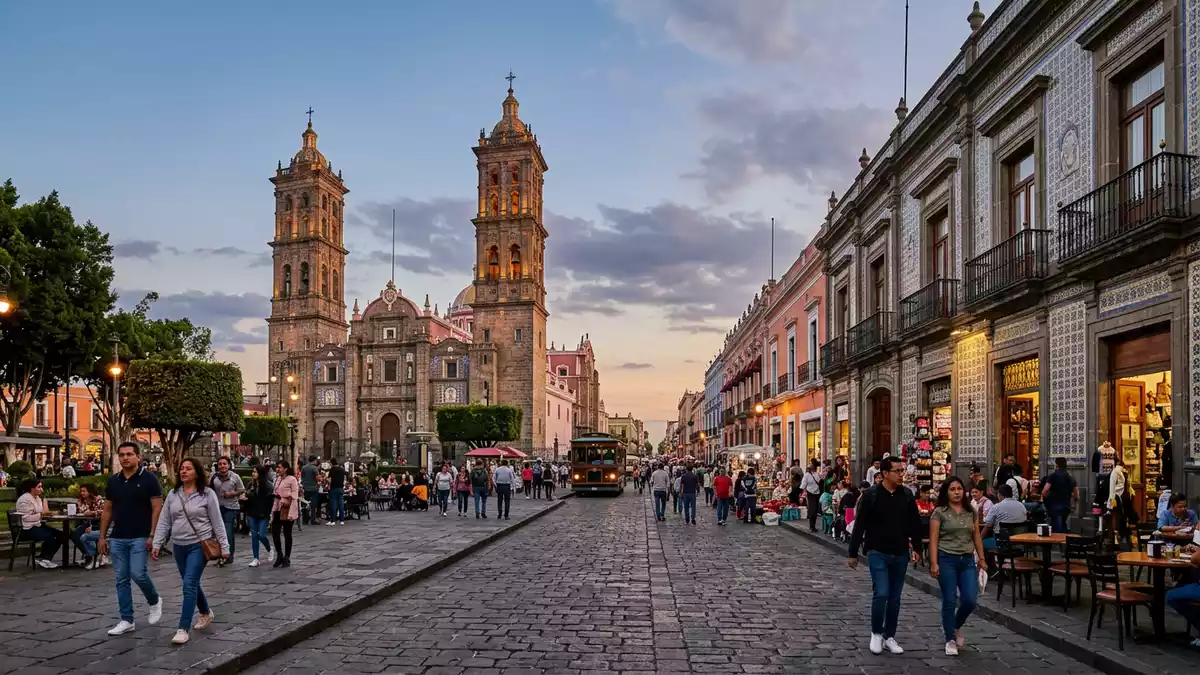
Centro Historico de Puebla in the city of Puebla is a Spanish colonial grid of churches, palaces and tiled townhouses that has grown into a dense open-air gallery of baroque façades. Founded in 1531 at the foot of the Popocatépetl volcano, the historic centre is recognised by UNESCO as the Historic Centre of Puebla and preserves layers of architecture from the sixteenth to the nineteenth century.
A Spanish colonial city traced as a grid
The Historic Centre of Puebla was laid out shortly after the city’s foundation in 1531 as a planned colonial town with streets arranged on a regular grid. The Zócalo, Puebla’s main square, formed the first block of that layout, with the surrounding streets traced out from its corners in a checkerboard pattern that still structures the Centro Historico de Puebla.The Zócalo, or main square remains the cultural and political focus of the centre, ringed by arcaded buildings and shaded walkways.
The historic core was decreed a Historic Monuments Zone in 1977 by presidential decree, and in 1987 UNESCO inscribed the Historic Centre of Puebla on the World Heritage List for its exceptional urban fabric and architecture.The city of Puebla was founded ex nihilo in 1531, and the protected zone today covers several hundred hectares of dense streets lined with religious and civil buildings.
Church towers, palaces and tiled townhouses
Walking through Centro Historico de Puebla brings one landmark after another into view, dominated by Puebla Cathedral with its twin towers and broad stone front. The cathedral, whose construction spans the sixteenth and seventeenth centuries, stands near the Zócalo and is counted among the major religious buildings of the World Heritage property alongside the churches of Santo Domingo, San Francisco and the Jesuit church.UNESCO highlights these churches as part of the centre’s outstanding baroque ensemble.
Secular architecture is just as present. The old archbishop’s palace, which houses the Palafox Library, stands among civic palaces with carved stone portals and balconies, while streets of townhouses are faced with patterned ceramic tiles and brick. Within the designated historic zone, thousands of buildings with historic value occupy hundreds of city blocks, with structures from the sixteenth to the nineteenth century represented in the urban fabric.The zone of monuments covers around 391 blocks and includes more than 2,600 historic buildings, many of them former residences and commercial houses.
Talavera tiles and baroque detail at street level
One of the most striking features of Centro Historico de Puebla is the use of glazed ceramic tiles, or azulejos, on the façades of houses and public buildings. These tiles, produced locally as Puebla’s talavera ceramics, are set in geometric patterns that pick out window surrounds, cornices and entire walls, giving the streets an alternating rhythm of brick and gleaming colour.UNESCO notes that many houses in Puebla have walls covered in tiles, a feature that distinguishes this baroque district within Mexico.
Alongside the tiled façades, Centro Historico de Puebla carries numerous ornamental details at ground level: carved wooden doors, wrought-iron balconies and stone window surrounds backed by the steady line of the street grid. Baroque churches rise above these streets with towers and domes, yet the scale of the blocks and the continuity of the façades keep the centre legible on foot as a sequence of streets, squares and shaded arcades.Descriptions of the centre emphasise the colonial streetscapes and tiled domes.
Visiting Centro Historico de Puebla: what travellers from Western Europe should know
- Centro Historico de Puebla lies in the city of Puebla in central Mexico, east of Mexico City, and is reached overland from Mexico City and by transport links from Puebla’s airport.
- The historic centre is largely level and laid out on a grid, but many churches and civic buildings are approached by exterior steps and some interiors have long stone staircases.
- The Zócalo functions as a central reference point within the Centro Historico de Puebla, with surrounding streets numbered from its corners, which helps with basic orientation while walking.
- The official language is Spanish and the currency is the Mexican peso.
- Entry requirements depend on your nationality; UK travellers can check the FCDO travel advice at gov.uk/foreign-travel-advice, Irish travellers the Department of Foreign Affairs at ireland.ie.
Searching for Centro Historico de Puebla on social platforms
These links open searches for Centro Historico de Puebla on each platform.
Frequently asked questions about Centro Historico de Puebla
Where is Centro Historico de Puebla?
Centro Historico de Puebla is the historic centre of the city of Puebla in central Mexico, east of Mexico City at the foot of the Popocatépetl volcano.
What can visitors expect in the historic centre?
Visitors encounter a planned colonial grid of streets, a cathedral and baroque churches, tiled townhouses, civic palaces and shaded squares such as the Zócalo.
Why is Centro Historico de Puebla significant?
The historic centre is recognised as a UNESCO World Heritage Site for its preserved colonial urban plan, baroque religious complexes and extensive stock of historic buildings.


