
Centro Historico de Ouro Preto on the baroque hills of Minas Gerais
Published on 09/21/2026 at 17:23 | Editorial responsibility: Rafael Müller, Editor-in-Chief AD HOC NEWS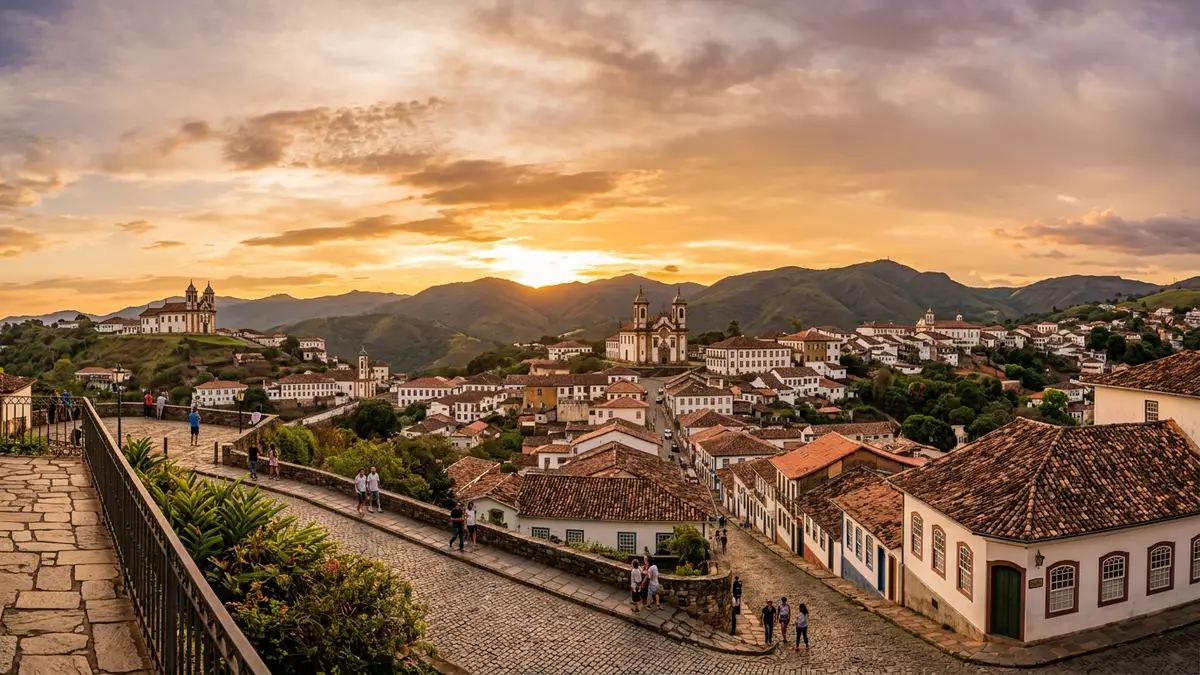
Centro Historico de Ouro Preto is the historic core of Ouro Preto in the Brazilian state of Minas Gerais, a hillside district shaped by the gold rush of the eighteenth century. Its steep streets, baroque churches and tiled houses together form the Historic Town of Ouro Preto, a UNESCO World Heritage Site inscribed in 1980 for its remarkably preserved colonial architecture and urban layout.
Eighteenth-century streets on steep hillsides
The historic centre occupies the slopes of the Vila Rica valley, where stone-paved streets climb and twist between ridges and shallow depressions. Many streets run on marked gradients, with flights of stone steps cut directly into the hillsides where the slope becomes too steep for wheeled traffic. Rows of terraced houses with plastered façades and timber-framed balconies front these streets, their tiled roofs forming staggered lines that follow the contours of the terrain.The Historic Town of Ouro Preto is described as a hillside ensemble whose urban fabric reflects the intense mining activity of the eighteenth century, and that hillside character remains one of the district’s most striking features.
Ouro Preto became the capital of the province of Minas Gerais in 1720, anchoring administrative and religious power in the heart of what was then a rich gold-mining region.The city developed in the Serra do Espinhaço mountains, and the Centro Historico de Ouro Preto still shows that layered growth in the pattern of streets radiating from its main squares. The historic centre’s status as part of the Historic Town of Ouro Preto, inscribed on the UNESCO World Heritage List in 1980, underlines the importance of this eighteenth-century urban fabric in the context of Brazil’s colonial past.
Baroque and rococo churches above the roofs
Scattered across the ridges of Centro Historico de Ouro Preto stand a series of baroque and rococo churches, their towers and façades rising above the tiled roofs of the houses below.Among them are churches such as Nossa Senhora do Pilar, Nossa Senhora do Carmo and São Francisco de Assis, each associated with religious brotherhoods that were active in the eighteenth century. Their interiors contain gilded carvings, painted ceilings and altarpieces, while their exteriors show a mixture of baroque massing and the lighter, later rococo ornament that characterises much of Minas Gerais architecture from that period.
The Church of Saint Francis of Assisi, or Igreja de São Francisco de Assis, stands near Largo de Coimbra within the historic centre and is one of the most recognised religious buildings in Ouro Preto.It is a rococo Catholic church designed by Antônio Francisco Lisboa, known as Aleijadinho, with painting by Manuel da Costa Ataíde. Construction of this church began in 1766 and continued into the early nineteenth century, making it a key reference point for the evolution of baroque and rococo architecture in Minas Gerais. Ornamental stonework in soapstone and intricate carved woodwork connect the building directly to Aleijadinho’s wider body of work, which is central to the artistic heritage of the region.
From gold-rush town to protected historic centre
Ouro Preto’s name, meaning “Black Gold”, recalls its origins as a gold-mining town in the early eighteenth century, when deposits in the surrounding hills drew prospectors, traders and colonial authorities.The settlement grew into a major centre of the gold economy, and its wealth is still legible in the density and quality of buildings in Centro Historico de Ouro Preto. As mining activity diminished and political power shifted, Ouro Preto lost its role as provincial capital in 1897, but its historic core retained an extensive concentration of colonial-era structures that later became the focus of preservation efforts.
In the twentieth century Ouro Preto was designated a national monument in Brazil, reflecting a growing recognition of its historic value.Its historic town was inscribed on the UNESCO World Heritage List in 1980, identified as the first Brazilian cultural property to receive that status. The Centro Historico de Ouro Preto, as the heart of this listing, therefore represents not only a preserved colonial streetscape but also a milestone in the development of heritage protection in Brazil. The combination of steep topography, continuous lines of historic houses and a skyline marked by eighteenth-century church towers offers a clear, tangible link to the period when Minas Gerais stood at the centre of the Portuguese Empire’s American territories.
Visiting Centro Historico de Ouro Preto: what travellers from Western Europe should know
- Centro Historico de Ouro Preto lies in the city of Ouro Preto in the state of Minas Gerais in south-eastern Brazil, reached from larger hubs such as Belo Horizonte by road.
- The historic centre spreads across pronounced hills, and exploring it on foot involves frequent climbs on stone-paved streets and stairways with uneven steps.
- Many of the major churches, including Igreja de São Francisco de Assis, occupy elevated sites above the surrounding houses and are reached by short but steep approaches from nearby squares.
- The climate reflects the city’s inland, upland position in Minas Gerais, with noticeable variation between sun-exposed slopes and shaded streets in the historic centre.
- The official language is Portuguese and the currency is the Brazilian real. Entry requirements depend on your nationality; UK travellers can check the FCDO travel advice at gov.uk/foreign-travel-advice, Irish travellers the Department of Foreign Affairs at ireland.ie.
Searching for Centro Historico de Ouro Preto on social platforms
These links open searches for Centro Historico de Ouro Preto on each platform.
Frequently asked questions about Centro Historico de Ouro Preto
Where is Centro Historico de Ouro Preto?
Centro Historico de Ouro Preto is in the city of Ouro Preto in the state of Minas Gerais in south-eastern Brazil, within the Serra do Espinhaço mountain region.
What should visitors expect in the historic centre?
Visitors encounter steep stone-paved streets, terraced houses with tiled roofs and a series of eighteenth-century churches whose towers and façades rise above the surrounding roofs.
What makes Centro Historico de Ouro Preto distinctive?
Its combination of hillside topography, dense colonial architecture from the eighteenth century and churches associated with artists such as Aleijadinho has earned it recognition as a UNESCO World Heritage Site.


