
Centro Historico de Lima and its colonial grid of plazas
Published on 09/12/2026 at 19:35 | Editorial responsibility: Rafael Müller, Editor-in-Chief AD HOC NEWS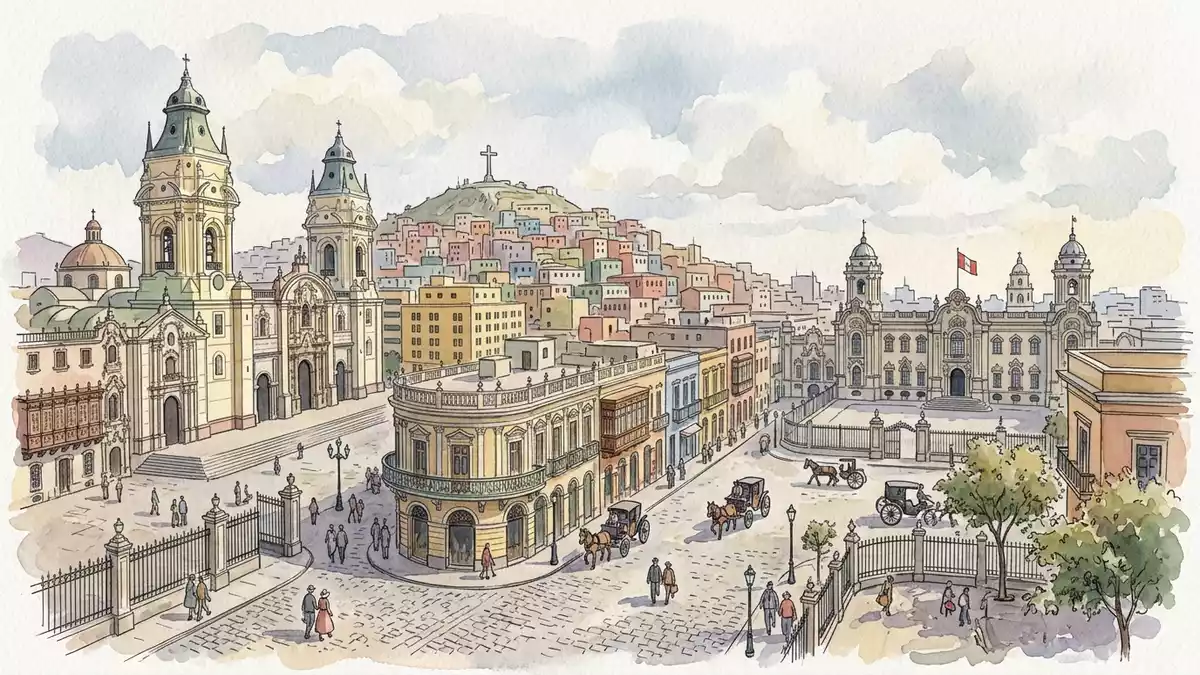
Centro Historico de Lima is the historic heart of Lima, the capital of Peru, laid out as a Spanish colonial grid around a central square that still anchors the city’s life. Founded in January 1535 by the Spanish conquistador Francisco Pizarro as the “Ciudad de los Reyes”, it later gained formal recognition as a UNESCO World Heritage Site for the originality of its colonial urban fabric and the concentration of historic monuments from the viceregal era.
The colonial checkerboard and the Plaza Mayor
The core of Centro Historico de Lima follows a checkerboard pattern of straight streets and rectangular blocks, a classic Spanish colonial plan that can still be read on the ground. Francisco Pizarro set out this grid in 1535, marking the Plaza Mayor as the point from which streets radiate in cardinal directions, and the alignment remains visible despite later layers of republican building.checkerboard layout Within this pattern, the Plaza Mayor de Lima, also known as the Plaza de Armas, forms the main public square of the historic centre and has done so since the foundation of the city by Pizarro on 18 January 1535.Plaza Mayor de Lima
The Plaza Mayor is enclosed by four landmark institutions that define the political and religious character of Centro Historico de Lima. On one side stands the Government Palace, the presidential residence fronting the Rímac river; facing it are the Municipal Palace, seat of the city administration, and the Archbishop’s Palace, with its carved wooden balcony projecting above the arcades. Along another side rises the Cathedral of Lima, whose construction began in the sixteenth century and whose present form reflects reconstructions after earthquakes and later additions into the eighteenth century.Cathedral and civic ensemble At the centre of the square stands a bronze fountain dating from 1650, one of the oldest surviving public sculptures in the city, tying the open space to the long history of the colonial capital.bronze fountain from 1650
UNESCO status and viceregal architecture
Centro Historico de Lima holds formal recognition as part of the Historic Centre of Lima on the UNESCO World Heritage List. The convent ensemble of San Francisco de Lima first gained inscription in 1988, and in 1991 the protected property was extended to include the wider historic centre for its originality and high concentration of monuments constructed during the period of Spanish presence in the region.Historic Centre of Lima inscription UNESCO describes the centre as bearing witness to the architecture and urban development of a colonial town of major political, economic and cultural importance in Latin America, and selected buildings within the zone carry the organisation’s black-and-white shield on their façades.UNESCO shield marking
Architecturally, Centro Historico de Lima is characterised by a dense mixture of religious complexes, civic palaces and traditional houses with inner courtyards, many dating from the viceregal period and the early republican era. The Convento de San Francisco de Lima stands out as a large convent ensemble from the colonial period, with church, cloisters and catacombs forming an integrated complex a short walk from the Plaza Mayor.San Francisco de Lima convent Across the historic centre, long timber balconies project from the upper levels of mansions and official buildings, a hallmark of Lima’s urban architecture that reflects a blend of Spanish and Moorish influence adapted to local materials such as cedar.traditional houses with balconies
Streets, plazas and daily life in the historic centre
Beyond the Plaza Mayor, Centro Historico de Lima extends across an area measured in hundreds of hectares, mapped within the central districts of Lima and Rímac along the Rímac valley.mapped World Heritage property Within this zone, streets such as Jirón Ucayali preserve nineteenth-century façades, and successive generations have added republican and modern elements around older colonial cores.Jiron Ucayali block The monumental zone established by the Peruvian government in 1972 overlaps with the UNESCO-listed area, so heritage regulation covers both major landmarks and more modest buildings lining the grid.
Daily life in the historic centre plays out in and around its squares, churches and commercial streets. The Plaza Mayor forms a natural meeting place, while the streets leading towards the Rímac district pass traditional shops and access routes to other plazas and churches. Convents, monasteries and parish churches from the sixteenth to eighteenth centuries dot the area, their towers and façades emerging above the street grid and providing reference points amid the dense fabric of balconied houses and civic blocks.viceregal and republican fabric The coexistence of governmental palaces, religious buildings and residential patios within a walkable district gives Centro Historico de Lima a layered character that reflects its long history as seat of the Viceroyalty of Peru and later as national capital.capital of the Viceroyalty of Peru
Visiting Centro Historico de Lima: what travellers from Western Europe should know
- Centro Historico de Lima lies in the Cercado de Lima district on both banks of the Rímac river, north of the more modern coastal neighbourhoods such as Miraflores, and is reached overland from those districts by city bus routes and road connections.
- The historic centre is compact enough to explore on foot, but many streets are paved and some plazas have broad stone surfaces, so walking involves uneven ground and occasional kerbs.
- The official language is Spanish and the currency is the Peruvian sol.
- Entry requirements depend on your nationality; UK travellers can check the FCDO travel advice at gov.uk/foreign-travel-advice, Irish travellers the Department of Foreign Affairs at ireland.ie.
Searching for Centro Historico de Lima on social platforms
These links open searches for Centro Historico de Lima on each platform.
Frequently asked questions about Centro Historico de Lima
Where is Centro Historico de Lima located within the city?
Centro Historico de Lima occupies the historic core of Lima in the districts of Lima and Rímac along the Rímac valley, centred on the Plaza Mayor and surrounding blocks.
What should a visitor expect on a walk through the historic centre?
A walk through Centro Historico de Lima passes colonial and republican churches, convents, civic palaces, balconied houses and plazas laid out on a Spanish grid, all within a dense urban fabric.
What makes Centro Historico de Lima distinctive among Latin American city centres?
Centro Historico de Lima combines a sixteenth-century colonial grid, landmark squares such as Plaza Mayor, extensive religious complexes like San Francisco de Lima and long timber balconies that give its streets a characteristic profile.


