
Centro Historico de Cuenca and its Andean street grid
Published on 09/22/2026 at 11:34 | Editorial responsibility: Rafael Müller, Editor-in-Chief AD HOC NEWS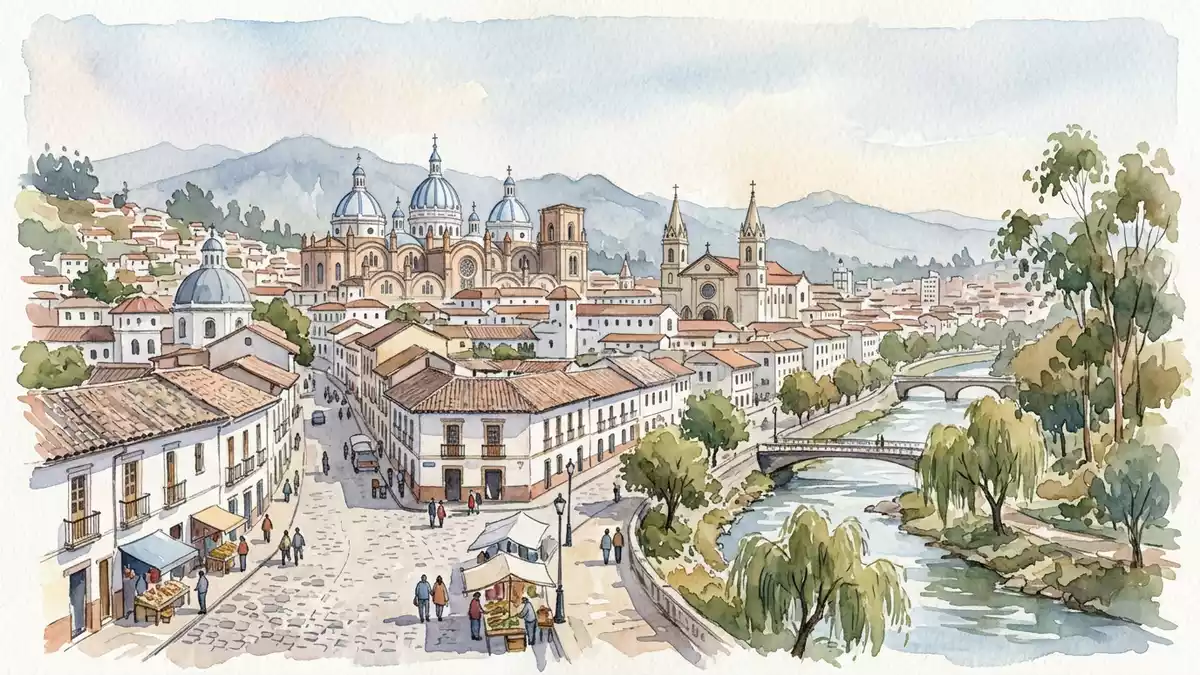
Centro Historico de Cuenca is an Andean urban landscape laid across a rectilinear street grid. In Cuenca, Ecuador, colonial churches, republican buildings, tiled roofs and riverside edges form a historic centre whose underlying plan reaches back to the sixteenth century.
Centro Historico de Cuenca: streets drawn across the Andes
The formal heritage name is Historic Centre of Santa Ana de los Ríos de Cuenca. The centre occupies the historic core of Cuenca in Azuay Province, on a highland plateau bordered by rivers including the Río Tomebamba.
Its streets meet at regular junctions and enclose blocks containing plazas, churches, convents, civic buildings and town houses. The grid remains the clearest feature of the district: a geometric urban pattern set within an Andean valley, with the river corridors marking a contrasting edge.
From Spanish town plan to layered cityscape
Cuenca was founded in 1557 under Spanish rule, following urban planning regulations issued during the reign of Charles V. UNESCO records the town as a planned inland Spanish settlement that preserves its original orthogonal plan across four centuries of urban history. Cuenca’s preserved urban plan remains central to its heritage.
The architecture belongs to several periods. Colonial churches and convents stand beside republican civic buildings and residential façades, while baroque, neoclassical, art deco and early modern details appear within the wider fabric.
Churches, domes and domestic façades
Religious architecture gives the centre its strongest vertical accents. The Cathedral of the Immaculate Conception, known through its blue domes, forms a major landmark near Parque Calderón, the principal central square.
Street-facing houses bring a smaller scale to the same district. Rendered façades, wooden balconies, carved stone portals, plaster ornament and wrought-iron details appear alongside courtyards and cloisters hidden behind comparatively restrained fronts. The result is an urban ensemble rather than a collection of isolated monuments.
Several sites extend the historical picture beyond the colonial street plan. The inscribed area includes the archaeological site of Pumapungo and historic access corridors connected with the town. Spanish, Cañari and Inca cultural elements meet within this wider urban setting. The UNESCO heritage listing identifies Cuenca as an example of Spanish colonial planning in the Americas.
Visiting Centro Historico de Cuenca: what travellers from Western Europe should know
- Centro Historico de Cuenca occupies central Cuenca in southern Ecuador. Cuenca’s Mariscal Lamar Airport serves the city, while the historic centre is reached through the surrounding urban streets.
- The district is laid across a highland plateau, with streets descending towards river corridors such as the Río Tomebamba. Historic paving, steps and sloping connections occur at the edges of the grid.
- The official language is Spanish and the national currency is the US dollar.
- Entry requirements depend on your nationality; UK travellers can check the FCDO travel advice at gov.uk/foreign-travel-advice, Irish travellers the Department of Foreign Affairs at ireland.ie.
Searching for Centro Historico de Cuenca on social platforms
These links open searches for Centro Historico de Cuenca on each platform.
Frequently asked questions about Centro Historico de Cuenca
Where is Centro Historico de Cuenca?
It is the historic core of Cuenca, in Azuay Province in southern Ecuador. The district lies on a highland plateau bordered by Andean rivers.
What can visitors expect to see?
Visitors encounter a grid of streets, plazas, churches, convents, civic buildings and houses. The architecture includes colonial, republican, neoclassical, art deco and early modern features.
What makes the centre distinctive?
Its distinctive feature is the preserved orthogonal plan founded in 1557, combined with Spanish, Cañari and Inca cultural elements. UNESCO inscribed the Historic Centre of Santa Ana de los Ríos de Cuenca on the World Heritage List in 1999.


