
Centro Historico de Cuenca, a planned Andean colonial centre
Published on 08/27/2026 at 16:08 | Editorial responsibility: Rafael Müller, Editor-in-Chief AD HOC NEWS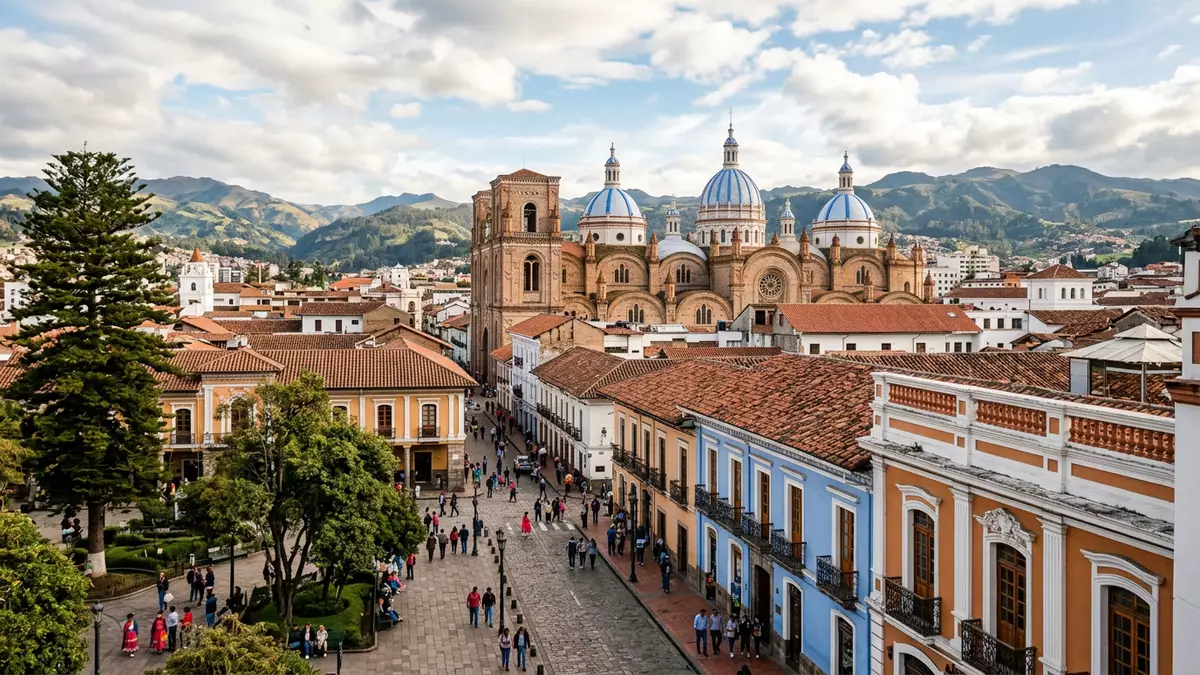
Centro Historico de Cuenca in southern Ecuador is the historic core of Santa Ana de los Ríos de Cuenca, an Andean city laid out on a planned grid above several rivers and recognised as a UNESCO World Heritage site since 1999.Historic Centre of Santa Ana de los Ríos de Cuenca The historic streets and squares sit on a highland plateau framed by the Andes, where colonial houses, churches and civic buildings share a regular town plan dating back to the sixteenth century.
A Renaissance grid in the Andes
Cuenca was founded as Santa Ana de los Ríos de Cuenca in 1557, following planning guidelines issued by Charles V for Spanish colonial towns in the Americas.founded in 1557 The historic centre still follows the orthogonal plan set out at that time, with straight streets intersecting at right angles to form a grid of blocks and plazas that can be traced across the plateau.
The World Heritage inscription underlines this planned character, describing Cuenca as an inland colonial town that has respected its formal street pattern for around four centuries.inland colonial town with orthogonal plan Within the Centro Historico de Cuenca, the grid descends towards the Río Tomebamba, where the regular street layout meets terraces and riverside edges shaped by the local topography.
UNESCO recognition and layered architecture
The Centro Historico de Cuenca and its historic areas were declared national cultural heritage of Ecuador in 1982, recognising the concentration of historic buildings, works of art and archaeological remains.Patrimonio Cultural del Ecuador 1982 On 1 December 1999, UNESCO inscribed the Historic Centre of Santa Ana de los Ríos de Cuenca on the World Heritage List as “Patrimonio Cultural de la Humanidad”, confirming its status among the protected cities of Latin America.UNESCO World Heritage inscription 1999
The architecture within Centro Historico de Cuenca reflects several periods. Churches and civic buildings carry Renaissance and Baroque details, while later Republican-era structures add neoclassical façades and ironwork balconies.blend of colonial and Republican architecture Indigenous craftsmanship appears in carved wooden doors, clay roof tiles and decorative stonework, and the skyline of red roofs punctuated by turquoise domes of the main cathedral has become a defining image of the city.
Streets, rivers and daily life
Centro Historico de Cuenca occupies the historic core of Cuenca in the Azuay province, centred on Parque Calderón and extending across several dozen blocks.historic core centred on Parque Calderón The area sits on a plateau bordered by rivers including the Río Tomebamba, Yanuncay, Tarqui and Machángara, which cross the valley and shape the edges of the historic centre.valley irrigated by four rivers
Within this setting, the grid of streets links plazas, markets and church squares that still organise daily activity in the city.grid and daily rhythm around the cathedral square Historic houses with red-tiled roofs line many of the streets, while terraces overlooking the Río Tomebamba mark the transition from the planned town to the riverbanks below.
Visiting Centro Historico de Cuenca: what travellers from Western Europe should know
- Centro Historico de Cuenca lies in the city of Cuenca in southern Ecuador, on a highland plateau in the Andes that is reached by road and air connections through regional airports.
- The historic centre is set above rivers including the Río Tomebamba, with streets that rise and fall between the plateau and the riverbanks; some routes involve stairs and sloping pavements.
- Cuenca stands at an elevation of around 2,560 m (8,400 ft), so walking in Centro Historico de Cuenca takes place at high altitude compared with most Western European cities.
- The official language is Spanish and the currency is the US dollar.
- Entry requirements depend on your nationality; UK travellers can check the FCDO travel advice at gov.uk/foreign-travel-advice, Irish travellers the Department of Foreign Affairs at ireland.ie.
Searching for Centro Historico de Cuenca on social platforms
These links open searches for Centro Historico de Cuenca on each platform.Frequently asked questions about Centro Historico de Cuenca
Where is Centro Historico de Cuenca?
Centro Historico de Cuenca is the historic centre of the city of Cuenca in Azuay province, in the southern highlands of Ecuador, set in an Andean valley crossed by several rivers.
What should visitors expect on a visit?
Visitors encounter a planned grid of streets, plazas and churches laid out since 1557, colonial and Republican architecture, markets and riverside terraces where the town meets the Río Tomebamba.
What makes Centro Historico de Cuenca distinctive?
Its distinction lies in the combination of a Renaissance-inspired orthogonal plan, layered architectural styles, highland setting and recognition as a UNESCO World Heritage site since 1999.


