
Centro Historico de Arequipa and its sillar cityscape
Published on 09/12/2026 at 11:19 | Editorial responsibility: Rafael Müller, Editor-in-Chief AD HOC NEWS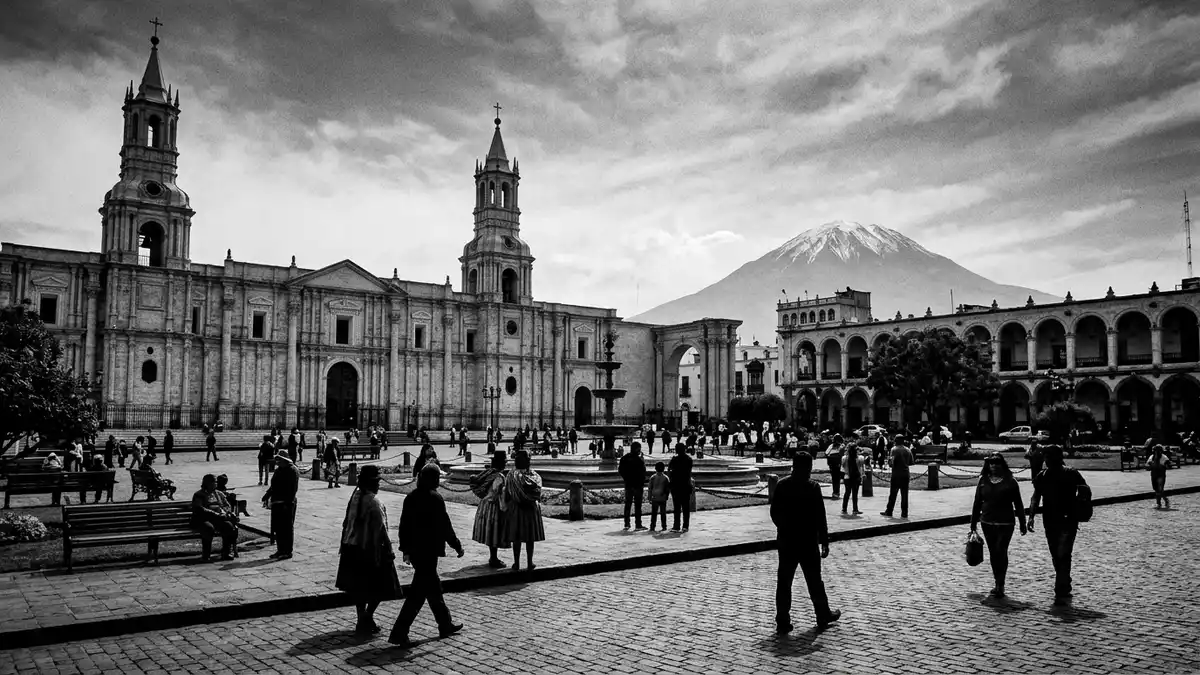
Centro Historico de Arequipa is the historic core of Arequipa, a UNESCO World Heritage site built around a colonial grid and a stone cityscape. Its streets, plazas and façades are tied together by sillar, the pale volcanic stone that gives the centre its distinctive surface.
A sillar city built around Plaza de Armas
At the heart of Centro Historico de Arequipa lies Plaza de Armas, a broad square framed by arcades and civic buildings. The historic centre is inscribed under the name Historical Centre of the City and covers a protected urban area of 166.52 ha.
The square and the streets around it follow the Spanish colonial pattern associated with the founding of Arequipa on 15 August 1540 by Garcí Manuel de Carbajal. That date and name belong to the city’s core identity, and they explain why the centre reads as a planned urban ensemble rather than a single monument.
Stone façades, arcades and church fronts
The most visible material here is sillar, used in churches, houses and public buildings across the historic centre. The result is a cityscape of carved façades, arches and walls that keeps the same stone language from one block to the next.
The Basilica Cathedral of Arequipa occupies one edge of Plaza de Armas, and its long front is one of the strongest visual anchors in the centre. Its neoclassical face belongs to a later phase of the city’s building history, and the cathedral remains part of the ensemble that gives the square its formal edge.
Monasteries, mansions and civic blocks
Centro Historico de Arequipa is not a single monument but a dense historic district. Alongside the cathedral, it includes monasteries, mansions and civic buildings arranged on streets that keep the colonial grid legible.
That mixture of religious, domestic and administrative architecture gives the area its layered character. The UNESCO description highlights the integration of European and native building traditions, a theme visible in the carved stone façades and the use of local material.
Visiting Centro Historico de Arequipa: what travellers from Western Europe should know
- The historic centre lies in Arequipa, in southern Peru, and Plaza de Armas forms its most recognisable focus. The official language is Spanish and the currency is the Peruvian sol.
- The district is walkable on foot, with straight streets, paved squares and a clear grid layout. Sillar paving, steps and uneven surfaces appear around older buildings and church fronts.
- The cathedral, the monastery district and the civic blocks sit close together around the main square. This makes the centre readable as one urban ensemble rather than isolated sights.
- Entry requirements depend on your nationality; UK travellers can check the FCDO travel advice at gov.uk/foreign-travel-advice, Irish travellers the Department of Foreign Affairs at ireland.ie.
Searching for Centro Historico de Arequipa on social platforms
These links open searches for Centro Historico de Arequipa on each platform.
Frequently asked questions about Centro Historico de Arequipa
Where is Centro Historico de Arequipa?
It is the historic centre of Arequipa in southern Peru, centred on Plaza de Armas. The district contains the cathedral, civic buildings and many churches and houses in sillar.
What does a visit feel like?
The area reads as a walkable colonial centre with a strong stone character. Streets, arcades and squares link the main buildings in a compact urban pattern.
What makes it distinctive?
The key feature is sillar, the volcanic stone used across the centre’s façades and walls. The mix of Spanish colonial planning and local building traditions gives the district its character.


