
Centre Pompidou: Paris’s inside?out machine for modern art
Published on 08/29/2026 at 18:35 | Editorial responsibility: Rafael Müller, Editor-in-Chief AD HOC NEWS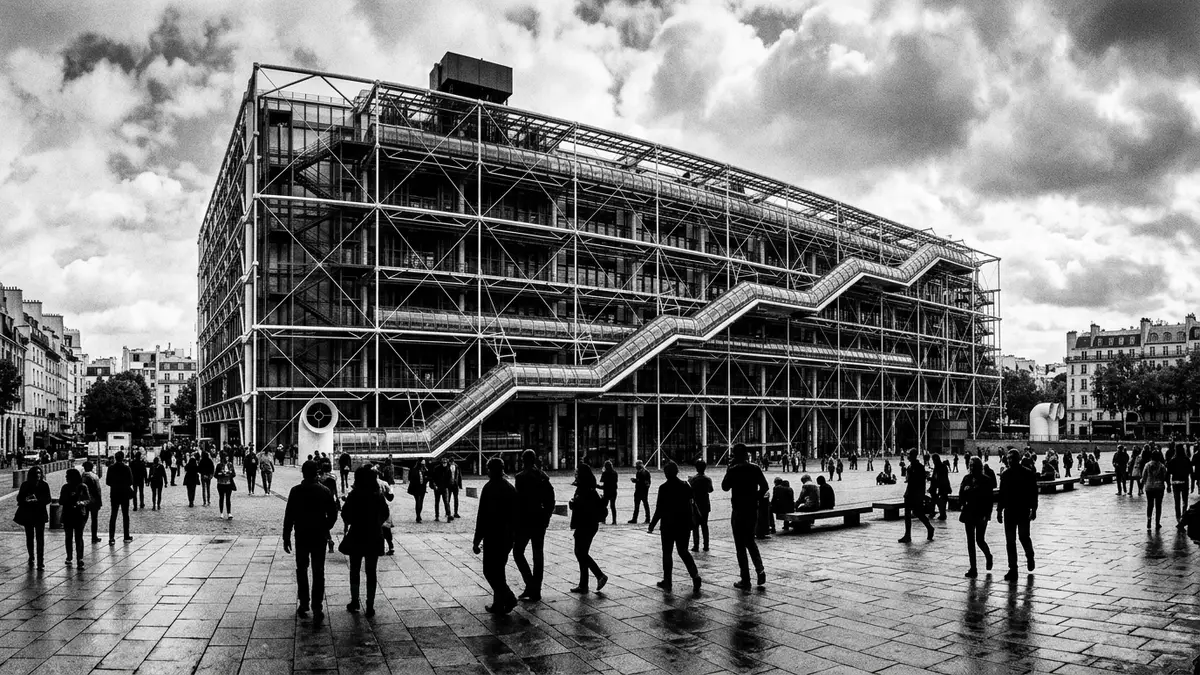
Centre Pompidou stands in central Paris as a vast cultural machine, its exposed steel skeleton and colour-coded pipework turning the conventional museum inside out. Commissioned under President Georges Pompidou and inaugurated in 1977, it reshaped a historic district into an open platform for modern and contemporary art.
An inside-out landmark of high-tech architecture
The core identity of Centre Pompidou lies in its high-tech architectural language, which brings the building’s structure and services out to its edges rather than hiding them behind stone or plaster. The complex was designed in the early 1970s by architects Renzo Piano and Richard Rogers, working with Gianfranco Franchini, after an international competition for a new cultural centre in central Paris.architects Renzo Piano and Richard Rogers The scheme they produced arranged the building as a long, rectangular volume supported by a steel superstructure with reinforced concrete floors.
Along the main street façade, the technical systems step forward visually. Ducts, pipes and circulation routes run along the exterior in bright primary colours, with each service coded consistently across the façade. The metal frame forms a regular grid, while escalators and walkways are carried in enclosed external galleries that climb the building in stages and give wide views over the rooftops of Paris.industrial-looking exterior Inside, the large floorplates are kept as open as possible, with spans running across the breadth of the building to create flexible exhibition halls.
A cultural factory for modern and contemporary art
Centre Pompidou was conceived as a national centre for culture and the arts, and its programme combines galleries, libraries and performance spaces under one roof.a vast multidisciplinary structure The Musée National d’Art Moderne occupies a substantial portion of the building, presenting one of Europe’s major collections of twentieth- and twenty-first-century works in galleries spread across several levels.largest museum for modern art in Europe Beside it, the Bibliothèque publique d’information functions as a large public reading library, drawing visitors who may come as much for books and study space as for the exhibitions.
The overall footprint of the building extends over multiple stacked levels of similar size, each with a generous open plan suitable for changing displays and large-scale installations.ten levels of 7,500 m² each Within this volume sit cinema auditoria, a performance theatre, conference rooms and specialised research facilities such as the Kandinsky Library, which documents modern art for scholars.Kandinsky Library The mix of uses turns the building into a daily working environment as well as a museum, with staff, students and artists sharing the same circulation routes as visitors.
Setting, dimensions and the Beaubourg plateau
Centre Pompidou occupies the Beaubourg area of the 4th arrondissement, close to the historic Marais district and within easy reach of the Seine. Its principal address on Place Georges-Pompidou fronts a broad paved piazza, which acts as an open forecourt to the building and gives unobstructed sightlines to its long façade.fringes of the historic Marais section Around it, narrow streets of older buildings frame the view, underlining the contrast between the steel and glass volume and the denser fabric of the surrounding neighbourhood.
The building itself extends over a length of around 160 m, with a width of roughly 60 m and a height of more than 40 m at its upper levels.rectangular building 164 m long and 60 m wide A steel frame carries the floors, and the façades are largely glazed, admitting daylight into the interior and making the movement along external escalators and galleries visible from the piazza.structure of glass and metal The proportions and openness mean that, from the upper terraces, visitors can look out across many of Paris’s key landmarks, while from ground level the building reads as a large industrial object laid against the historic street grid.
Visiting Centre Pompidou: what travellers from Western Europe should know
- Centre Pompidou stands in the Beaubourg area of the 4th arrondissement in Paris, facing Place Georges-Pompidou and reached along streets close to the Marais.
- The approaches around the building include a broad paved piazza in front and external escalator galleries that rise along the façade, with several flights of steps and long internal routes.
- Paris is served by public transport including Métro and RER lines; stations such as Rambuteau, Hôtel de Ville and Châtelet–Les Halles lie within walking distance of the complex.
- The official language is French and the currency is the euro.
Searching for Centre Pompidou on social platforms
These links open searches for Centre Pompidou on each platform.
Frequently asked questions about Centre Pompidou
Where is Centre Pompidou located in Paris?
Centre Pompidou stands in the Beaubourg area of the 4th arrondissement, close to the Marais and within walking distance of central Seine-side districts.
What should visitors expect inside the building?
Visitors encounter open-plan galleries for modern and contemporary art, a large public library, cinemas, a performance theatre and research facilities arranged across multiple levels.
What makes Centre Pompidou distinctive among museums?
Its high-tech architecture exposes the structural frame and services on the exterior, while combining a major modern art museum with public library, performance and research spaces.


