
Centre Pompidou and the inside-out skyline of Paris
Published on 09/14/2026 at 08:58 | Editorial responsibility: Rafael Müller, Editor-in-Chief AD HOC NEWS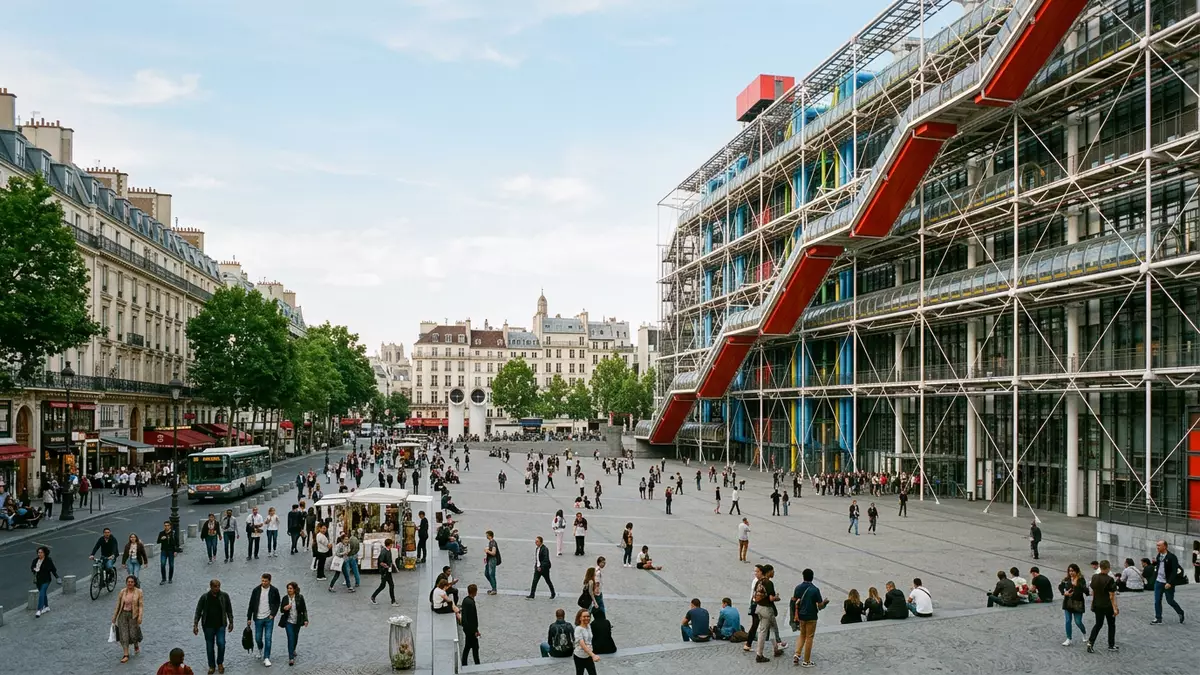
Centre Pompidou rises over the Beaubourg district of Paris as a cultural landmark that turns the conventional museum inside out, its exposed steel frame and colour-coded pipes announcing a different kind of art centre. Conceived in the early 1970s and opened in 1977 as the Centre national d’art et de culture Georges-Pompidou, it anchors the history of high?tech architecture in the French capital and gathers library, museum and performance spaces under one industrial-scale roof.
An inside-out machine for culture
From a distance, Centre Pompidou reads less like a classical museum and more like a piece of urban infrastructure stretched along the edge of a public plaza. The main block extends about 166 m in length, with a width of roughly 60 m and a height of around 42 m, creating deep floorplates that span the site with minimal internal supports.The building extends over 10 levels The structure combines a steel superframe with reinforced concrete floors, expressed openly on the exterior.
The most striking feature is the way services and circulation move to the outside of the envelope. Escalators climb the façade in long glazed tubes that trace their way diagonally across the building, while banks of pipes and ducts line the elevations in bright primary colours.The structure and mechanical services are visible on the exterior This colour-coding distinguishes different technical systems and turns what is usually hidden into a graphic pattern facing the streets around the Beaubourg area.
High-tech architecture and a new Paris landmark
Centre Pompidou emerged from an international competition launched under President Georges Pompidou for a major cultural centre in central Paris, with the winning scheme developed by architects Renzo Piano and Richard Rogers together with Gianfranco Franchini.The architects were Renzo Piano and Richard Rogers Work on the project progressed through the first half of the 1970s, and the building opened to the public in 1977, giving the city a post-war monument to modern and contemporary art.
The architectural language aligns Centre Pompidou with the high?tech and postmodern movements, where structural systems and building services become part of the visual identity rather than neutral backdrops.The complex is described as postmodern and high-tech in style Long clear-span floors, achieved with deep trusses at the roof and sides, create large column-free galleries that can be reconfigured for different exhibitions. The contrast between the industrial exterior and the flexible interiors adds to the sense that this is a working machine for culture rather than a static monument.
Museums, library and views over Paris
Inside, the building houses several major institutions that together define its role in French cultural life. The Musée National d’Art Moderne occupies the upper levels and holds one of the largest collections of twentieth and twenty?first?century art in Europe, with tens of thousands of works ranging from painting and sculpture to photography and design.The collection of modern and contemporary art brings together more than 140,000 works Below, the Bibliothèque publique d’information offers extensive public reading rooms and reference services that treat the complex as much as a civic library as a museum.
The programme also includes performance and screening spaces, with a theatre and cinema rooms integrated into the volume of the building.The building incorporates screening rooms and a performance theatre The upper terraces and circulation routes open onto views across the rooftops of Paris, with the skyline of the historic centre unfolding around the steel frame. Outside, a broad paved square on the south-western side acts as an informal gathering space, linking the museum to the streets of the 4th arrondissement and the Marais.
Visiting Centre Pompidou: what travellers from Western Europe should know
- Centre Pompidou stands in the Beaubourg area of the 4th arrondissement of Paris, a short walk north of the Seine between the Marais and Les Halles districts.
- The building fronts a wide paved plaza, and reaching the upper galleries involves long escalators enclosed in external tubes that rise several storeys above ground level.
- The official language is French and the currency is the euro.
- Entry requirements depend on your nationality; UK travellers can check the FCDO travel advice at gov.uk/foreign-travel-advice, Irish travellers the Department of Foreign Affairs at ireland.ie.
Searching for Centre Pompidou on social platforms
These links open searches for Centre Pompidou on each platform.
Frequently asked questions about Centre Pompidou
Where is Centre Pompidou located in Paris?
Centre Pompidou stands in the Beaubourg area of the 4th arrondissement of Paris, close to the Marais and within walking distance of the Seine.
What can visitors expect inside Centre Pompidou?
Visitors encounter large modern art galleries, a major public library, cinema and performance spaces, and long external escalators leading to terraces with city views.
What makes Centre Pompidou distinctive among museums?
Its high?tech design exposes structure, pipes and circulation on the exterior, creating an inside?out appearance that contrasts with the flexible column?free halls inside.


