
Centre Pompidou and the architecture turned inside out
Published on 09/23/2026 at 11:22 | Editorial responsibility: Rafael Müller, Editor-in-Chief AD HOC NEWS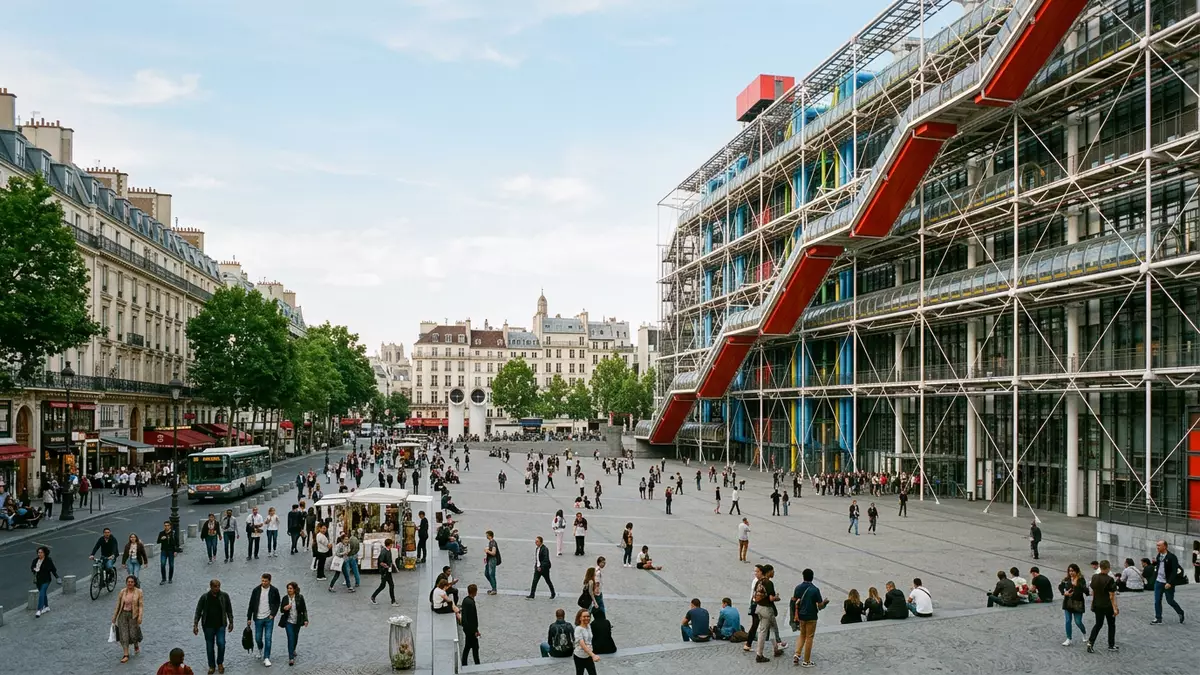
Centre Pompidou presents a museum as a piece of visible machinery. In Paris, Renzo Piano and Richard Rogers placed coloured pipes, steelwork and an external escalator on the façade, while modern art occupies the broad interior levels.
Centre Pompidou’s inside-out façade
Opened on 31 January 1977, Centre Pompidou is named after Georges Pompidou, the French president whose initiative created the institution. Renzo Piano and Richard Rogers designed the building with Gianfranco Franchini, producing a major work of high-tech architecture in the Beaubourg district.
The building’s services form part of its public appearance. Blue, yellow, green and red components identify different technical functions, while the steel frame remains visible outside the glazed walls. The result is an architectural composition in which pipes, lifts, ducts and circulation systems share the façade with the museum’s transparent surfaces. The colour-coded façade is one of the building’s clearest signatures.
The Piazza and the glass Forum
Place Georges Pompidou, known as the Piazza, stretches before the building as a gently sloping public square. Its rectangular surface measures 170 by 65 metres, and the slope rises by 11 per cent between Rue Saint-Martin and the Forum.
The Piazza forms the open foreground of Centre Pompidou. The glazed Forum faces it, placing the building’s central public space directly beside the square. Artworks, pedestrians and the changing view of the façade share this urban setting, while the diagonal escalator climbs across the building’s western side.
The external escalator is known as the Chenille, or “caterpillar”. Its transparent enclosure crosses the façade in a long diagonal, connecting the building’s levels and creating a moving line against the coloured structure. The sloping Piazza and the Chenille belong to the same visual sequence.
Modern art across open cultural floors
Centre Pompidou houses the Musée national d’Art moderne, France’s national collection of modern and contemporary art. Its holdings extend across painting, sculpture, photography, architecture, design, film, new media and artists’ books.
The collection includes works associated with Henri Matisse, Pablo Picasso, Georges Braque, Wassily Kandinsky, Marcel Duchamp, Joan Miró, Alberto Giacometti, Frida Kahlo, Andy Warhol and Yves Klein. Movements represented in the museum range from Fauvism, Cubism and Surrealism to Pop Art, Nouveau Réalisme, Arte Povera and conceptual art.
The museum shares the complex with cultural facilities that include a public information library, exhibition areas, spaces for children and IRCAM, the music and acoustic research centre founded by Pierre Boulez. This mixture gives Centre Pompidou a wider identity than a single gallery building. Its art collection and its architecture remain visible parts of the same cultural address. The Paris cultural centre combines museum spaces with library, design, cinema and music activities.
Visiting Centre Pompidou: what travellers from Western Europe should know
- Centre Pompidou is on Place Georges Pompidou in the fourth arrondissement, beside Rue Beaubourg and the historic Marais district.
- The Piazza slopes towards the Forum, while the Chenille runs diagonally up the western façade inside a glass-and-metal enclosure.
- Paris Metro and RER services connect the Beaubourg area with the wider city; nearby streets include Rue Beaubourg and Rue Saint-Martin.
- The official language is French and the currency is the euro.
Searching for Centre Pompidou on social platforms
These links open searches for Centre Pompidou on each platform.Frequently asked questions about Centre Pompidou
Where is Centre Pompidou?
Centre Pompidou is on Place Georges Pompidou in central Paris, beside Rue Beaubourg and near the Marais district.
What can visitors expect from the building?
The building combines modern and contemporary art with a glass Forum, a sloping Piazza, exposed services and the diagonal Chenille escalator.
What makes Centre Pompidou distinctive?
Its steel frame, coloured pipes and external circulation systems place the building’s infrastructure visibly on the façade.


