
Centre Pompidou and its exposed architecture in Paris
Published on 09/24/2026 at 02:38 | Editorial responsibility: Rafael Müller, Editor-in-Chief AD HOC NEWS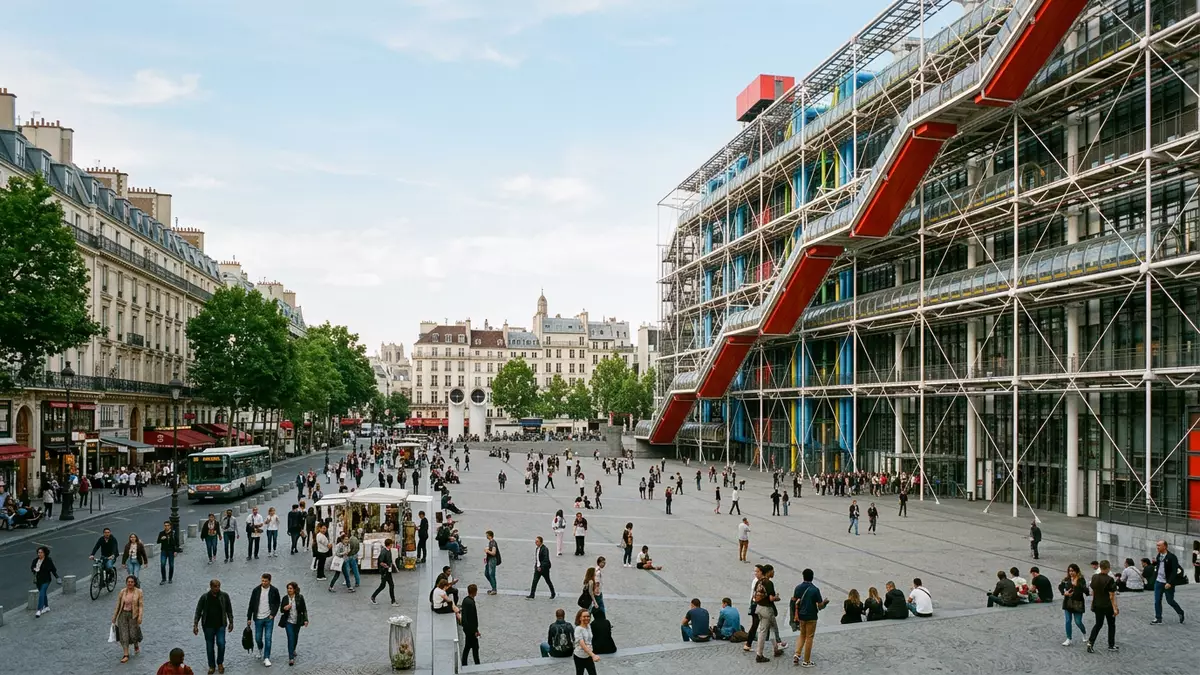
Centre Pompidou places a vast modern art museum inside a building whose structural and service systems are visible from the street. Opened in Paris in 1977, it uses glass, steel and bright coloured pipes to present the building’s working parts as part of its public identity.
Centre Pompidou: a building turned inside out
Centre Pompidou occupies Place Georges Pompidou in the Beaubourg district of Paris’s 4th arrondissement. Its broad glass façades reveal large interior floors, while the exterior carries ventilation ducts, water pipes, electrical conduits, lifts and escalators.
Renzo Piano and Richard Rogers designed the building with Gianfranco Franchini. Their high-tech architecture gives technical infrastructure a visible place on the façades. The building’s white structural frame contrasts with pipes and circulation elements in blue, green, yellow and red.
The colour system identifies different functions. Blue marks air circulation, green marks water, yellow marks electricity, and red marks the movement of people, lifts and escalators. The colours operate as a visual vocabulary across the exterior.
Renzo Piano, Richard Rogers and the Beaubourg project
French President Georges Pompidou launched the cultural project in 1969. It brought together a museum of modern and contemporary art, a public library, a centre for industrial creation and a centre for musical research and creation.
An international competition in 1971 selected the proposal by Renzo Piano and Richard Rogers. Construction began in May 1972, and the building was inaugurated on 31 January 1977 by President Valéry Giscard d’Estaing. Georges Pompidou had died in 1974, before the building’s completion.
The project joined several cultural functions within one large structure. The National Museum of Modern Art occupies a central place in the institution, alongside exhibitions, public programmes, research and library activity.
The building’s exposed systems also define its public image. The western façade carries a diagonal escalator enclosure known as the “Caterpillar”. Its transparent tunnel rises across the face of the building beside the Piazza.
Modern art, the Piazza and the city
Centre Pompidou holds more than 140,000 works in its modern and contemporary art collection. The collection includes painting, sculpture, photography, design, architecture, film and new media.
Artists and movements associated with the collection include Fauvism, Cubism, Dada, Surrealism and abstract art. The museum’s chronological and thematic displays connect the visual languages of the twentieth and twenty-first centuries.
The building opens onto the Piazza, a large public space facing its western façade. The square places the escalator, coloured pipes and glass walls in direct relation to the surrounding Beaubourg streets.
Nearby, the Stravinsky Fountain adds another layer of modern art to the district. Niki de Saint Phalle and Jean Tinguely created its moving, brightly coloured forms, which stand beside the Centre Pompidou’s southern side.
Inside, large floor plates provide gallery space for changing displays and permanent collections. Outside, the exposed frame, mechanical systems and escalator create an architectural composition that remains visible from the public square.
Visiting Centre Pompidou: what travellers from Western Europe should know
- Centre Pompidou is at Place Georges Pompidou in Paris’s 4th arrondissement, between the Marais and Les Halles. Metro access includes Rambuteau, Hôtel de Ville and Châtelet, while RER services reach Châtelet–Les Halles.
- The main public approach is across the Piazza. The building’s western façade carries the glass-covered Caterpillar escalator, while the galleries occupy broad interior floors.
- The Stravinsky Fountain lies beside the Centre Pompidou, close to the southern façade. Its mechanical sculptures were created by Niki de Saint Phalle and Jean Tinguely.
- The official language is French and the currency is the euro.
Searching for Centre Pompidou on social platforms
These links open searches for Centre Pompidou on each platform.Frequently asked questions about Centre Pompidou
Where is Centre Pompidou?
Centre Pompidou is at Place Georges Pompidou in the Beaubourg district of Paris’s 4th arrondissement. It stands between the Marais and Les Halles.
What can visitors expect inside?
The building contains modern and contemporary art galleries, a public library and spaces for cultural programmes. Its collection includes painting, sculpture, photography, design, architecture, film and new media.
What makes Centre Pompidou distinctive?
Its façades expose structural and service systems, including coloured pipes, lifts and a diagonal escalator tunnel. Blue, green, yellow and red identify different technical or circulation functions.


