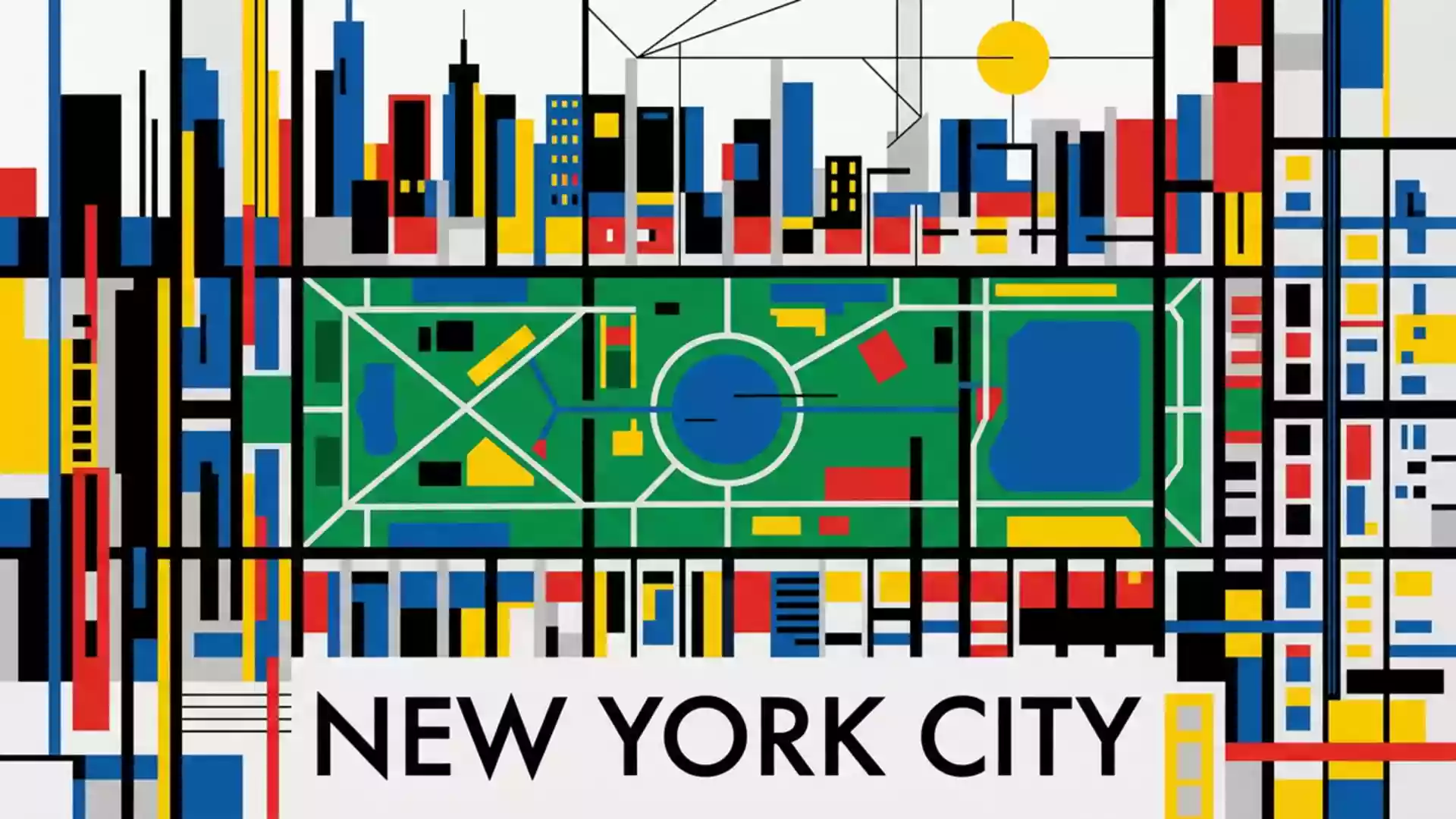
Central Park’s long green sweep through Manhattan
Published on 09/03/2026 at 18:41 | Editorial responsibility: Rafael Müller, Editor-in-Chief AD HOC NEWS
Central Park is the long strip of parkland laid out through central Manhattan between the Upper West Side and Upper East Side, a nineteenth?century landscape that reshaped New York City and remains its defining open space.
A nineteenth?century landscape carved into Manhattan’s grid
Central Park occupies a rectangular block of Manhattan between Fifth Avenue and Central Park West, extending from 59th Street in the south to around 110th Street in the north.extends between 59th and 110th streets The New York State Legislature authorised the city to acquire this land in 1853, and a competition for the park’s design followed a few years later.authorised the City of New York to buy a parcel of land from 59th to 106th Streets Landscape architect Frederick Law Olmsted and architect Calvert Vaux won with their Greensward Plan, an approach that treated the park as a piece of landscape design rather than a simple enclosed common.
The park took shape over the late 1850s and 1860s, becoming one of the first large urban parks in the United States to be developed using landscape architecture techniques.one of the first American parks to be developed using landscape architecture techniques Its completed form was officially opened in 1876, by which time the undulating lawns, planted groves and water bodies had been set within a firm frame of streets and avenues.The completed Central Park officially opened in 1876 The designation of Central Park as a National Historic Landmark in the twentieth century recognised both that historical role and the ambition of turning a rocky, uneven tract into a designed green landscape.In 1965 the Park was declared a National Historic Landmark
Scale, layout and the park’s distinct zones
Central Park covers about 843 acres, or 3.41 km², making it one of the largest continuous green areas in Manhattan.Central Park is 843 acres — 3.41 square kilometers The rectangle measures roughly 4 km in length north to south and about 0.8 km across, a size that makes it easy to understand both as a single park and as a sequence of contrasting landscapes.measures 4.0km from north to south and 0.80km from west to east Inside this frame, Olmsted and Vaux arranged broad meadows, wooded sections, water and circulation routes in a way that avoids straight lines and creates a sense of distance from the surrounding street grid.
The terrain rises and falls, with Summit Rock forming the highest natural point in the park at about 42 m (around 137 ft) above sea level.Summit Rock is the highest point at 137 ft The Great Lawn sits roughly in the centre of the park, where a reservoir once occupied the space; towards the east, the Jacqueline Kennedy Onassis Reservoir stretches along a substantial section with its encircling path popular with runners.the lower Croton Reservoir (now the Great Lawn) was drained Elsewhere, paths cross bridges over small lakes and weave through groves of trees, connecting more formal amenities such as playing fields and playgrounds.
Landmarks, culture and everyday uses
Beyond its general landscape, Central Park contains many recognisable features that have entered New York’s civic and cultural life. Bethesda Terrace and its fountain, crowned by sculptor Emma Stebbins’s Angel of the Waters, form one of the park’s most prominent architectural ensembles and give onto the Lake, which offers views of planted banks and distant skyline.Bethesda Fountain, also known as the Angel of the Waters, by Emma Stebbins, was dedicated on May 31, 1873 On the eastern side, the Metropolitan Museum of Art occupies a long frontage along Fifth Avenue and looks across to the park’s trees and paths.The Metropolitan Museum of Art is in the park, facing Fifth Avenue
Within Central Park lie a zoo, an ice?skating rink, an open?air theatre, a band shell, numerous children’s playgrounds and various sports pitches and courts.There are also a zoo, an ice-skating rink, three small lakes, an open-air theatre, a band shell, many athletic playing fields and children’s playgrounds These sit alongside more contemplative areas such as the Ramble, a deliberately irregular woodland, and formal promenades lined with statues and benches. Over the twentieth century, Central Park became a recognised setting for public gatherings, performances and civic events; milestones such as the first Earth Day celebrations in 1970 took place on its lawns.In 1970, the first Earth Day celebration is held in the Park The park continues to act as everyday recreation space for residents and a widely known point of orientation for visitors moving through Manhattan.
Visiting Central Park: what travellers from Western Europe should know
- Central Park lies in Manhattan between Fifth Avenue on the east and Central Park West on the west, reached directly from the surrounding New York City streets and nearby subway stations.
- The ground within the park varies from flat lawns to rocky outcrops; many routes involve walking on surfaced paths with occasional staircases or moderate slopes.
- The park’s long north?south axis means that covering more than one area on foot can involve extended walks, especially when moving between the southern meadows and the quieter northern sections.
- English is the official language and the currency is the United States dollar.
Searching for Central Park on social platforms
These links open searches for Central Park on each platform.Frequently asked questions about Central Park
Where is Central Park within New York City?
Central Park lies in Manhattan between the Upper West Side and Upper East Side, framed by Central Park West and Fifth Avenue from 59th to around 110th Street.
What can visitors expect on a walk through Central Park?
Visitors encounter a sequence of meadows, wooded sections, water bodies and built features such as Bethesda Terrace, the zoo and playgrounds linked by curving paths.
What makes Central Park distinctive among city parks?
Its nineteenth?century Greensward Plan, large rectangular scale and combination of landscape design, cultural institutions and everyday recreation space give Central Park a distinctive character among urban parks.