
Cenotes de Valladolid, limestone sinkholes on the edge of a colonial city
Published on 09/07/2026 at 07:50 | Editorial responsibility: Rafael Müller, Editor-in-Chief AD HOC NEWS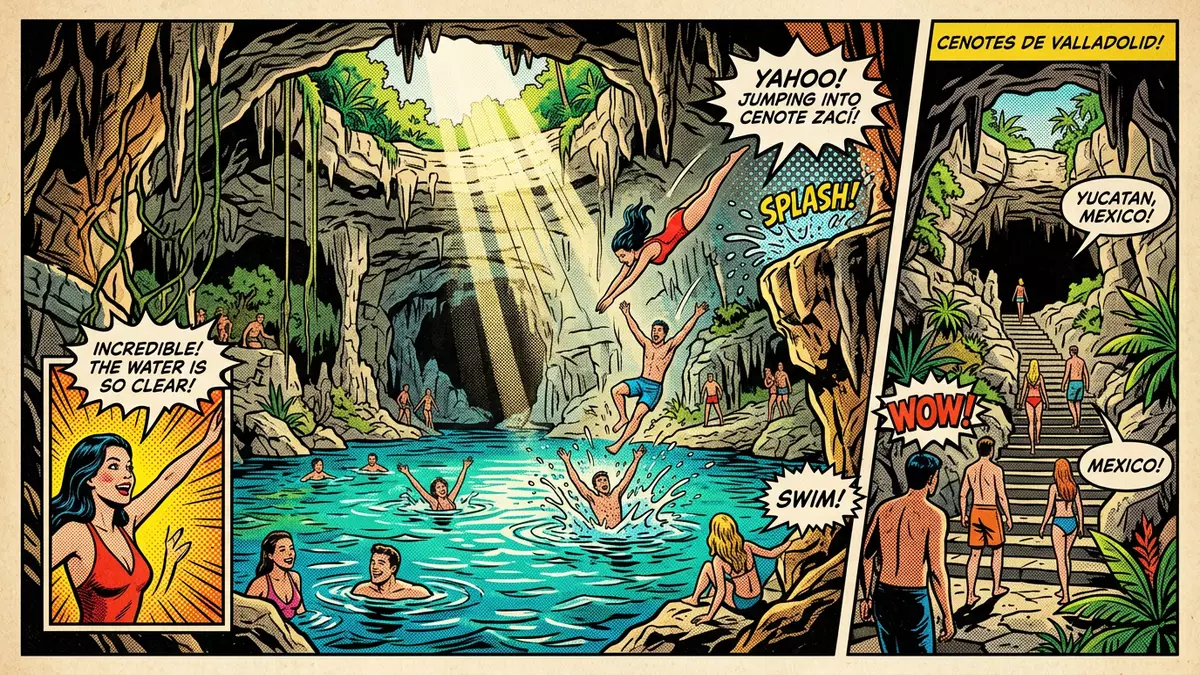
Cenotes de Valladolid are a cluster of limestone sinkholes and groundwater pools surrounding the colonial city of Valladolid in Mexico’s Yucatán Peninsula. The cenotes expose the peninsula’s porous limestone bedrock and reveal the underground water system that has shaped this landscape over geological time.
Limestone caverns filled with clear groundwater
Cenotes around Valladolid form where underground caves in the limestone have collapsed or opened, revealing pools fed by groundwater moving through the rock. They are part of the wider network of water-filled sinkholes that characterises large areas of the Yucatán Peninsula, where rivers flow mainly below the surface rather than in open channels. A cenote is essentially a natural sinkhole in limestone, with water collected in the cavity beneath. This principle is described for the region’s cenotes in an overview of water-filled sinkholes in limestone rock.
Many cenotes near Valladolid occupy large underground chambers where long-term erosion has carved extensive caverns. Over millions of years, rainwater filtering through the carbonate rock has enlarged natural fractures and hollows, leading to sizeable caves that are then partly flooded by groundwater. A guide to the area’s pools explains that cenotes are large underground caverns formed by water over long periods, with rainwater percolating through the limestone bedrock and accumulating below the surface.Cenotes as large underground caverns
Cenote Zaci and cenotes within reach of Valladolid
Among the Cenotes de Valladolid, Cenote Zaci stands out because it lies within Valladolid itself rather than in the countryside. This cenote occupies a large cave depression a short walk from the city’s central plaza, on a block enclosed by Calles 34, 36, 37 and 39. It is described as the cenote in the city of Valladolid, positioned only a few blocks north-east of the main square.Cenote Zaci in Valladolid The cave at Zaci has considerable dimensions, with the cavern reported as around 150 ft across and a much greater depth beneath the lip of the sinkhole.dimensions of the cenote cave
Beyond Cenote Zaci, Valladolid is surrounded by numerous cenotes in the countryside, reachable by minor roads from the city. Travel guides list groups of cenotes north and south of Valladolid, including Samula and Xkeken near Dzitnup, Oxman close to Hacienda San Lorenzo Oxman and more distant pools such as Sac Aua and Xcanahaltun.lists of open and closed cenotes One detailed overview notes that there are many cenotes within easy reach of Valladolid and describes the city as a practical base for visiting these sites, since several can be reached without a private car.Valladolid as a base for cenote visits
Water, limestone and a layered landscape
The Cenotes de Valladolid sit in a flat but geologically active limestone plain, where the contrast between the level terrain and vertical sinkhole walls is a defining feature. Around Valladolid, cenotes range from open basins where the water surface is visible from the surrounding land to roofed caverns where daylight enters through breaks in the rock. Some lists of local cenotes distinguish open pools from closed cave cenotes, underlining the varied character of these formations in the region.classification of open and closed cenotes
This combination of limestone geology and groundwater creates a layered landscape: a dry surface used for farming and settlement, and an underground world of flooded caverns and interconnected passages. Articles on Valladolid’s surroundings emphasise that cenotes around the city form part of broader systems, with deep shafts and caverns linked by subterranean watercourses and, in some areas, forming extensive networks towards the sea.cenotes as deep water-filled shafts For travellers based in Western Europe, this means that Cenotes de Valladolid offer not only individual pools but an insight into how geology and water interact in a wider region of Mexico.
Visiting Cenotes de Valladolid: what travellers from Western Europe should know
- Cenotes de Valladolid lie in and around Valladolid in Yucatán, Mexico. Cenote Zaci is in the city itself, a short walk north-east from the main central plaza.
- Approaches to cenotes usually involve uneven limestone ground, steps or stairways down into the sinkholes, and occasional damp surfaces near the water.
- Several cenotes sit along minor roads outside Valladolid; reaching them commonly involves local transport on paved and unpaved routes through low, rural terrain.
- The official language is Spanish and the currency is the Mexican peso.
- Entry requirements depend on your nationality; UK travellers can check the FCDO travel advice at gov.uk/foreign-travel-advice, Irish travellers the Department of Foreign Affairs at ireland.ie.
Searching for Cenotes de Valladolid on social platforms
These links open searches for Cenotes de Valladolid on each platform.
Frequently asked questions about Cenotes de Valladolid
Where are Cenotes de Valladolid located?
Cenotes de Valladolid are spread in and around the city of Valladolid in Yucatán, Mexico, including Cenote Zaci within the urban area and numerous pools in the surrounding countryside.
What should visitors expect on a visit to Cenotes de Valladolid?
Visitors encounter limestone sinkholes and flooded caverns, reached by paths or stairways and set within low, rural terrain around a colonial city.
What makes Cenotes de Valladolid distinctive compared with other Mexican landscapes?
The area combines a historic city with accessible cenote pools, including Cenote Zaci within Valladolid itself and varied open and cave cenotes in the nearby countryside.


