
Cenotes de Valladolid and the limestone rings of Yucatán
Published on 09/19/2026 at 15:34 | Editorial responsibility: Rafael Müller, Editor-in-Chief AD HOC NEWS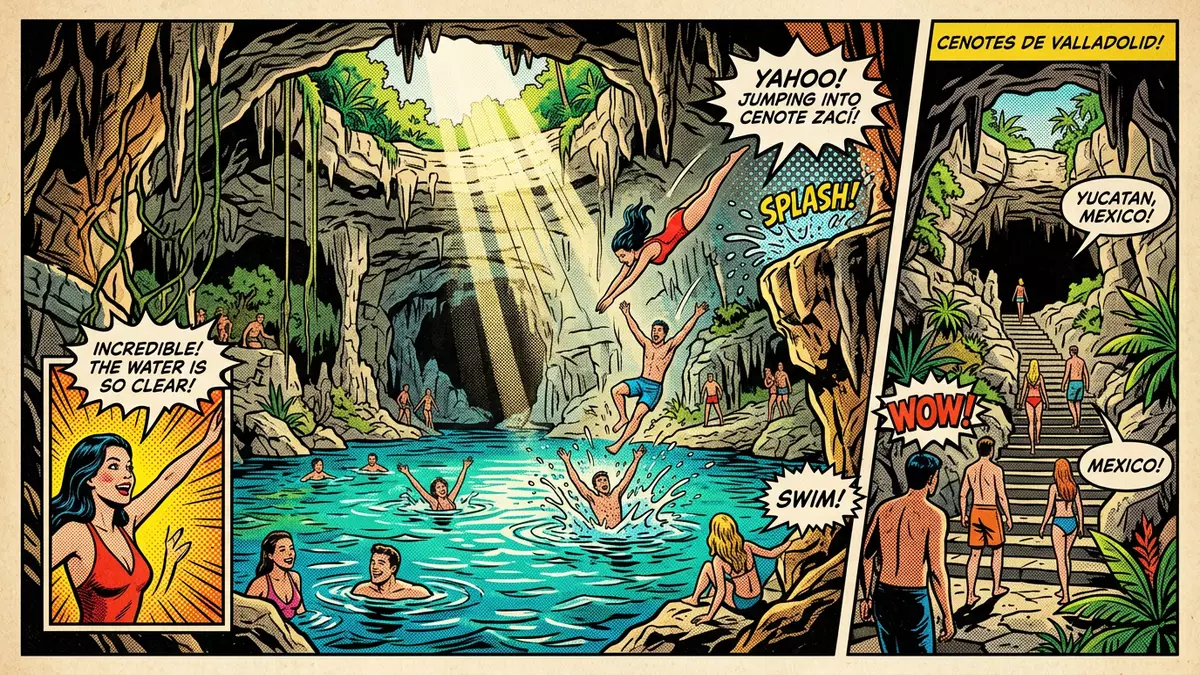
Cenotes de Valladolid are a cluster of freshwater sinkholes in and around Valladolid in Yucatán, Mexico. Their appeal lies in contrast: some sit in open ground, others drop into cave chambers, and Cenote Zací lies within the city itself.freshwater sinkholes The wider setting is the limestone plateau of the Yucatán Peninsula, where water has opened pools beneath the rock surface.limestone plateau
The cenote landscape around Valladolid
The cenotes around Valladolid range from large open basins to roofed chambers with stone steps descending into the water. Xkekén and Samulá near Dzitnup are the cave pair most closely associated with that enclosed form, while Suytun is known for an underground chamber with a central platform.Xkekén and Samulá Oxman, Saamal and Zací show a different side of the same landscape, with wider openings and more daylight reaching the water.Cenote Zací
That variety makes the area more than a single swimming stop. It is a compact set of limestone features, each with a different profile above and below ground. Cenote Zací, set within Valladolid, brings the natural feature into the fabric of the city, while the rural cenotes keep the same water-world a short drive away.Cenote Zací
Valladolid, Zací and the city’s older layers
The city of Valladolid was founded in 1543 under Francisco de Montejo “the Nephew” and moved to the site of the Maya settlement of Zací in 1545. That relocation links the cenote landscape to the colonial street pattern that survives around the plaza.Francisco de Montejo Zací itself is central to the story because the cenote carries the name of the earlier Maya town, and the in-town pool remains one of Valladolid’s most distinctive water spaces.the earlier Maya town
That history helps explain why Cenotes de Valladolid belong to both landscape and city. The cenotes are not isolated attractions in the countryside alone; they sit beside a historic centre, a Franciscan convent at San Bernardino de Siena and a grid of streets that grew from the colonial settlement.San Bernardino de Siena
Swimming, stairs and stone around the cenotes
The cenotes near Valladolid are shaped by stone and water rather than by a single architectural rule. Some require a walk down stairs into a deep shaft, while others open more broadly to the sky. Oxman is reached by a winding staircase, and Xkekén has a shorter stair descent into a cave chamber.winding staircase
For travellers, that means the main experience is tactile as much as visual: stone steps, cool water, rock walls and changing light across a limestone hollow. Some cenotes are managed as full visitor sites with platforms and facilities, while others feel simpler and more direct. The variety comes from the natural form of the sinkholes, not from a single planned layout.managed as full visitor sites
Visiting Cenotes de Valladolid: what travellers from Western Europe should know
- The cenotes sit in and around Valladolid in Yucatán, in Mexico’s east, and the city is reached by road, coach, car, private transfer and Tren Maya. Cenote Zací lies in the city itself, while Oxman, Suytun, Xkekén and Samulá are short drives away.
- Expect limestone steps, wet stone and changing light below ground. Xkekén and Samulá involve cave access, and Oxman uses a staircase down to the water.
- The area combines open pools and enclosed cenotes rather than one single type of site. Zací, Oxman and Saamal are more open, while Suytun, Xkekén and Samulá are more enclosed.
- The official language is Spanish and the currency is the Mexican peso.
Searching for Cenotes de Valladolid on social platforms
These links open searches for Cenotes de Valladolid on each platform.
Frequently asked questions about Cenotes de Valladolid
Where are Cenotes de Valladolid?
They are in and around Valladolid in Yucatán, Mexico. Cenote Zací is within the city, and several others sit a short drive away.
What does a visit involve?
Most visits involve stone steps, water, rock walls and either an open or enclosed sinkhole. Some sites are set up for swimming, while others are more striking as cave spaces.
What makes them different from one another?
The main difference is form: some are open to daylight, others are roofed or partly roofed, and Zací brings the cenote into the city centre.


