
Cattedrale di Santa Maria del Fiore and the great brick dome of Florence
Published on 09/09/2026 at 10:58 | Editorial responsibility: Rafael Müller, Editor-in-Chief AD HOC NEWS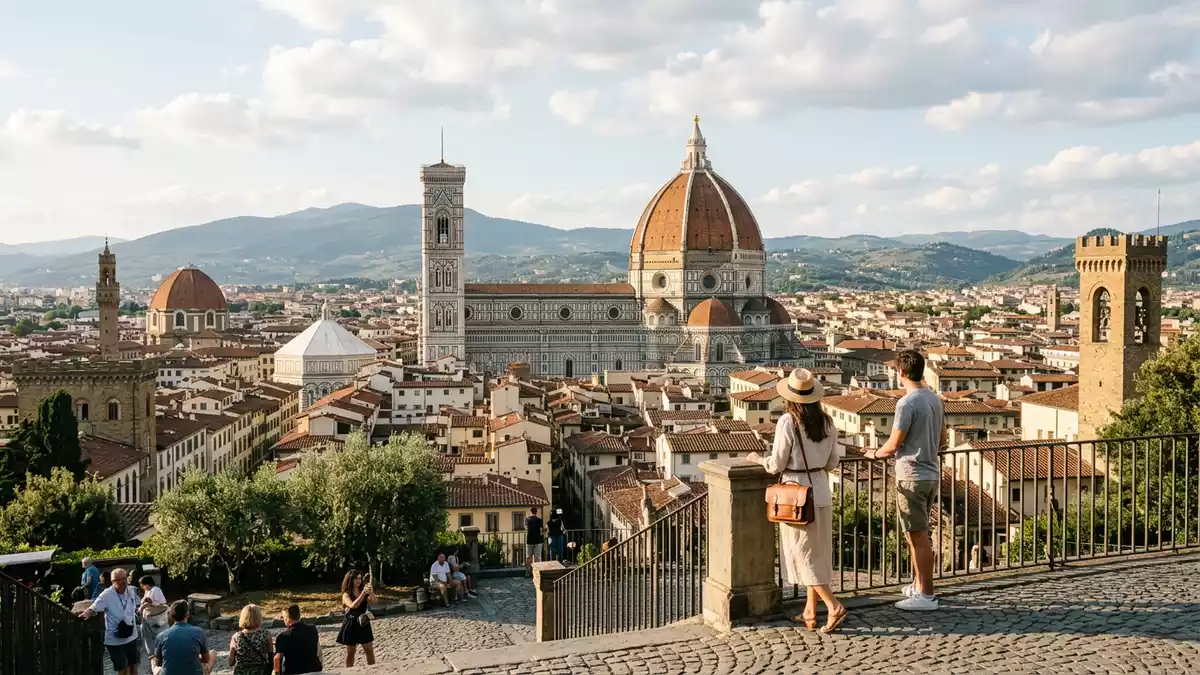
Cattedrale di Santa Maria del Fiore is the cathedral of Florenz in Tuscany, its vast masonry dome and patterned marble walls forming one of Italy’s defining city silhouettes. Rising over Piazza del Duomo, it combines a late thirteenth-century Gothic body with Filippo Brunelleschi’s fifteenth-century dome, tying the medieval city to the early Renaissance in a single building.
A brick dome that reshaped Florence’s skyline
The most striking feature of Cattedrale di Santa Maria del Fiore is the immense dome that crowns the octagonal crossing above the nave and choir. Engineered by Filippo Brunelleschi and structurally completed in 1436, it remains the largest masonry dome ever built, a layered shell of brick and stone resting on a tall drum.largest masonry dome From the surrounding streets the dome’s terracotta tiles dominate the view, stepping up in ribs towards the lantern that continued to rise in the decades after Brunelleschi’s death.lantern completed in 1461
Inside the cathedral the dome sits above an octagonal space defined by piers and arches, a clear structural pivot between the long basilican plan and the short transept arms. The interior of the vault is covered with fresco decoration spreading across its eight segments, while windows at the drum level admit light that falls down into the crossing. Below, the floor is patterned in stone and the spatial effect changes as visitors move from the entrance under the nave into the wide central volume beneath the dome.
Gothic basilica, Renaissance engineering and a nineteenth-century face
The origins of Cattedrale di Santa Maria del Fiore lie in a late thirteenth-century decision to replace the earlier church of Santa Reparata with a larger cathedral, begun in 1296 under the architect Arnolfo di Cambio.first stone laid in 1296 The plan took the form of a triple-nave basilica, the central nave flanked by aisles leading towards a broad choir area bounded by three polygonal apses. Over the following decades figures including Giotto di Bondone, Andrea Pisano and Francesco Talenti contributed to the structure and its campanile, extending the church to its present length and reinforcing its Gothic character.work of Giotto and Talenti
The exterior of the cathedral is faced with polychrome marble panels in white, green and pink, arranged in geometric schemes that wrap the walls and emphasise vertical elements.polychrome marble cladding On the west front, the present façade belongs to the nineteenth century, designed by Emilio De Fabris in a neo-Gothic idiom that echoes the medieval vocabulary with pointed arches, tracery and sculptural niches set within the marble revetment.façade by Emilio De Fabris Together, the marble skin, stone structure and brick dome form a layered timeline in built form: Gothic conception, Renaissance engineering at the top, and a later historicist completion at the front.
A cathedral at the centre of a UNESCO-listed ensemble
Cattedrale di Santa Maria del Fiore stands at the heart of the historic centre of Florenz, an area recognised as a UNESCO World Heritage Site for its dense concentration of medieval and Renaissance monuments.historic centre of Florence The cathedral forms a triad with the free-standing Campanile di Giotto and the octagonal Baptistery of San Giovanni, all aligned around Piazza del Duomo, where the urban space frames views of different parts of the complex as travellers move across the square. The dedication to “Santa Maria del Fiore”, referring to the lily symbol of Florence, ties the building’s identity directly to the city’s civic emblem.name linked to the lily
The cathedral was consecrated in 1436 by Pope Eugene IV after the structural completion of Brunelleschi’s dome, marking the end of a building campaign that had begun in 1296 and extended across nearly a century and a half.consecration in 1436 Beneath the present floor, excavations have revealed remains of Santa Reparata, while the cathedral itself continues to serve as the principal church of the archdiocese, its interior accommodating liturgical spaces, chapels and artworks spanning many centuries.
Visiting Cattedrale di Santa Maria del Fiore: what travellers from Western Europe should know
- Cattedrale di Santa Maria del Fiore stands in Piazza del Duomo in the historic centre of Florenz, with streets of the old city radiating away from the cathedral complex.
- The interior involves a walk along the nave and into the crossing; the floor is largely level, but some chapels and side areas are reached by short steps.
- Florenz is in Italy, where the official language is Italian and the currency is the euro.
- The cathedral complex lies close to the Baptistery of San Giovanni and Campanile di Giotto, both visible from Piazza del Duomo and forming a continuous architectural ensemble.
Searching for Cattedrale di Santa Maria del Fiore on social platforms
These links open searches for Cattedrale di Santa Maria del Fiore on each platform.
Frequently asked questions about Cattedrale di Santa Maria del Fiore
Where is Cattedrale di Santa Maria del Fiore located?
Cattedrale di Santa Maria del Fiore stands in Piazza del Duomo in the historic centre of Florenz, the capital of Tuscany in Italy.
What should visitors expect inside the cathedral?
Visitors encounter a long Gothic nave leading to a wide octagonal crossing beneath Brunelleschi’s dome, with chapels, artworks and a patterned stone floor.
What makes Cattedrale di Santa Maria del Fiore distinctive?
The cathedral combines a Gothic basilican body begun in 1296 with Brunelleschi’s vast fifteenth-century brick dome and a marble-clad neo-Gothic façade, spanning several key periods of Italian architecture.


