
Cathedrale Notre-Dame de Chartres and its world of light
Published on 08/29/2026 at 08:00 | Editorial responsibility: Rafael Müller, Editor-in-Chief AD HOC NEWS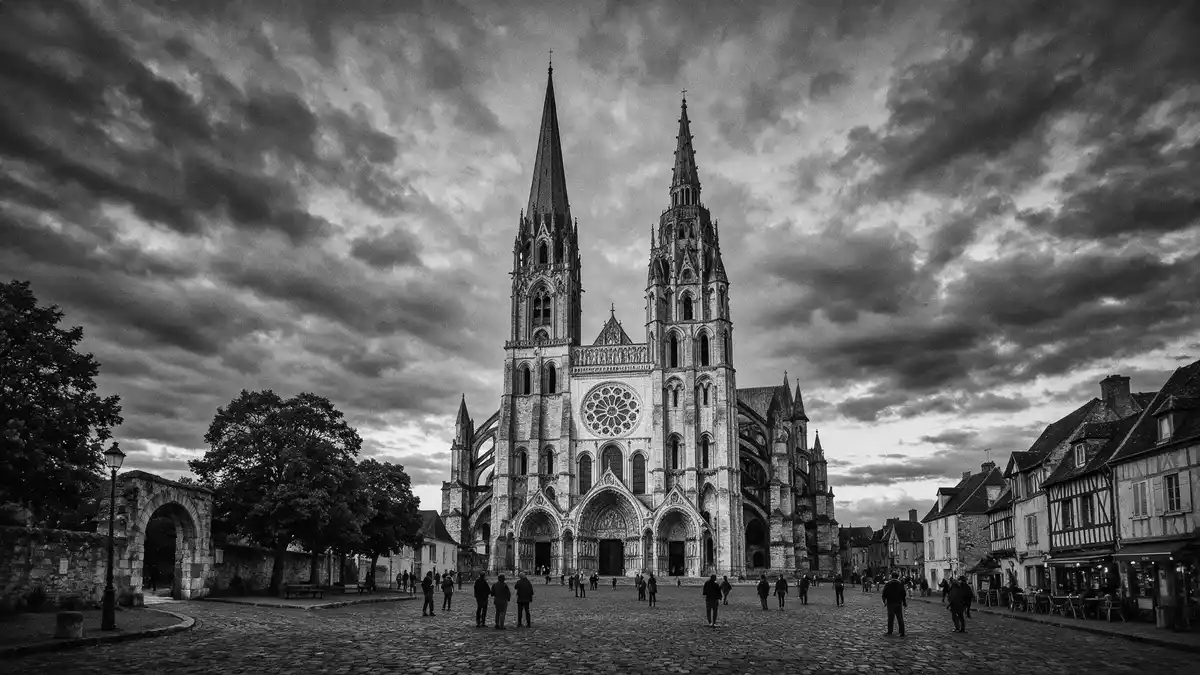
Cathedrale Notre-Dame de Chartres dominates the skyline of Chartres in northern France, a Gothic stone mass whose fame rests on light as much as height. Built largely between 1194 and the early thirteenth century, it brings together soaring architecture, intricate sculpture and stained glass in a single, coherent ensemble that has drawn travellers and pilgrims for centuries.
A high point of Gothic architecture in stone
Cathedrale Notre-Dame de Chartres stands in the historic centre of Chartres in the Eure-et-Loir department, in the Centre-Val de Loire region of France, its bulk rising above the town’s streets and low roofs.Chartres Cathedral in France The cathedral as seen today was constructed after a major fire in 1194, with the main campaign of building extending into the early decades of the thirteenth century, giving the structure a striking unity of style.construction after the fire of 1194
The architecture belongs to the mature phase of French Gothic, with a vast nave carried by clustered piers and ribbed vaults, flanked by aisles that run towards an eastern choir ringed with chapels.high point of French Gothic art The western front carries deep porches filled with mid-twelfth-century sculpture, while the later work above and around them retains a consistent Gothic language, so that the building reads as a largely uninterrupted thirteenth-century design despite its long religious history.Romanesque and Gothic form between 1190 and 1220
Stained glass and the famed Chartres blue
Inside Cathedrale Notre-Dame de Chartres, stone and glass work together, and the stained glass is the feature most closely associated with the building. The cathedral contains an exceptional ensemble of medieval windows, with a large proportion of the glass dating from the early thirteenth century between about 1205 and 1225.ensemble of stained glass between 1205 and 1225 Many windows take the form of tall lancets and rose compositions in the transepts and choir, each panel assembled from countless pieces of coloured glass held in lead.
The glass at Chartres is known in particular for its deep blues, and the depiction of the Virgin Mary in one celebrated window has given rise to the term “Chartres blue” for the intense colour of her cloak.the mystical blue of the Madonna's tunic Themes range across the Bible and the lives of saints, with transept roses presenting Old Testament figures on one side and scenes linked to the Apocalypse and New Testament on the other.rose windows in the north and south transepts The overall effect is that of a stone volume filled with narrative glass, where coloured light patterns the floor and masonry.
Pilgrimage, heritage status and living worship
Cathedrale Notre-Dame de Chartres has long been associated with Marian devotion, and the cathedral serves as the seat of the Bishop of Chartres within the Catholic Church.seat of the Bishop of Chartres It became a major destination for pilgrims in the Middle Ages, with travel focused on relics associated with the Virgin Mary, and liturgical life continues around the high altar and in the crypt beneath the choir.destination of a pilgrimage dedicated to the Virgin Mary
The cathedral is recognised internationally as a cultural monument, and in 1979 it was inscribed on the UNESCO World Heritage List as one of the early French sites to receive that status, under criteria highlighting its architectural achievement and influence on Gothic art.UNESCO World Heritage Site since 1979 The fabric is also protected within France as a historic monument, reflecting both the building’s completeness and the survival of its medieval glass and sculpture.listed as Historic Monument since 1862
Visiting Cathedrale Notre-Dame de Chartres: what travellers from Western Europe should know
- Cathedrale Notre-Dame de Chartres stands in central Chartres, with its towers visible from the surrounding plain; main approaches pass through the town’s streets towards the cathedral close.
- The interior involves walking along stone floors and up and down steps between different levels, especially around the choir and crypt areas.
- Chartres lies south-west of Paris, and rail services connect the French capital with Chartres station, from which the cathedral can be reached on foot through the town.
- The official language is French and the currency is the euro.
- Entry requirements depend on your nationality; UK travellers can check the FCDO travel advice at gov.uk/foreign-travel-advice, Irish travellers the Department of Foreign Affairs at ireland.ie.
Searching for Cathedrale Notre-Dame de Chartres on social platforms
These links open searches for Cathedrale Notre-Dame de Chartres on each platform.
Frequently asked questions about Cathedrale Notre-Dame de Chartres
Where is Cathedrale Notre-Dame de Chartres located?
Cathedrale Notre-Dame de Chartres stands in the town of Chartres in the Eure-et-Loir department of northern France, within the Centre-Val de Loire region.
What should visitors expect inside the cathedral?
Visitors encounter a vast Gothic interior with high stone vaults, extensive stained glass windows casting coloured light and areas of sculpted decoration around the porches and choir.
What makes Cathedrale Notre-Dame de Chartres distinctive among European cathedrals?
The cathedral is distinguished by the completeness of its thirteenth-century Gothic architecture, its large ensemble of medieval stained glass, including the deep Chartres blue, and its UNESCO World Heritage status.


