
Cathedrale Notre-Dame de Chartres and its world of glass
Published on 09/03/2026 at 17:07 | Editorial responsibility: Rafael Müller, Editor-in-Chief AD HOC NEWS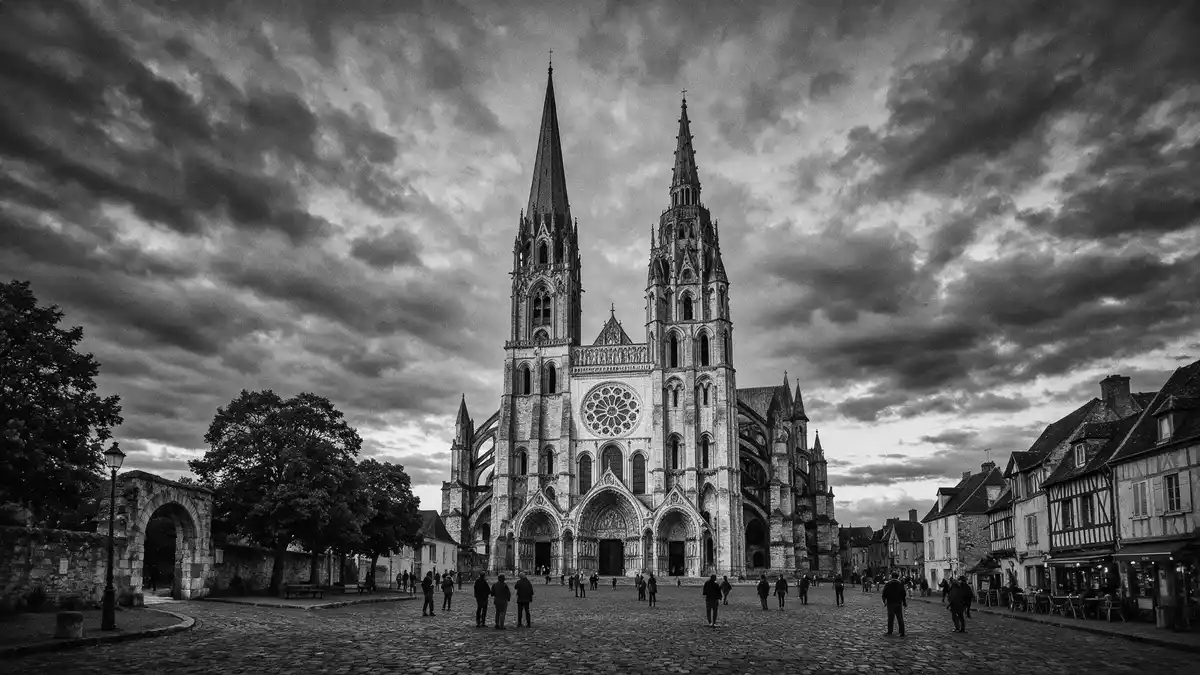
Cathedrale Notre-Dame de Chartres dominates the small city of Chartres with a mass of pale stone pierced by medieval stained glass, a Gothic landmark that grew from fire and faith in the early thirteenth century. Built largely between 1194 and the mid-thirteenth century, it became a touchstone of French Gothic architecture and a major centre of pilgrimage dedicated to the Virgin Mary.
A Gothic cathedral shaped by fire and stone
The present Cathedrale Notre-Dame de Chartres took form after a devastating fire in 1194 destroyed much of an earlier Romanesque church on the same site, while preserving parts of its crypt and western front. Within a few decades, builders raised a new stone shell whose nave, transept and choir created one of the most coherent ensembles of early Gothic architecture in France.Notre-Dame de Chartres was built immediately after the fire of 1194 The main construction campaign in the early thirteenth century gave the cathedral its characteristic Latin-cross plan, with a long nave, projecting transept arms and a deep eastern choir surrounded by chapels.It is mostly constructed between 1194 and 1220
The architecture combines massive masonry with structural innovation. Pointed rib vaults rise high above the nave arcades, while an unusually extensive clerestory admits light through stained glass rather than bare openings. Around the outside, flying buttresses brace the upper walls and help carry the weight of the vaults, leaving room for large windows that became a hallmark of Gothic building in northern France.Chartres Cathedral is noted for its tall arcades, narrow triforium and large clerestory supported by flying buttresses
Towers, portals and the sculpted stone bible
From the town below, the twin western towers of Cathedrale Notre-Dame de Chartres form one of its most recognisable profiles. The southern tower, whose lower parts belong to the twelfth century, carries a spire with relatively simple Gothic lines, while the northern tower rises higher in an ornate Flamboyant Gothic spire added in the early sixteenth century.The north tower was rebuilt between 1507 and 1514 in the Flamboyant Gothic style Seen together, the two towers stage a dialogue between early Gothic austerity and later Gothic ornament.
Below the towers, the west front carries the so?called Royal Portal, a set of sculpted doorways that survive from the earlier Romanesque church. Their elongated figures of kings, queens and prophets flank the entrances, carved in stone with a mixture of stylised drapery and attentive faces. Around the building, other portals present densely populated tympana and jambs where biblical scenes and saints occupy almost every surface, turning the exterior into a stone encyclopaedia of Christian imagery.
Light, stained glass and the legendary blue
Inside Cathedrale Notre-Dame de Chartres, the experience is defined by stained glass. The walls of the nave and choir are lined with windows dating largely from the twelfth and thirteenth centuries, many of them preserved in their original positions.The cathedral presents a near-complete ensemble of medieval glazed decoration More than a hundred windows fill the interior with filtered light, including celebrated panels devoted to the Virgin Mary, local trades and biblical narratives.The stained glass of Chartres forms one of the most extensive medieval collections
The deep blue that dominates many windows has become strongly associated with Chartres. In compositions such as the “Blue Virgin” window, this colour surrounds figures with a saturated field that seems to hold the stone structure in a luminous skin of glass. As daylight moves around the building, the windows shift from glowing panes to more subdued mosaics, revealing details of storytelling, heraldry and craft that link medieval donors with scenes from scripture.
Pilgrimage, relics and a medieval city of faith
Cathedrale Notre-Dame de Chartres grew as a major pilgrimage sanctuary dedicated to the Virgin Mary, in part because it houses a relic associated with her, kept in the cathedral treasury. In the Middle Ages, Chartres formed one of the principal Marian pilgrimage destinations in Western Christendom, drawing travellers who approached across the plains of the Beauce and saw the towers long before reaching the town.Chartres was a major centre of pilgrimage dedicated to the Virgin Mary
The building’s role in Christian devotion is underlined by its liturgical spaces. Beneath the choir, an extensive crypt incorporates earlier structures associated with Bishop Fulbert of Chartres in the eleventh century, linking the Gothic church with its Romanesque predecessors.Fulbert commissioned an earlier cathedral dedicated in 1037, whose crypt survives beneath the present church On the floor of the nave, a large stone labyrinth offers a symbolic path set into the paving, echoing the idea of a spiritual journey within the architectural frame of the cathedral.
Visiting Cathedrale Notre-Dame de Chartres: what travellers from Western Europe should know
- Cathedrale Notre-Dame de Chartres stands in the historic centre of Chartres in northern France, south-west of Paris, within walking distance of Chartres railway station on main lines from the capital.
- The approach from the town involves streets that climb steadily towards the cathedral hill, and the interior includes staircases, uneven stone floors and passages in the crypt.
- Chartres lies in the Beauce plain of northern France, with winters that can be cold and damp and summers that bring bright light to the cathedral’s stained glass.
- The official language is French and the currency is the euro.
- Entry requirements depend on your nationality; UK travellers can check the FCDO travel advice at gov.uk/foreign-travel-advice, Irish travellers the Department of Foreign Affairs at ireland.ie.
Searching for Cathedrale Notre-Dame de Chartres on social platforms
These links open searches for Cathedrale Notre-Dame de Chartres on each platform.
Frequently asked questions about Cathedrale Notre-Dame de Chartres
Where is Cathedrale Notre-Dame de Chartres?
Cathedrale Notre-Dame de Chartres stands in the city of Chartres in northern France, south-west of Paris on the plains of the Beauce.
What can visitors expect inside the cathedral?
Visitors encounter a high Gothic nave, extensive stained glass from the twelfth and thirteenth centuries, a large stone labyrinth in the floor and a crypt beneath the choir.
What makes Cathedrale Notre-Dame de Chartres distinctive among Gothic cathedrals?
Its rapid early thirteenth-century construction, near-complete ensemble of medieval stained glass and combination of early and Flamboyant Gothic towers give Chartres an exceptional coherence and richness.


