
Catedral de Santiago de Compostela and the layered stone of pilgrimage
Published on 08/21/2026 at 12:39 | Editorial responsibility: Rafael Müller, Editor-in-Chief AD HOC NEWS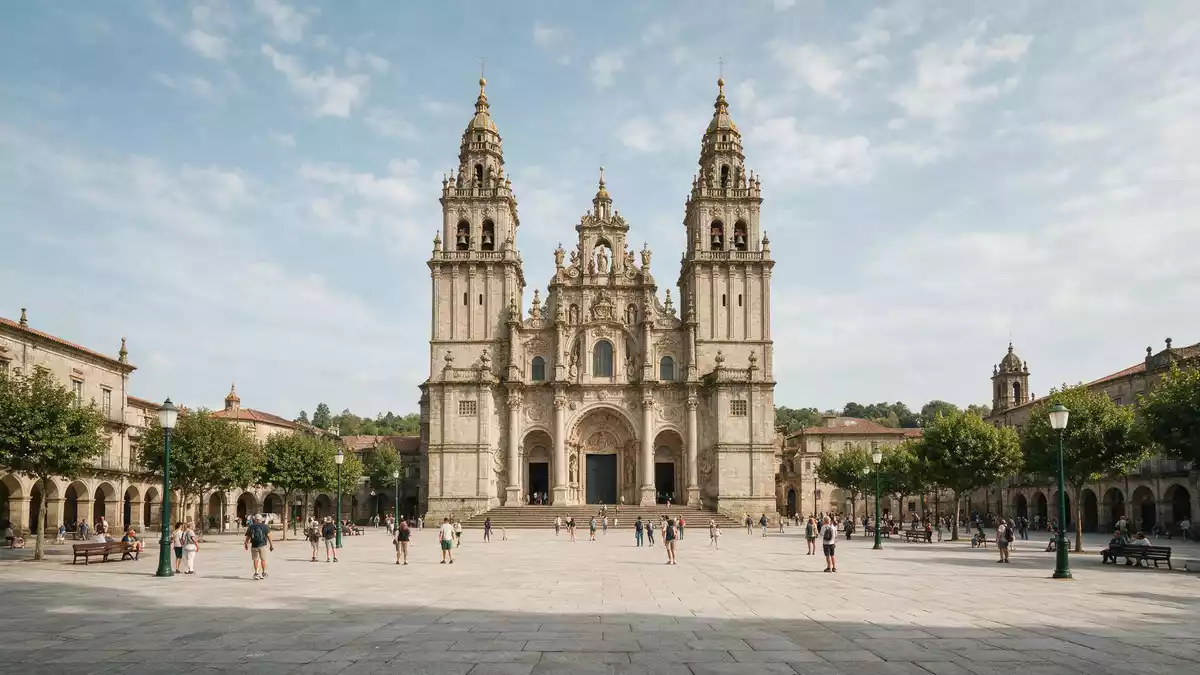
Catedral de Santiago de Compostela rises over the old streets of Santiago de Compostela as a layered monument to faith, stonework and long-distance pilgrimage. At its core it is a Romanesque basilica begun in 1075 under Alfonso VI of León and Castile, later wrapped in Gothic and Baroque additions that turn a single church into an entire architectural timeline.The Romanesque cathedral began in 1075
Romanesque core and Baroque skin
The main body of Catedral de Santiago de Compostela belongs to the high point of Romanesque architecture in the Iberian Peninsula, with massive piers, barrel vaults and round arches marching down the nave.The cathedral is described as a Romanesque structure with later additions Construction of this stone shell started in the late eleventh century under Bishop Diego Peláez, and the work attracted master builders such as Bernard the Elder and Master Mateo, whose names are preserved in documents and later tradition.Bernard the Elder and Master Mateo are named among the builders
On the outside, those Romanesque walls are masked by later fronts, and nowhere is this more visible than on the western side. Facing Praza do Obradoiro stands a richly sculpted Baroque façade, begun in the sixteenth century and brought to its definitive form between 1738 and 1750 by architect Fernando de Casas Novoa, whose work crowns the medieval structure with tall towers and layered ornament.The Obradoiro façade was completed between 1738 and 1750 The result is a deliberate contrast: heavy Romanesque masonry within, exuberant Baroque stonework without, both belonging to the same complex.
Place of an apostle and destination of the Camino
Catedral de Santiago de Compostela stands on the reputed burial place of Saint James the Great, one of the twelve apostles of Jesus, and this association with the apostle has shaped its identity.The cathedral is described as the burial place of Saint James A shrine to Saint James developed here from the ninth century onwards, and by the High Middle Ages the building had become the end point of the Camino de Santiago, the network of pilgrimage routes that crosses France and northern Spain. The cathedral forms part of the wider Santiago de Compostela World Heritage Site, reflecting the combined value of the building, the pilgrimage and the historic city around it.The cathedral is included in the Santiago de Compostela World Heritage Site
Under the main altar, a crypt holds a silver reliquary associated with Saint James, visited by generations of travellers who arrive by foot, bicycle or other means. Above, the nave is long enough to absorb processions of pilgrims, clergy and visitors, with side chapels branching from the aisles and a crossing crowned by a central dome. The building works as a spiritual destination and as a dense architectural object in stone, where carved capitals, portals and altarpieces recall different centuries and artistic languages.
The Botafumeiro and the lived space of the nave
Inside the crossing of Catedral de Santiago de Compostela hangs one of its most recognisable artefacts, the Botafumeiro, a very large metal thurible suspended from the dome by a pulley system fixed high in the structure.The Botafumeiro hangs from the main dome on a pulley system References to this vessel appear in the twelfth-century Codex Calixtinus under the Latin term “Turibulum Magnum”, and the present version was crafted in 1851 by the goldsmith José Losada from brass plated with silver, replacing an earlier one lost in the Napoleonic era.The current Botafumeiro dates from 1851 and is linked to José Losada
On selected high days, teams of tiraboleiros set the Botafumeiro swinging along the length of the transept, where it travels in a wide arc above the congregation and under the vaults. Technical descriptions give an empty weight of around 53 kg and a height of about 1.5 m, emphasising that the object is as much engineering as liturgical instrument.The cathedral site gives height and weight figures for the Botafumeiro Even at rest, the presence of the thurible and its ropes marks the crossing as a focal point where stone, ritual and movement intersect.
Visiting Catedral de Santiago de Compostela: what travellers from Western Europe should know
- Catedral de Santiago de Compostela stands in the historic centre of Santiago de Compostela in north-west Spain, with the main western entrance opening onto Praza do Obradoiro.
- The interior includes long stretches of paving and a number of staircases, and reaching some chapels or viewpoints involves climbing relatively narrow stone steps.
- The official language is Spanish and the currency is the euro.
Searching for Catedral de Santiago de Compostela on social platforms
These links open searches for Catedral de Santiago de Compostela on each platform.
Frequently asked questions about Catedral de Santiago de Compostela
Where is Catedral de Santiago de Compostela?
Catedral de Santiago de Compostela stands in the city of Santiago de Compostela in Galicia, north-west Spain, forming the focal point of the historic centre.
What can visitors expect inside the cathedral?
Visitors encounter a Romanesque nave with later Gothic and Baroque elements, a crypt linked to Saint James, side chapels and the suspended Botafumeiro thurible.
What makes Catedral de Santiago de Compostela distinctive?
The cathedral combines an eleventh-century Romanesque core, an eighteenth-century Baroque Obradoiro façade and its role as the end point of the Camino de Santiago pilgrimage.


