
Catedral de Santiago de Compostela and its Romanesque core
Published on 09/04/2026 at 14:23 | Editorial responsibility: Rafael Müller, Editor-in-Chief AD HOC NEWS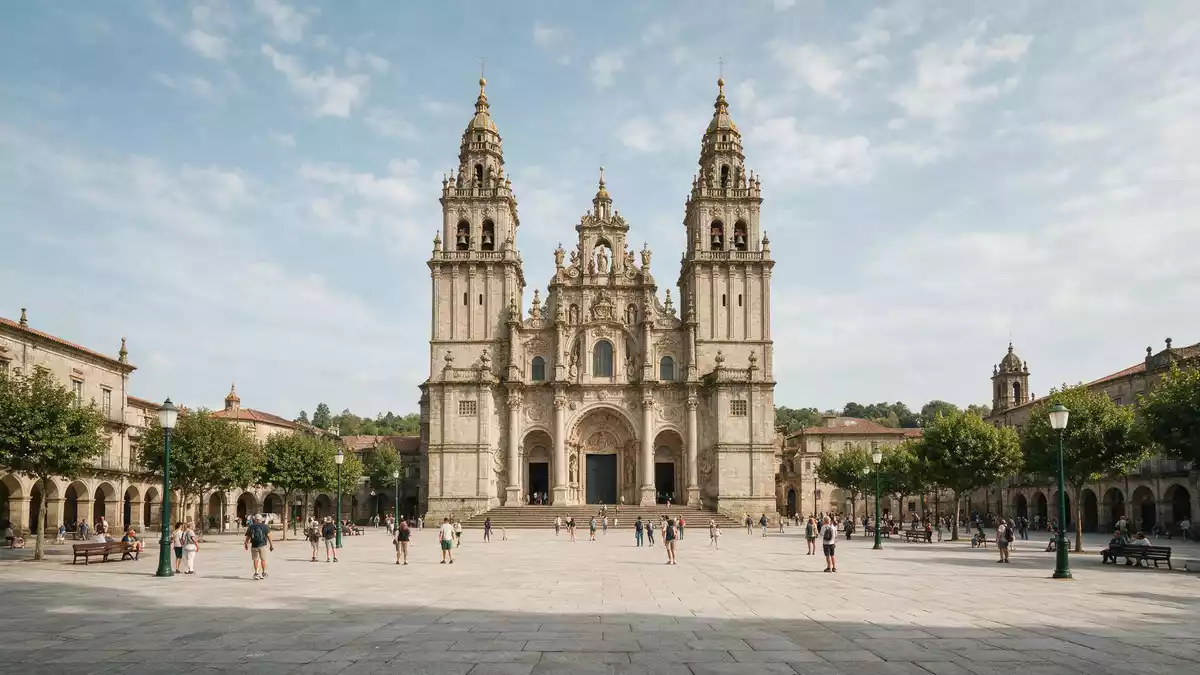
Catedral de Santiago de Compostela in Santiago de Compostela is a Romanesque cathedral whose stone mass still anchors the city’s historic centre. Its present church began in 1075 under Alfonso VI of Castile and the bishop Diego Peláez.1075 under Alfonso VI
Romanesque walls and later fronts
The building keeps a medieval core, but its outer face belongs to several periods. The cathedral is made of granite and cut stone, with a Latin-cross plan and a long nave under Romanesque vaulting.granite and cut stone
Its facades present a layered city of styles rather than a single campaign. Baroque, Renaissance, Gothic and Neoclassical work all forms part of the ensemble, and the Obradoiro front is the best-known of the later additions.later additions
A cathedral shaped by pilgrimage
The cathedral stands at the centre of the Camino de Santiago, a route that leads to the tomb of Saint James. That connection gave the church its long European significance and placed Santiago de Compostela among the key pilgrimage cities of western Christendom.the Camino de Santiago
The Romanesque structure was consecrated in 1211 in the presence of Alfonso IX of León. In the medieval church, that date marked the completion of a major building campaign that had begun more than a century earlier.consecrated in 1211
From western front to choir and cloister
Inside, the cathedral contains the Pórtico da Gloria, linked to Master Mateo and finished in the twelfth century. The choir, the cloister and the chapels add further medieval and early modern layers to the interior plan.Master Mateo
The western mass and the surrounding chapels give the interior a dense sequence of spaces, arches and crossings. The result is a church that reads as both a pilgrimage shrine and a palimpsest of Spanish sacred architecture.the surrounding chapels
Visiting Catedral de Santiago de Compostela: what travellers from Western Europe should know
- The cathedral stands on the Obradoiro side of Santiago de Compostela’s historic core, with the old town around it and the city’s main civic squares close by.
- The building is large and stone-built, with steps, heavy masonry and a layered interior of naves, chapels and crossings.
- The official language is Spanish and the currency is the euro.
- Conditions on the mountain change with the seasons; the local cable-car operators and alpine clubs provide information.
Searching for Catedral de Santiago de Compostela on social platforms
These links open searches for Catedral de Santiago de Compostela on each platform.
Frequently asked questions about Catedral de Santiago de Compostela
Where is Catedral de Santiago de Compostela?
It stands in Santiago de Compostela, in Galicia, at the heart of the city’s historic centre. The cathedral is the main landmark of the pilgrimage destination associated with Saint James.
What should a visit involve?
The building is a large stone church with a Romanesque core, later facades and a layered interior. Its scale is best read through the nave, the crossing, the cloister and the Pórtico da Gloria.
What makes it distinctive?
Its defining feature is the combination of a Romanesque medieval structure with major later additions. The cathedral also carries the long association with the Camino de Santiago and the tomb of Saint James.


