
Catedral de Sal de Zipaquira carved beneath the Andes
Published on 09/24/2026 at 11:16 | Editorial responsibility: Rafael Müller, Editor-in-Chief AD HOC NEWS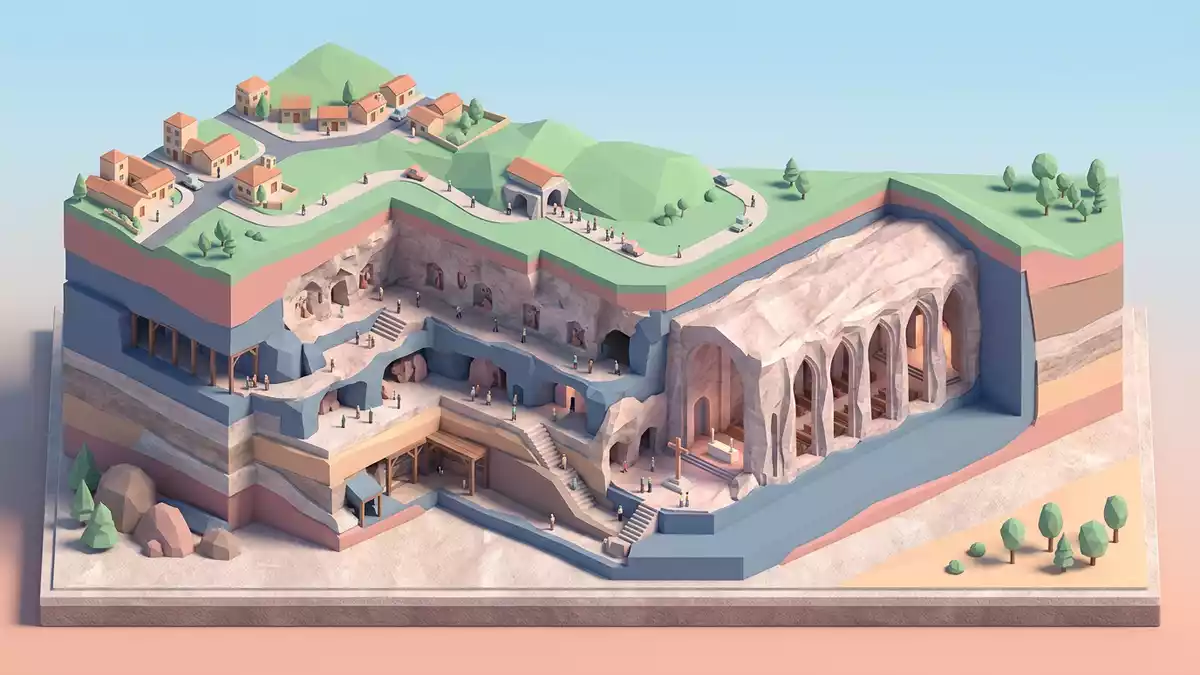
Catedral de Sal de Zipaquira is a Roman Catholic church carved inside a salt mine beneath Zipaquira, Colombia. Its chapels, passages and sculptures occupy an underground landscape of halite, where religious imagery shares the walls with exposed geological layers.
The present church was inaugurated in 1995, after a design by Bogotá architect Roswell Garavito Pearl. The combination of salt, darkness, engineered chambers and Christian symbolism gives the complex its distinctive character.
Inside a church made from a salt mine
Catedral de Sal de Zipaquira lies within the Zipaquira Salt Park in the department of Cundinamarca, north of Bogotá. The church is approximately 180 metres underground, inside a mountain associated with salt extraction.
The material is not a decorative surface added to an ordinary building. Halite forms the mine walls, ceilings and carved details throughout the subterranean route. Some areas retain the texture of the excavated rock, while others contain polished surfaces, sculptures and carefully lit religious scenes.
The complex belongs to a much older salt landscape. The deposit formed when an inland sea covered the region tens of millions of years ago, leaving salt beneath later layers of earth. The Muisca people used the deposit before European colonisation, and salt became an important trading material on the Bogotá savanna.
Roswell Garavito Pearl and the 1995 cathedral
The present Catedral de Sal de Zipaquira was developed during the 1990s. Roswell Garavito Pearl won an architectural competition held in 1990, and engineer Jorge Enrique Castelblanco Reyes directed the technical work. The church opened in December 1995.
The site has an earlier religious history within the mine. Miners created a sanctuary dedicated to Our Lady of the Rosary of Guasá, a figure associated with the mining community. A larger underground church opened in the 1950s, but that structure closed in the early 1990s.
The current complex is therefore a modern work of architecture within a geological setting shaped over millions of years. Its historical layers include pre-Columbian salt use, colonial extraction, republican industry and twentieth-century religious practice.
The official cathedral description presents the underground church as part of a cultural complex devoted to mining, geology and natural resources.
The Stations of the Cross beneath Zipaquira
The route through the cathedral includes Stations of the Cross carved into the salt. Crosses, niches, reliefs and pools of water appear along the passages, connecting the mine’s industrial history with Catholic devotional imagery.
Three principal naves represent stages in the life of Jesus: birth and baptism, life and death, and resurrection. Each nave contains an altar and sculptural work made from salt or related materials.
The main cross is formed within the rock at the altar area. Other notable works include La Piedad and a guardian angel carved by the Italian sculptor Ludovico Consorte in 1950. The Virgen de Guasá appears in the area above ground, linking the mine’s religious identity with the miners who worked there.
Water also belongs to the visual language of the complex. Reflective pools contain mineral-rich water, while lighting picks out the surfaces of the chambers and the edges of the carved forms. The result is an interior where architecture and geology remain visibly connected.
Catedral de Sal de Zipaquira received the designation First Wonder of Colombia on 4 February 2007. The title reflects its cultural and architectural role within the country.
Its dimensions are encountered through sequence rather than a single exterior façade. Visitors pass from the mine’s access passages into devotional stations, larger chambers, naves and altar spaces. The changing scale makes the relationship between excavation and church visible in every section.
Visiting Catedral de Sal de Zipaquira: what travellers from Western Europe should know
- Zipaquira lies in Cundinamarca, north of Bogotá. Roads and regional transport connect the town with Bogotá, while the cathedral stands within the Zipaquira Salt Park.
- The route is underground and includes passages, chambers and walking between the Stations of the Cross. The cathedral lies about 180 metres below ground.
- The surrounding town preserves colonial buildings, balconies and thick-walled architecture around its central squares. The salt complex forms a separate cultural landscape outside the historic centre.
- The official language is Spanish and the currency is the Colombian peso.
- Entry requirements depend on your nationality; UK travellers can check the FCDO travel advice at gov.uk/foreign-travel-advice, Irish travellers the Department of Foreign Affairs at ireland.ie.
Searching for Catedral de Sal de Zipaquira on social platforms
These links open searches for Catedral de Sal de Zipaquira on each platform.
Frequently asked questions about Catedral de Sal de Zipaquira
Where is Catedral de Sal de Zipaquira?
The church is in Zipaquira, in Colombia’s Cundinamarca department, north of Bogotá. It forms part of the Zipaquira Salt Park.
What is inside the cathedral?
The underground route contains Stations of the Cross, carved religious sculptures, chapels, naves, altars and passages through halite rock.
What makes the church distinctive?
Its architecture is carved within a salt mine approximately 180 metres underground. The 1995 church combines a modern design by Roswell Garavito Pearl with mineral walls and a long mining history.


