
Catedral de Sal de Zipaquira and its underground salt mountain
Published on 09/09/2026 at 22:54 | Editorial responsibility: Rafael Müller, Editor-in-Chief AD HOC NEWS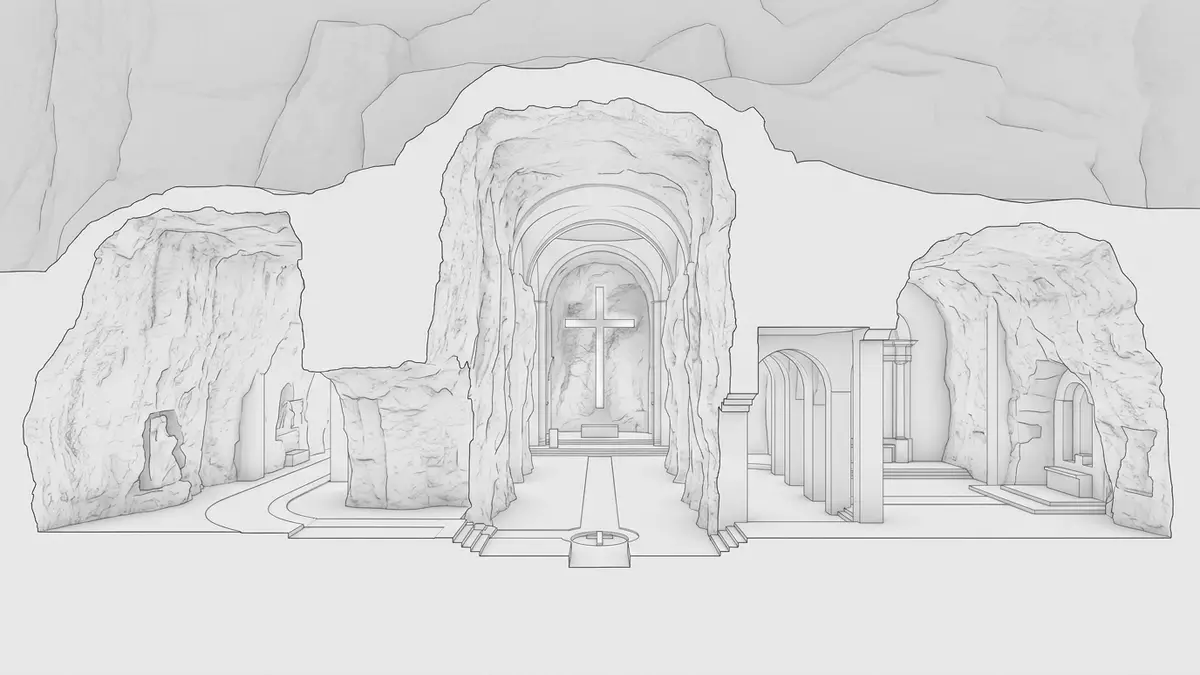
Far beneath the streets of Zipaquira in Colombia, Catedral de Sal de Zipaquira occupies the tunnels of a worked salt mountain, an underground church carved directly into halite rock and opened in 1995 as the successor to an earlier miners’ chapel.
A cathedral carved inside a halite mountain
Catedral de Sal de Zipaquira stands inside a hill of halite just outside the town, in the department of Cundinamarca north of Bogotá.The site lies within a former commercial salt mine where galleries and chambers have been sculpted into a vast devotional complex roughly 180 to 200 m (590 to 660 ft) below the surface.The cathedral forms part of a wider salt park dedicated to mining and geology
The church itself is Roman Catholic in character, although it does not serve as the seat of a bishop and therefore holds the status of a sanctuary rather than a formal diocesan cathedral.The current underground complex opened in 1995 after safety concerns led to the closure of an earlier chapel carved closer to active extraction zones. Visitors enter through the upper mine levels and descend into the mountain along broad tunnels illuminated to reveal crystalline salt surfaces.
Stations of the Cross and the main nave underground
The route into Catedral de Sal de Zipaquira follows a sequence of chapels marking the Stations of the Cross, each carved out of the salt strata and furnished with crosses and altars that echo the surrounding rock.Accounts of the mine layout describe fourteen chapels leading towards the heart of the sanctuary where the main nave opens in a long, high chamber. Here, a large cross cut from salt dominates the far wall, standing above the principal altar.
The entire interior is stereotomic architecture, created by removing material from the mountain rather than erecting new walls.Reports on the design point to more than 8,000 square metres of underground space given over to liturgical areas, circulation tunnels and side chambers. In place of stained glass or external façades, the effect comes from mineral surfaces cut and lit to reveal textures within the rock.
From Muisca salt to a modern sanctuary
The salt mountain around Zipaquira has been worked for centuries by local communities, including the Muisca people, who extracted salt long before Spanish colonisation.Twentieth-century miners created an underground chapel as early as the 1930s, and a larger church inaugurated in 1954 became a place of devotion within the mine. Structural concerns and the industrial exploitation of the deposits later made a replacement necessary.
The present Catedral de Sal de Zipaquira grew from a design competition organised in 1990 by the Colombian Society of Architects.Architect Roswell Garavito Pearl and engineer Jorge Enrique Castelblanco led the project, carving the new sanctuary deeper into more stable sections of the mountain while maintaining the spiritual role of the earlier miners’ church. The complex forms part of an officially promoted group of attractions around Bogotá and has been described within Colombia as a national wonder.
Visiting Catedral de Sal de Zipaquira: what travellers from Western Europe should know
- Catedral de Sal de Zipaquira stands on the edge of Zipaquira in Cundinamarca, Colombia, in a halite hill north of Bogotá, reached from the town by roads and paths.
- The visit involves descending into underground galleries, with stretches of sloping tunnels and stairways inside the former mine linking the chapels and the main nave.
- The wider salt complex lies close to the built-up area of Zipaquira, with viewpoints over the town and the surrounding Andean plateau near the entrance.
- The official language is Spanish and the currency is the Colombian peso. Entry requirements depend on your nationality; UK travellers can check the FCDO travel advice at gov.uk/foreign-travel-advice, Irish travellers the Department of Foreign Affairs at ireland.ie.
Searching for Catedral de Sal de Zipaquira on social platforms
These links open searches for Catedral de Sal de Zipaquira on each platform.
Frequently asked questions about Catedral de Sal de Zipaquira
Where is Catedral de Sal de Zipaquira?
Catedral de Sal de Zipaquira is in Zipaquira, a town in Cundinamarca, Colombia, in a halite hill north of Bogotá within a former salt mine complex.
What can visitors expect inside the cathedral?
Visitors walk through a series of underground chapels carved in salt, culminating in a large nave with a prominent salt cross and extensive rock-cut spaces.
What makes Catedral de Sal de Zipaquira distinctive?
The church is carved entirely from the rock of a working salt mountain, combining mining heritage, stereotomic architecture and Catholic devotional spaces deep underground.


