
Catedral de Sal de Zipaquira: an underground world of salt and light
Published on 08/29/2026 at 11:17 | Editorial responsibility: Rafael Müller, Editor-in-Chief AD HOC NEWS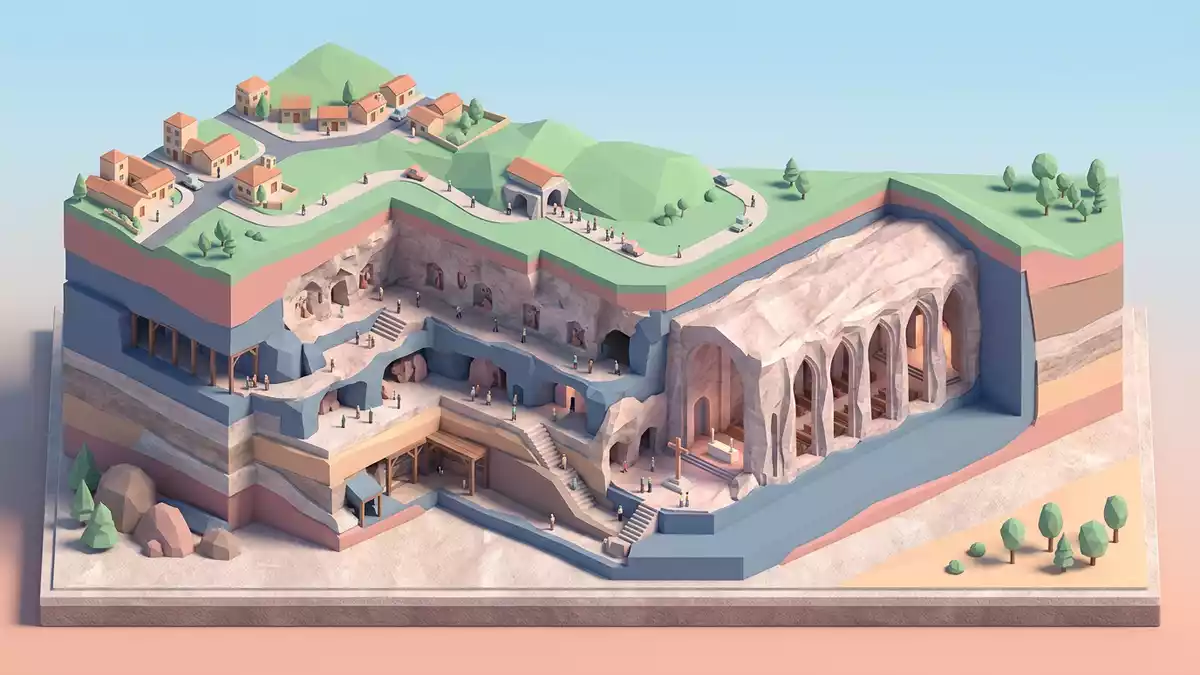
Far beneath the streets of Zipaquira in Colombia, Catedral de Sal de Zipaquira transforms a former salt mine into an underground church where carved rock, chapels and luminous crosses line a long sequence of tunnels. The present cathedral, opened in 1995 inside the halite deposits of the eastern Andes, replaced an earlier miners’ sanctuary carved into the same hill during the twentieth century.Salt Cathedral of Zipaquirá
A cathedral hewn from an ancient salt mountain
Catedral de Sal de Zipaquira sits within the salt-bearing hill that rises on the edge of Zipaquira, north of Bogotá in Colombia’s Andean interior.Zipaquira salt deposit The rock itself is halite laid down tens of millions of years ago when an inland sea covered this part of the eastern Andean range, leaving thick beds of salt that were later uplifted with the mountains.Andean salt formation Long before Christian worship reached the mine, the Muisca people of the region were extracting salt here by the fifth century BC, turning the deposit into one of their main sources of wealth.
The industrial mine that underpins the present cathedral began to take shape in the nineteenth century, with several tunnels driven into the hill to remove rock salt.Zipaquira salt mine tunnels Over time miners carved a small sanctuary in the workings and, in the mid twentieth century, an underground church was created deeper inside the mine and inaugurated in 1954 with a long nave and a basilica dome.1954 underground church Safety concerns eventually led to the closure of that first cathedral around 1990, clearing the way for the present layout.
The 1990s redesign: architecture inside a mine
The current Catedral de Sal de Zipaquira was built in the early 1990s inside disused workings of the mine, roughly 60 m below the level of the original sanctuary.new cathedral depth An architectural competition organised by Colombian institutions in 1990 selected a proposal by Roswell Garavito Pearl, a Bogotá architect whose design combined large worship spaces with reinforced tunnel structures and new circulation routes.Roswell Garavito Pearl Construction of the new cathedral took several years and involved removing hundreds of thousands of tonnes of salt rock to create broad chambers while maintaining the mine’s stability.cathedral excavation
The plan is organised in three main sections that unfold as a descending walk. The first is a sequence of chapels carved into the rock, each representing a Station of the Cross from the Passion narrative.Viacrucis chapels Beyond them lies a transitional zone that includes a dome-like chamber and approach galleries, leading towards the main worship spaces. The final section consists of large naves with altars carved directly into the salt, a prominent illuminated cross at the principal altar and ancillary spaces cut from the rock around the core church.main illuminated cross
Walking the underground route of chapels and naves
A visit to Catedral de Sal de Zipaquira follows the long axis of the former mine workings. From the surface visitors enter the tunnels and descend along passages lined with devotional spaces, their salt walls and ceilings shaped into arches, sculpted reliefs and recesses that hold altars and crosses. The chapels of the Viacrucis stand at intervals, each cut from the halite and lit to pick out the form of the cross associated with that Station, so that the path becomes a sequence of distinct rock-cut interiors.
Lower down, the route opens into wide caverns where the main naves stand, linked by walkways and flanked by carved columns and wall surfaces that retain the crystalline texture of the salt. In the principal nave a large cross rises behind the altar, formed from the salt rock and emphasised by lighting that throws its silhouette against the back wall.principal nave cross The overall effect is that of a church laid out inside a mine, where walls, floors and vaults are all part of the same geological body rather than added masonry.
Art, devotion and the wider salt landscape
The interior of Catedral de Sal de Zipaquira combines engineering with religious art. Sculptors worked alongside miners to carve reliefs, statues and abstract forms into the salt, contributing to chapels, altars and focal points throughout the route.sculptors in the mine Light plays a central role, with illuminated crosses, coloured washes on the rock and carefully placed fixtures highlighting the grain of the halite. The material can take on varied appearances, from opaque white masses to translucent bands, and these changes are visible where the walls have been cut back or polished.
Outside the underground church, the wider salt park on the hill gathers the industrial and geological story of the site. Exhibitions and trails explain how the salt deposit formed, how it was worked over centuries and how the underground spaces evolved from a miners’ sanctuary into the present cathedral.Parque de la Sal The combination of deep history, twentieth-century mining and late twentieth-century design gives the place a layered character: the worship spaces sit inside rock that predates human settlement, yet their layout reflects a specific period of Colombian architecture.
Visiting Catedral de Sal de Zipaquira: what travellers from Western Europe should know
- Catedral de Sal de Zipaquira stands in Zipaquira, a town in the Cundinamarca department of Colombia, north of Bogotá, with access from the town’s Villaveces Park near the salt hill.
- The approach into the cathedral follows mine tunnels that slope down through the hill, with sections of uneven floor and extended walks underground between chapels and naves.
- The official language is Spanish and the currency is the Colombian peso.
- Entry requirements depend on your nationality; UK travellers can check the FCDO travel advice at gov.uk/foreign-travel-advice, Irish travellers the Department of Foreign Affairs at ireland.ie.
Searching for Catedral de Sal de Zipaquira on social platforms
These links open searches for Catedral de Sal de Zipaquira on each platform.Frequently asked questions about Catedral de Sal de Zipaquira
Where is Catedral de Sal de Zipaquira located?
Catedral de Sal de Zipaquira lies within a salt hill beside the town of Zipaquira in the Cundinamarca department of Colombia, north of Bogotá.
What can visitors expect inside the cathedral?
Visitors walk through former mine tunnels past rock-cut chapels of the Stations of the Cross into broad underground naves with carved altars and a large illuminated salt cross.
What makes Catedral de Sal de Zipaquira distinctive?
The cathedral is distinctive in combining Christian worship spaces with the geology of a working salt mine, housing chapels, naves and sculptures inside halite rock carved from an Andean deposit.


