
Catedral de Puebla and its towers above the historic zócalo
Published on 08/29/2026 at 22:18 | Editorial responsibility: Rafael Müller, Editor-in-Chief AD HOC NEWS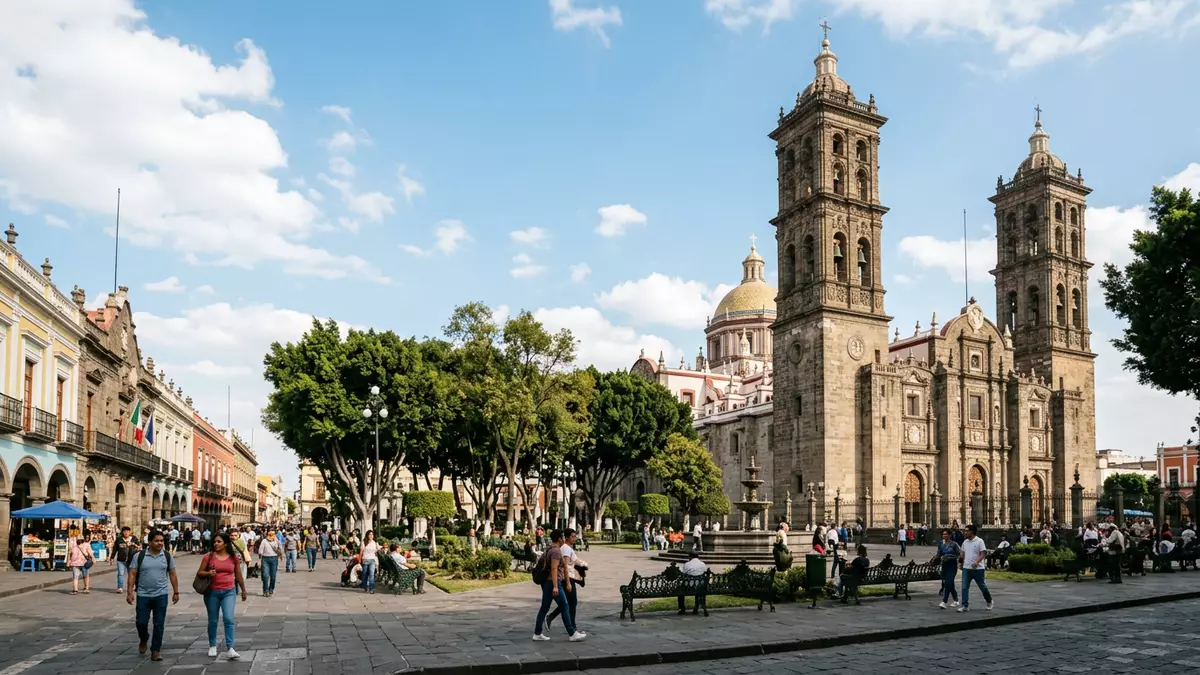
Catedral de Puebla dominates the historic centre of Puebla with its dark stone bulk, tall twin towers and a long interior filled with chapels and altars. Rising on the southern edge of the main square, the cathedral forms a constant reference point in the city’s historic core and has been closely linked to Puebla’s role as a colonial and ecclesiastical centre since the sixteenth century.
A sixteenth- and seventeenth-century cathedral at the heart of Puebla
The cathedral stands in the historic centre of Puebla, capital of the state of the same name in central Mexico, facing the city’s zócalo across a broad paved frontage.The Cathedral of Puebla is described as a Baroque style cathedral in the City of Puebla Built as the episcopal seat of the Archdiocese of Puebla de los Ángeles, it carries the formal Marian dedication of Our Lady of the Immaculate Conception.The basilica cathedral of Puebla is also known as the Cathedral of Our Lady of the Immaculate Conception
Construction of the present cathedral began in the second half of the sixteenth century and continued well into the seventeenth century, when the building was consecrated in 1649 under Bishop Juan de Palafox y Mendoza.Bishop Palafox consecrated the cathedral in 1649 Architectural historians trace its construction history through successive phases from 1575 onwards, with the work extending into the eighteenth century as the fabric was completed and the towers and interior furnishings were added.Research on the cathedral’s construction describes phases from 1575 and notes completion of the south tower in 1768
Stone, towers and Renaissance-Baroque architecture
Catedral de Puebla is built in stone, with a broad Latin-cross plan, a deep main nave and a high vaulted ceiling carried on strong piers. Its exterior shows a blend of Renaissance forms and Baroque detail, with a relatively austere main façade and more elaborate elements concentrated around portals and towers.The architecture is described as a blend of Herreresque Renaissance and early Baroque styles The dark stone walls and classical orders give the building a weighty, horizontal emphasis, while the towers rise high above the surrounding roofs.
The twin towers are a distinctive feature of the cathedral, rising to about 69 m (226 ft) and serving as bell towers that frame the main body of the church.The towers of the cathedral reach a height of 69 m Their completion belongs to the later phases of construction: the south tower was finished in the eighteenth century after decades of work.The south tower was built between 1731 and 1768 Inside, the nave is lined with side chapels under smaller vaults, while the crossing is marked by a dome and a baldachin over the high altar, reflecting a shift toward Neoclassical forms in the later interior additions.The last major element added was a Neoclassical baldachin begun in 1797
Interior chapels, choir and sacred art
The interior of Catedral de Puebla contains a long sequence of side chapels, each with its own altar and devotional focus, reflecting the cathedral’s role as a centre of liturgical and community life in Puebla.The cathedral houses retables in numerous chapels and other spaces such as the sacristy Many of these chapels are furnished with retables carrying paintings and sculptures, forming a gallery of sacred art within the building. The sacristy and other rooms also hold important works, including canvases and decorative fittings associated with bishops and local artists.
Closer to the centre of the nave stands the choir, enclosed by wooden structures and fitted with carved stalls. The main choir seating was completed in the early eighteenth century in a style that draws on Mudejar traditions, combining woodwork with patterned decoration.The wooden choir seating in a Mudejar style was completed in 1722 Together with the baldachin above the high altar and the long line of chapels, these features give a visit to the cathedral a strong focus on craftsmanship, materials and the layering of different artistic periods within a single ecclesiastical space.
Visiting Catedral de Puebla: what travellers from Western Europe should know
- Catedral de Puebla stands on Avenida 16 de Septiembre at the edge of the zócalo in Puebla’s historic centre and is reached on foot from the surrounding streets.
- The cathedral interior is reached by several doors opening from the surrounding streets, and visitors move across stone floors between chapels and the main nave.
- Puebla lies in central Mexico; the official language is Spanish and the currency is the Mexican peso.
- Entry requirements depend on your nationality; UK travellers can check the FCDO travel advice at gov.uk/foreign-travel-advice, Irish travellers the Department of Foreign Affairs at ireland.ie.
Searching for Catedral de Puebla on social platforms
These links open searches for Catedral de Puebla on each platform.Frequently asked questions about Catedral de Puebla
Where is Catedral de Puebla located?
Catedral de Puebla stands on the southern side of Puebla’s main square, the zócalo, on Avenida 16 de Septiembre in the historic centre of Puebla in central Mexico.
What can visitors expect inside Catedral de Puebla?
Visitors find a long nave with a high vaulted ceiling, a central choir, a baldachin above the high altar and multiple side chapels furnished with retables, paintings and sculptures.
What makes Catedral de Puebla distinctive among Mexican cathedrals?
The cathedral is distinctive for its combination of Renaissance and Baroque architecture, its tall twin towers, its extensive sequence of chapels and its richly worked choir and baldachin.


