
Catedral de Mallorca, a stone lantern above Palma’s waterfront
Published on 09/03/2026 at 17:40 | Editorial responsibility: Rafael Müller, Editor-in-Chief AD HOC NEWS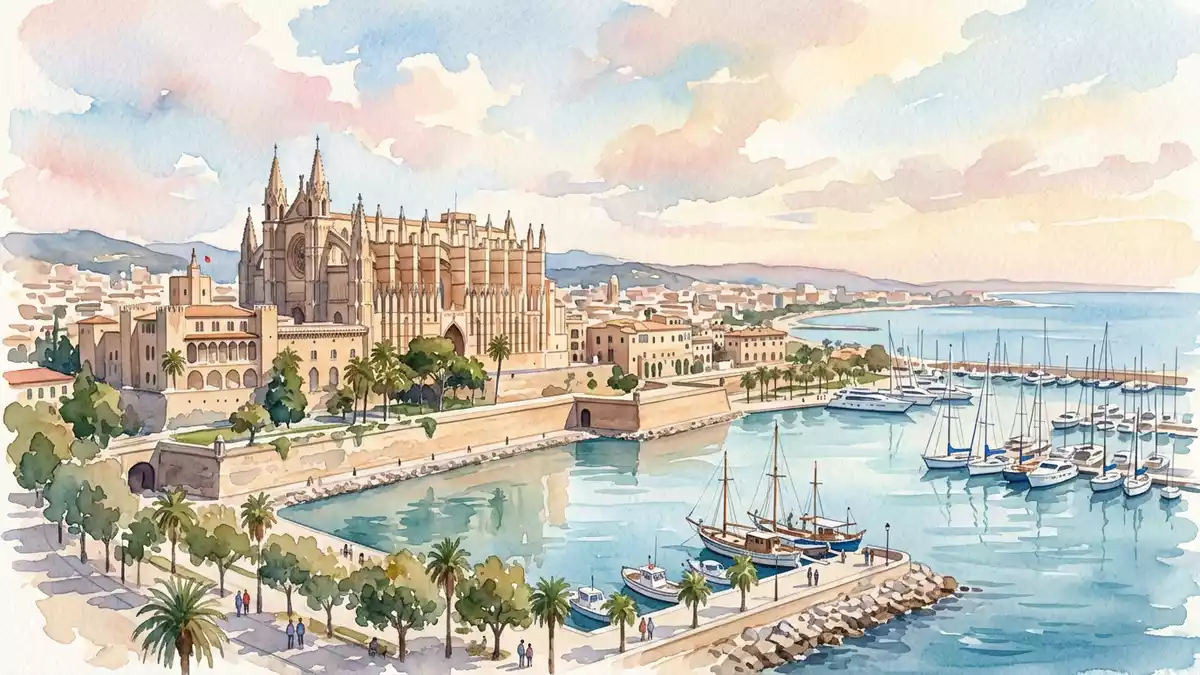
Catedral de Mallorca, also known as La Seu, is the Gothic cathedral that dominates Palma’s waterfront, rising above the old harbour with a vast stone interior and towering columns dating from the thirteenth to the seventeenth century.
Gothic stone above the bay of Palma
Catedral de Mallorca stands close to the shoreline of the bay of Palma, facing the Parc de la Mar and the Mediterranean beyond the city walls. The building’s full title, Catedral-Basílica de Santa María de Mallorca, reflects its status as the principal Roman Catholic cathedral of the Balearic Islands.Catedral-Basílica de Santa María de Mallorca The cathedral belongs to the Mediterranean or Levantine Gothic tradition, a strand of Gothic architecture associated with the Crown of Aragon and the Catalan-speaking lands around the western Mediterranean.Mediterranean Gothic tradition
The cathedral stretches along a stone platform above the former shoreline with a long main body and high nave carried on octagonal columns. The building reaches a length of about 121 m (397 ft), with a width of around 55 m (180 ft) and a maximum height in the central nave of approximately 44 m (144 ft).length, width and height Its exterior presents flying buttresses, pinnacles and traceried windows, while the interior opens into a single luminous space with three naves divided into sections by slender supports.
From conquest to completion: centuries of building
The origins of Catedral de Mallorca lie in the conquest of Madina Mayurqa, the Muslim city, by King James I of Aragon in 1229, when the main mosque on the site was consecrated for Christian worship and dedicated to the Virgin Mary.conquest in 1229 Documentary tradition records that construction of the Gothic cathedral began in the thirteenth century, with sources giving initial phases in the decades after 1229 and major work continuing into the fourteenth century.construction started in the 13th century Early work focused on the east end, including the Royal Chapel and the Chapel of the Holy Trinity, which served as a burial space for the monarchs of Mallorca.Royal Chapel and Chapel of the Holy Trinity
Construction extended into the fifteenth and sixteenth centuries as the great nave and principal façades took shape, with the main body declared substantially complete around 1601.work declared complete around 1601 The cathedral’s story continued into later centuries, when an earthquake in 1851 damaged the west front and led to a neo-Gothic rebuilding of the main façade in the nineteenth century.earthquake and neo-Gothic façade In the early twentieth century Antoni Gaudí introduced significant changes to the interior, moving the choir and adding a wrought-iron baldachin above the high altar, while between 2001 and 2006 the Mallorcan artist Miquel Barceló created a large ceramic intervention in the Chapel of the Blessed Sacrament.Gaudí and Miquel Barceló interventions
A luminous interior of columns and chapels
Inside, Catedral de Mallorca follows a basilica or hall plan with three naves divided into sections by octagonal pillars, creating a wide and unified space rather than sharply separated aisles.three naves divided into sections The central nave rises higher than the flanking ones, but the overall impression remains one of continuous volume, strongly characteristic of Catalan Gothic. The stone surfaces carry traces of successive periods, from Gothic ribs and pointed arches to Baroque retables and modern interventions in selected chapels.works from different periods
The cathedral is noted for its large window openings, including a prominent rose window facing the interior, and for the way natural light enters the nave through high-level traceried glass. Along the sides, chapels occupy the spaces between buttresses, some containing royal tombs associated with the medieval kingdom of Mallorca, while others host altars, sculptures and paintings from later centuries.side chapels and royal tombs Towards the east end, Gaudí’s early twentieth-century work and Barceló’s ceramic surfaces mark out an ensemble where Gothic forms and contemporary art coexist within the same stone envelope.
Visiting Catedral de Mallorca: what travellers from Western Europe should know
- Catedral de Mallorca stands in central Palma on the bay’s edge, beside the old city walls and opposite Parc de la Mar; Plaça de la Seu marks the immediate surroundings.
It is reached on foot from the historic centre or by road along the waterfront. - The interior involves walking across stone floors and using steps between levels, while the exterior terraces sit on a raised platform above the former shoreline.
Approaches from the city side pass along streets with gradients and cobbled sections. - The official language is Spanish and the currency is the euro.
Searching for Catedral de Mallorca on social platforms
These links open searches for Catedral de Mallorca on each platform.
Frequently asked questions about Catedral de Mallorca
Where is Catedral de Mallorca located within Palma?
Catedral de Mallorca rises above the bay of Palma near the former city walls, beside Parc de la Mar and the Almudaina Palace, in the historic centre.
What should visitors expect inside the cathedral?
Visitors encounter a wide Gothic interior with three naves, tall octagonal columns, chapels along the sides and a combination of medieval, Baroque and contemporary artworks.
What makes Catedral de Mallorca distinctive among Gothic cathedrals?
The cathedral is distinctive for its Mediterranean Gothic hall-plan, large rose window, waterfront position and the coexistence of historical fabric with interventions by Gaudí and Miquel Barceló.


