
Catedral de Leon and its broad white silhouette over Leon
Published on 08/20/2026 at 17:33 | Editorial responsibility: Rafael Müller, Editor-in-Chief AD HOC NEWS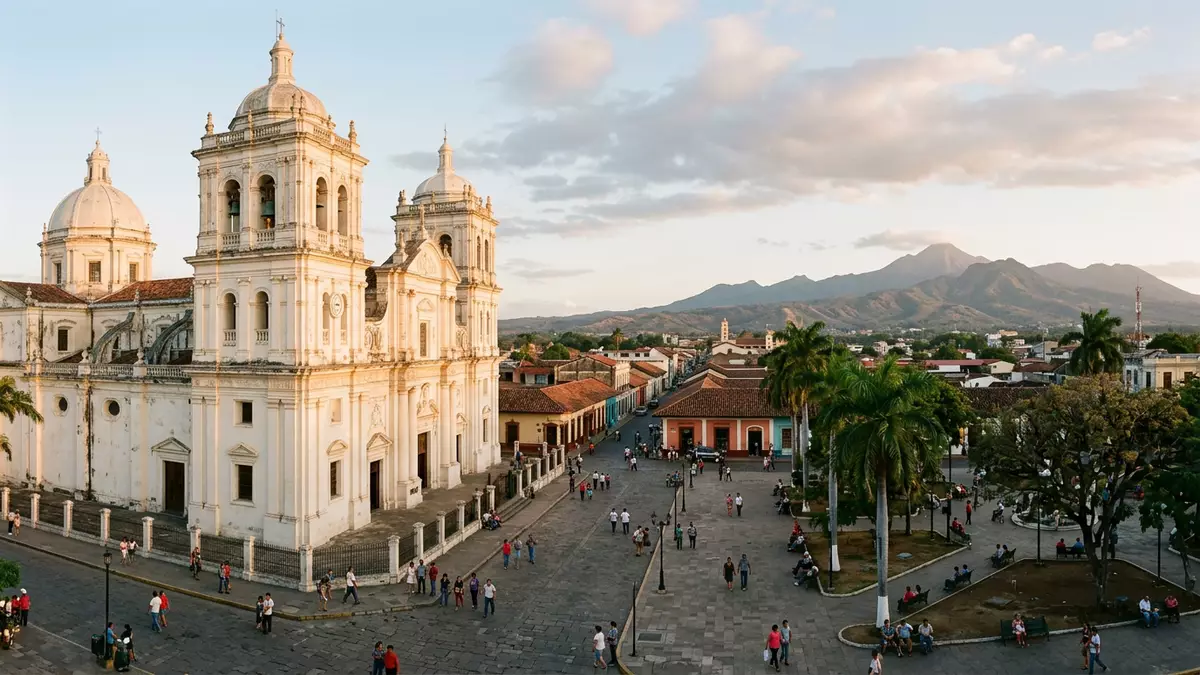
Catedral de Leon dominates the centre of Leon in western Nicaragua, a vast white basilica whose broad roof and interior chapels have become part of the city’s daily life. Built in the late colonial period in the eighteenth century and completed in 1814, it anchors the main square and carries the history of the diocese and of Nicaragua in its walls.
A colonial basilica between Baroque and Neoclassical
The official name of Catedral de Leon is the Royal and Renowned Basilica Cathedral of the Assumption of the Blessed Virgin Mary, a Roman Catholic cathedral raised over several decades between 1747 and 1814.Royal and Renowned Basilica Cathedral The project is attributed to the Guatemalan architect Diego José de Porres Esquivel, who worked from a rectangular basilica layout common in Spanish America at the time.architect Diego José de Porres Esquivel
The cathedral’s architecture reflects the transition from late Baroque to Neoclassical style, with a sober façade and thick, relatively low towers described in UNESCO documentation as a regional response to earthquake risks.transition from late Baroque to Neoclassical Inside, large barrel vaults span the nave and side aisles, and light filters down onto pale walls and chapels that frame altarpieces and devotional images. The overall plan measures a little over 100 m (328 ft) in length and more than 50 m (164 ft) in width, giving the interior a horizontal, expansive character rather than a sharply vertical one.105.83 m long by 57.13 m wide
A national monument and World Heritage site
Catedral de Leon is recognised as a national monument of Nicaragua and is the seat of the Roman Catholic Diocese of Leon, with roots in one of the earliest dioceses in the Americas.main historic monument of Nicaragua In 2011, the cathedral was inscribed on the UNESCO World Heritage List under cultural criteria (ii) and (iv), highlighting its architectural significance and its role as an expression of Latin American society in the colonial period.inscribed on the World Heritage List in 2011
The World Heritage listing emphasises how the building merges a Spanish-derived basilica plan with proportions and decorative details characteristic of Central America, particularly those associated with Antigua Guatemala Baroque architecture.Antigua Guatemala Baroque architectural style Low, massive towers, thick walls and a restrained exterior are paired with richer interior ornament in selected areas, such as the sanctuary vault and the main altar. The cathedral’s status as a World Heritage site places it alongside León Viejo, the earlier colonial settlement nearby, in the small group of Nicaraguan properties recognised at this level.second Nicaraguan site on the UNESCO list
Inside the cathedral and on its broad roof
The interior of Catedral de Leon is laid out as a large nave with side aisles and chapels, opening towards the main sanctuary. Among the notable works of art is a Flemish altar and a cycle of paintings representing the fourteen Stations of the Cross by Nicaraguan artist Antonio Sarria, begun at the end of the nineteenth century and completed in the early twentieth century.altar flamenco and Stations of the Cross The cathedral also houses tombs of writers and national figures in side chapels and crypts, turning the building into a kind of cultural pantheon.
One of the most striking experiences associated with Catedral de Leon is the possibility to access its roof, a broad, gently undulating surface rendered in bright white lime that contrasts with the darker interior below.roof access From this upper level, domes and towers frame views over Leon’s low-rise streets and towards distant volcanoes on clear days. The roof’s balustrades, cupolas and small details reveal how the architecture was finished and maintained above the façades that face the square.
Visiting Catedral de Leon: what travellers from Western Europe should know
- Catedral de Leon stands on the central square of Leon, known as Plaza Parque Juan José Quezada, and is reached along the grid of streets that organise the city’s historic core.
Regional buses connect Leon with Managua and other Nicaraguan towns, while international travellers usually arrive through the main airport serving Managua. - The cathedral interior involves walking across stone floors and using stairways to reach chapels or higher levels; roof access uses a staircase within one of the towers, where steps are narrow and enclosed.
- Nearby landmarks include the Mercado Central on the eastern side of the cathedral and civic buildings such as the Episcopal Palace and the Museo de la Revolución within a short walk of the main doors.
- The official language is Spanish and the currency is the Nicaraguan córdoba.
- Entry requirements depend on your nationality; UK travellers can check the FCDO travel advice at gov.uk/foreign-travel-advice, Irish travellers the Department of Foreign Affairs at ireland.ie.
Searching for Catedral de Leon on social platforms
These links open searches for Catedral de Leon on each platform.
Frequently asked questions about Catedral de Leon
Where is Catedral de Leon located?
Catedral de Leon stands in the colonial centre of Leon in western Nicaragua, facing the main square and forming part of the historic urban block around Plaza Parque Juan José Quezada.
What can visitors expect inside Catedral de Leon?
Visitors encounter a large basilica interior with side chapels, an ornate sanctuary vault, artworks including a Flemish altar and Stations of the Cross paintings, and access routes leading towards crypts and upper levels.
What makes Catedral de Leon distinctive among Central American churches?
The building combines late Baroque and Neoclassical architecture on a grand scale, with thick earthquake-conscious towers, a wide rectangular plan and World Heritage recognition that underlines its importance for Nicaragua and Central America.


