
Catedral de Burgos and its forest of Gothic stone
Published on 09/23/2026 at 23:36 | Editorial responsibility: Rafael Müller, Editor-in-Chief AD HOC NEWS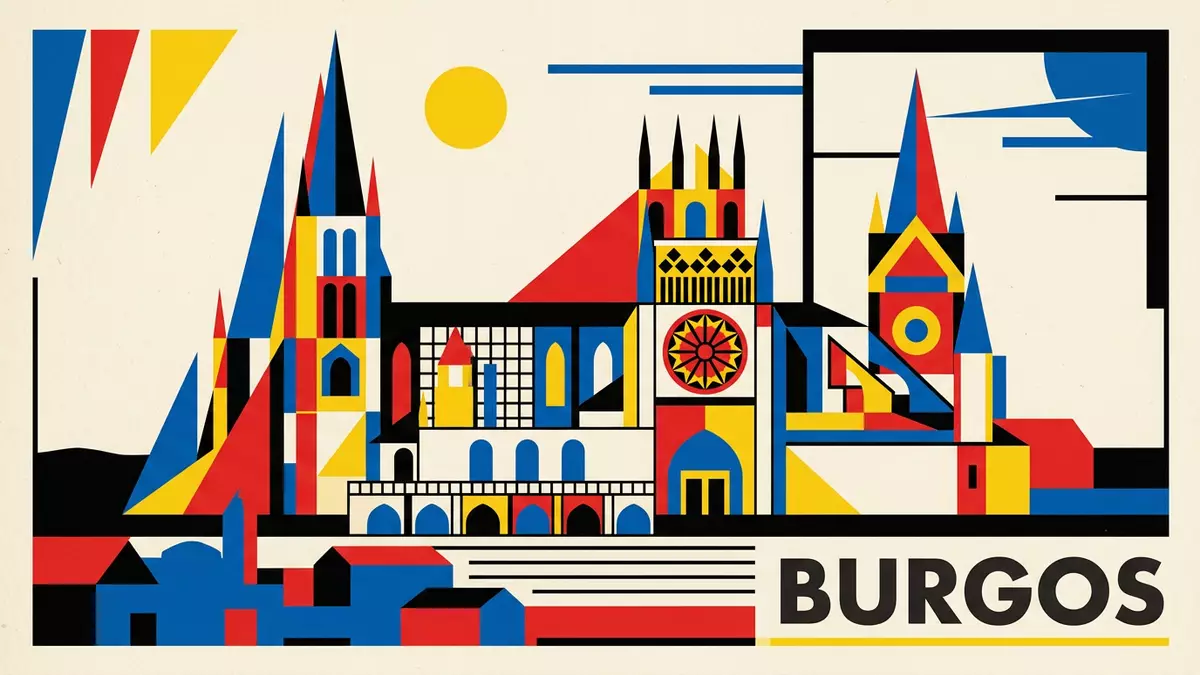
Catedral de Burgos rises from Plaza de Santa María as a Gothic cathedral shaped by four centuries of building and artistic change. Its openwork spires, sculpted portals and lantern dome form a stone skyline, while paintings, choir stalls, tombs and stained glass fill the interior.
Catedral de Burgos begins with French Gothic
Construction began in 1221 during the reign of Ferdinand III of Castile. The cathedral follows a Latin-cross plan measuring 84 by 59 metres, with elevations, vaults and window tracery related to northern French Gothic models. The Latin-cross plan records the building’s large scale and formal clarity.
The cathedral was completed in 1567, after work had resumed in the middle of the fifteenth century. Its fabric brings together High Gothic foundations, later Gothic embellishment, Renaissance works and Baroque additions. The result is not a single-period monument, but a continuous architectural record from the thirteenth to the eighteenth century.
Openwork spires, chapels and the lantern dome
The western facade is crowned by slender openwork spires associated with Juan de Colonia and his son Simón. Their stone tracery contrasts with the broad walls and sculpted portals below, including the Puerta del Sarmental and the Puerta de la Coronería.
Inside, the Capilla del Condestable occupies a prominent place behind the main altar. The chapel combines late Gothic forms with work by the Colonia family, Diego de Siloé and Felipe Vigarny. Its vault, heraldic decoration, tombs and altarpiece belong to the dense artistic world of fifteenth- and sixteenth-century Castile. The cathedral’s chapels also include Santa Ana, Santa Tecla, San José and the Presentation.
El Cid beneath the crossing
Catedral de Burgos is also a funerary monument linked with Rodrigo Díaz de Vivar, known as El Cid, and his wife Doña Jimena. Their remains were placed beneath the cimborrio in 1921, at the centre of the crossing.
The crossing dome joins several layers of the cathedral’s history. A Gothic-Plateresque structure raised by Juan de Colonia was reconstructed by Juan de Vallejo in the sixteenth century. Beneath it, the tomb of El Cid and Jimena connects the building’s religious setting with medieval Castilian history. The crossing burial is marked by a simple floor monument.
Other details reward attention: the Golden Staircase by Diego de Siloé, the choir, the retables and the cathedral clock figure known as the Papamoscas. Together, these works give the interior a changing register of sculpture, painting, metalwork, mechanics and coloured glass.
Visiting Catedral de Burgos: what travellers from Western Europe should know
- Catedral de Burgos stands on Plaza de Santa María in the historic centre of Burgos. The city lies on the Camino de Santiago, and the cathedral is reached through the old town near the Arco de Santa María.
- The building is an extensive stone complex with chapels, cloisters, transepts and a museum. A visit involves moving between broad nave spaces, enclosed chapels and stairways.
- The official language is Spanish and the currency is the euro.
- Nearby landmarks include the Arco de Santa María, the Plaza Mayor and the River Arlanzón. The cathedral’s address is Plaza de Santa María, Burgos.
Searching for Catedral de Burgos on social platforms
These links open searches for Catedral de Burgos on each platform.
Frequently asked questions about Catedral de Burgos
Where is Catedral de Burgos?
Catedral de Burgos stands on Plaza de Santa María in the historic centre of Burgos, in Castilla y León, northern Spain. It is close to the Arco de Santa María and the Camino de Santiago route through the city.
What can visitors expect inside?
The interior contains a Latin-cross layout, chapels, cloisters, tombs, retables, choir stalls, stained glass and the Golden Staircase. The spaces combine Gothic, Renaissance and Baroque works.
What makes Catedral de Burgos distinctive?
Its construction began in 1221 and ended in 1567, bringing several centuries of Gothic development into one cathedral. El Cid and Doña Jimena lie beneath the crossing dome, while openwork spires crown the facade.


