
Cataratas del Iguazu: a waterfall spread across a basalt frontier
Published on 09/24/2026 at 04:23 | Editorial responsibility: Rafael Müller, Editor-in-Chief AD HOC NEWS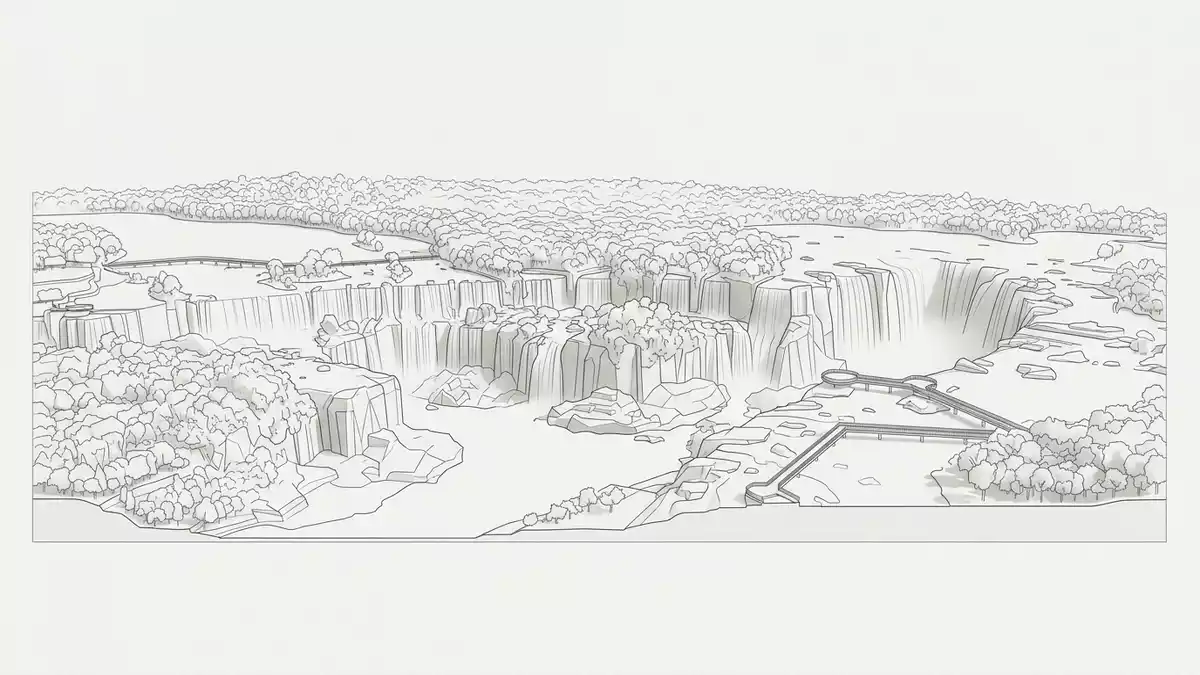
Cataratas del Iguazu is a broad waterfall system on the Iguazu River, where Brazil and Argentina meet. Its cascades extend across a basalt frontier, with forested islands and deep channels dividing the water into a succession of falls.
The main Brazilian access lies in Foz do Iguacu, while the Argentine side is reached from Puerto Iguazu. The landscape belongs to two national parks and carries a Guarani name associated with “great water”.
Basalt, islands and the great water
The waterfall front forms a sweeping arc about 2,700 metres (8,858 ft) wide. The central cataract rises to roughly 80 metres (262 ft), while individual drops occupy channels separated by islands, rocks and wooded strips.
The visible drama comes from the relationship between moving water and volcanic rock. The Iguazu River crosses a basalt plateau before dropping into a gorge, creating ledges, curtains and plunges across the frontier.
The system is not a single uninterrupted wall. It is a landscape of separate falls, channels and islands, with the exact appearance changing according to the river’s flow. The forest remains close to the water on both national-park sides.
Devil’s Throat and the river frontier
Garganta del Diablo, or Devil’s Throat, is the best-known section of Cataratas del Iguazu. Water gathers in a broad chasm and drops through a concentrated central section surrounded by spray and dark basalt.
The river itself forms the international boundary in this part of South America. The Brazilian and Argentine national parks therefore present different viewpoints of the same geological system, with Foz do Iguacu facing the Brazilian sector and Puerto Iguazu facing the Argentine sector.
The name Iguazu comes from Guarani language. It is linked to words for water and greatness, a description preserved in the name of the river, the falls and the protected landscapes on both sides.
A protected landscape with a long human history
Guarani communities knew the river and its falls before European expeditions reached the region. Álvar Núñez Cabeza de Vaca recorded the waterfalls during a Spanish expedition in 1541, bringing them into European written accounts.
Argentina created Iguazú National Park in 1934, followed by Iguaçu National Park in Brazil in 1939. The two protected areas preserve the waterfall system within subtropical Atlantic Forest, a habitat associated with dense vegetation and varied wildlife.
UNESCO inscribed Iguazú National Park in Argentina as a World Heritage site in 1984. Iguaçu National Park in Brazil received the same status in 1986, placing the two sides within an international framework of natural conservation.
The geological setting reaches far beyond the visible cascades. Volcanic processes dating back around 500 million years shaped the wider landscape, while basalt layers define the river’s dramatic descent.
Visiting Cataratas del Iguazu: what travellers from Western Europe should know
- The Brazilian sector lies in Foz do Iguacu, in Paraná. Road access uses BR-469, and public transport includes the route known as Line 120 to the national park.
- The Argentine sector lies in Misiones Province, beside Puerto Iguazu. Internal movement includes a park railway linking Central Station with Cataratas and Garganta stations.
- The surrounding terrain combines forest, exposed basalt, river channels and viewpoints near the waterfall edge. Walkways and steps form part of the experience on both sides.
- The official language is Portuguese in Brazil and Spanish in Argentina; the currencies are the Brazilian real and the Argentine peso.
Searching for Cataratas del Iguazu on social platforms
These links open searches for Cataratas del Iguazu on each platform.
Frequently asked questions about Cataratas del Iguazu
Where are Cataratas del Iguazu?
The falls lie on the Iguazu River between Brazil and Argentina. Foz do Iguacu is the principal Brazilian city, while Puerto Iguazu is the Argentine gateway.
What can visitors expect from the landscape?
Visitors encounter forest, basalt, islands, channels and viewpoints around a wide system of cascades. Devil’s Throat forms the most concentrated section.
What makes the waterfalls distinctive?
Cataratas del Iguazu combines a waterfall front about 2,700 metres (8,858 ft) wide with a border shared by two countries. Its Guarani name connects the landscape with the region’s Indigenous history.


