
Cataratas del Iguazu, a monumental waterfall frontier
Published on 09/21/2026 at 23:26 | Editorial responsibility: Rafael Müller, Editor-in-Chief AD HOC NEWS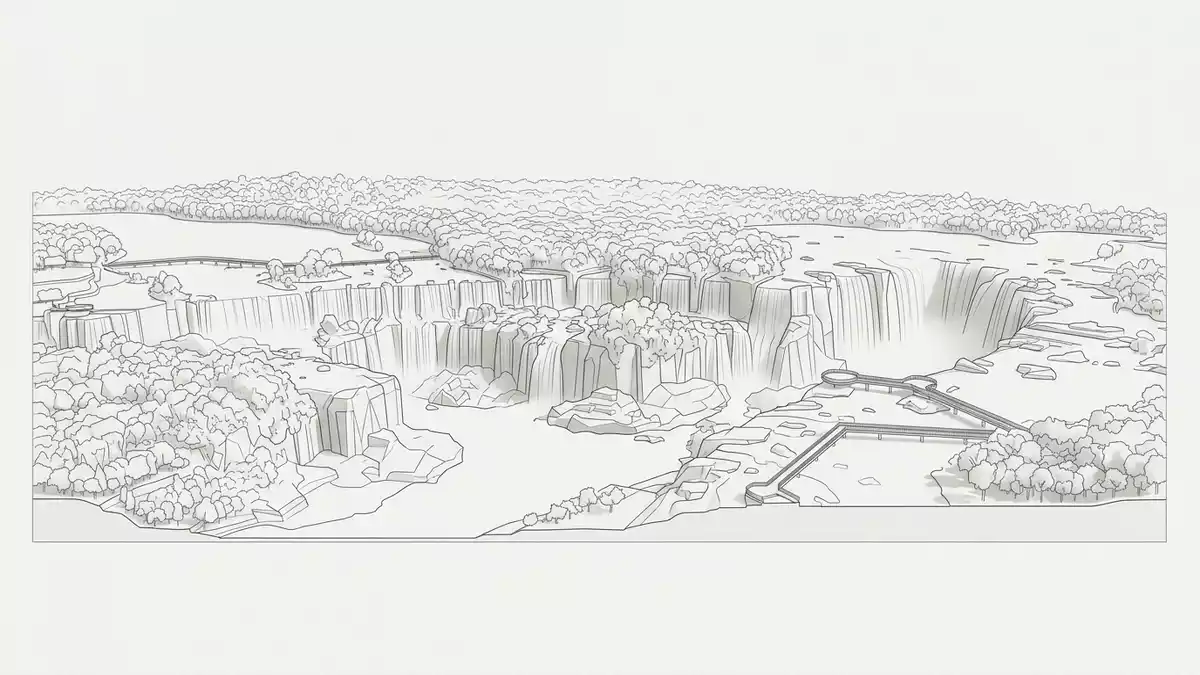
Cataratas del Iguazu, known in English as Iguazu Falls, forms an extensive system of waterfalls on the Iguazu River between Foz do Iguacu in Brazil and Puerto Iguazu in Argentina, where the river plunges from a basalt plateau into a deep canyon.
A crescent of water on the Iguazu River border
Cataratas del Iguazu occupies a stretch of the Iguazu River that marks part of the international boundary between Brazil’s Paraná State and Argentina’s Misiones Province. The waterfall system lies roughly 23 km (14 mi) upstream from the confluence of the Iguazu and Paraná rivers near the tri-border region shared by Argentina, Brazil and Paraguay.23 km above the Paraná On the Brazilian side, visitors approach from Foz do Iguacu, while the Argentine walkways begin near Puerto Iguazu, giving two distinct vantage points onto the same river gorge.Brazil–Argentina border setting
The Iguazu River itself is a tributary of the Paraná River and forms a natural boundary between Paraná State and Misiones Province along much of its lower course.River as frontier At Cataratas del Iguazu the river drops off the edge of the Paraná Plateau into a narrow gorge, dividing into upper and lower reaches around the canyon carved by the water. The waterfall front follows a basalt escarpment that arcs in a broad curve, creating a wide curtain of cascades framed by subtropical forest.
Basalt plateau and subtropical forest
Geologically, Cataratas del Iguazu marks the point where the Iguazu River falls from the Paraná Plateau, a tableland built from extensive basaltic lava flows of the Serra Geral Formation.Paraná Plateau and Serra Geral basalt These dark volcanic rocks, laid down during the Cretaceous period, give the escarpment its characteristic colour and stepped profile as the river cuts across successive layers. Over millions of years, erosion has shaped the plateau edge into a complex sequence of ledges and recesses that break the water into multiple cataracts.
The surrounding landscape forms part of the Atlantic Forest biome, a subtropical rainforest belt that once covered wide areas of eastern South America. Around Cataratas del Iguazu this forest clads the canyon walls and plateau rim, creating dense green cover around the river. The humid climate and varied topography support a rich mix of trees, lianas and understorey plants, along with fauna ranging from birds to mammals that inhabit both the forest interior and the river margins.Atlantic Forest ecosystem
World Heritage protection on both banks
Cataratas del Iguazu is protected within two national parks that face one another across the river: Iguazú National Park in Argentina and Iguaçu National Park in Brazil.Iguazú and Iguaçu National Parks The Argentine park was inscribed on the UNESCO World Heritage List in 1984, recognising its natural value and biodiversity, and the Brazilian park followed in 1986 with a separate inscription covering the opposite bank.World Heritage listings in 1984 and 1986 Together, these protected areas safeguard the waterfall system and extensive tracts of Atlantic Forest.
The falls are also recognised within geoheritage frameworks that highlight their geological significance. The escarpment forms a semicircular waterfall front around 2,700 m (8,858 ft) long and around 75 m (246 ft) high, with hundreds of individual cataracts distributed along the rim.dimensions of the waterfall front In this sector the Iguazu River discharges large volumes of water into the gorge, creating sprays and mist plumes that rise above the canyon and interact visually with the forested slopes.
Approaching Cataratas del Iguazu from Foz do Iguacu
From Brazil, Foz do Iguacu serves as the main urban gateway to Cataratas del Iguazu. The city lies in Paraná State close to the Paraguay border, and road links connect its urban area with the entrance of Iguaçu National Park. Within the park, paved routes and designated viewpoints lead towards the rim of the canyon, where walkways and terraces give panoramic views across the river to the Argentine side and down into the gorge where the water drops.
On the Argentine bank, access runs from Puerto Iguazu in Misiones Province into Iguazú National Park, where trails and structures reach the plateau edge at several points along the waterfall front.Argentine park access Together, the two park systems frame Cataratas del Iguazu within a protected landscape that includes forest, river islands and canyon viewpoints, while the tri-border region nearby adds a geopolitical dimension to the setting.
Visiting Cataratas del Iguazu: what travellers from Western Europe should know
- Cataratas del Iguazu lies on the Iguazu River at the frontier between Brazil’s Paraná State and Argentina’s Misiones Province, reached from the cities of Foz do Iguacu and Puerto Iguazu by road.
- The main viewpoints in Iguaçu and Iguazú National Parks stand on the rim of a canyon carved into a basalt plateau, and reaching them involves walking on established paths and boardwalks with some sections of steps.
- The surrounding region forms part of the subtropical Atlantic Forest, and the proximity of the tri-border area means that Argentina, Brazil and Paraguay lie within a short radius of the waterfall system.
- The official language is Portuguese in Brazil and Spanish in Argentina, and the currencies are the Brazilian real and the Argentine peso.
- Entry requirements depend on your nationality; UK travellers can check the FCDO travel advice at gov.uk/foreign-travel-advice, Irish travellers the Department of Foreign Affairs at ireland.ie.
Searching for Cataratas del Iguazu on social platforms
These links open searches for Cataratas del Iguazu on each platform.
Frequently asked questions about Cataratas del Iguazu
Where are Cataratas del Iguazu located?
Cataratas del Iguazu lies on the Iguazu River at the border between Argentina’s Misiones Province and Brazil’s Paraná State, near the cities of Foz do Iguacu and Puerto Iguazu.
What should visitors expect on a visit?
Visitors encounter an extensive waterfall front dropping from a basalt plateau into a canyon, reached via park roads, designated trails and constructed viewpoints within subtropical forest.
What makes Cataratas del Iguazu distinctive among waterfalls?
The site combines a long, curved escarpment carrying many cataracts with protection by paired national parks on both banks and recognised World Heritage status for the waterfall system and surrounding Atlantic Forest.


