
Cataratas del Iguazu, a basalt waterfall frontier
Published on 09/14/2026 at 13:27 | Editorial responsibility: Rafael Müller, Editor-in-Chief AD HOC NEWS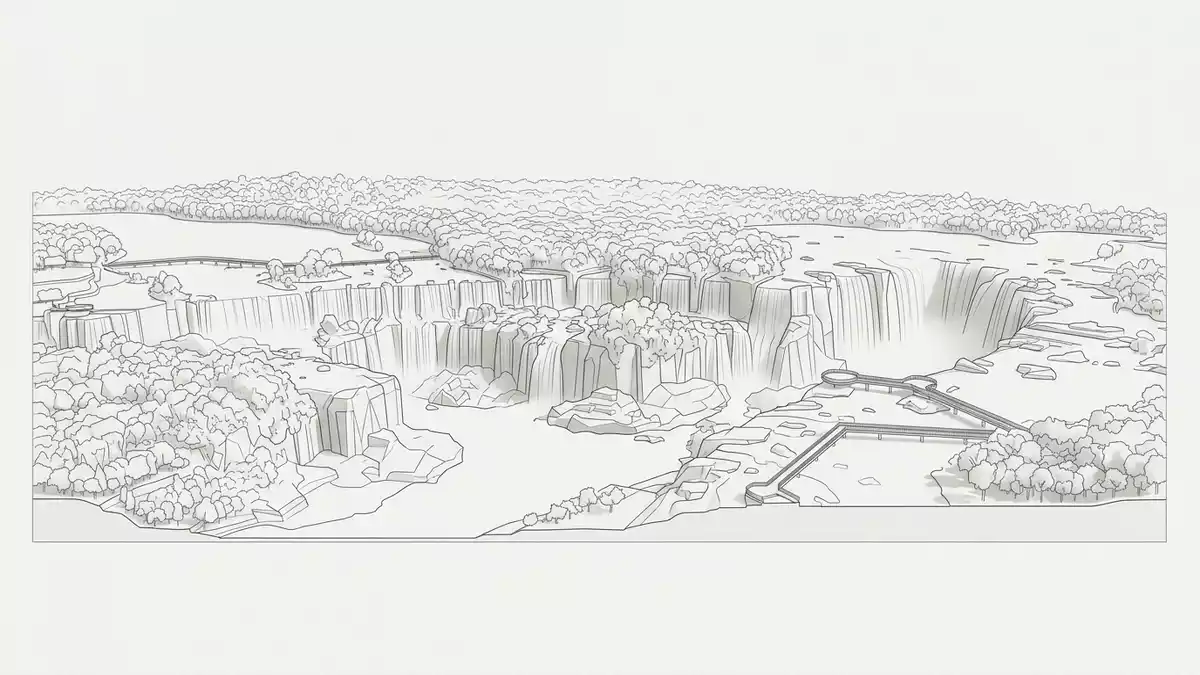
Cataratas del Iguazu, known in English as Iguazu Falls, forms a sweeping chain of waterfalls where the Iguazu River drops over a dark basalt escarpment on the frontier between Brazil and Argentina. The cascades lie between Misiones Province in northeastern Argentina and Paraná State in southern Brazil, close to the cities of Puerto Iguazu and Foz do Iguacu, and are protected inside two adjoining national parks recognised as World Heritage sites in the 1980s.
A crescent of water on the Iguazu River
The defining feature of Cataratas del Iguazu is the way the Iguazu River breaks into multiple channels and plunges in a broad arc along the edge of a volcanic plateau. The waterfall system runs for around 2.7 km (1.7 mi) along the rim, forming a crescent-shaped curtain where water spills from the upper river terrace towards the Paraná River basin below.semicircular waterfall The falls stand at the point where the Iguazu River marks the international border, so the flowing water and rising mist belong to Brazil and Argentina at the same time.located on the Iguazu River
The river drops in a succession of cascades that together form a complex system rather than a single plunge. Many individual waterfalls line up beside and behind one another, separated by rock ledges and islands of forest, so that from many vantage points the visitor sees overlapping walls of water. One of the most dramatic sections is the Garganta del Diablo, or Devil’s Throat, a deep chasm where water falls from the upper rim to the lower level in a powerful torrent that concentrates a large share of the river’s flow.Garganta del Diablo
Basalt bedrock and Atlantic Forest
Cataratas del Iguazu sits on a foundation of basalt laid down by ancient volcanic activity, and the hard, dark rock governs the overall form of the waterfall front. The plateau upstream is built of successive basalt layers, with softer rock beneath, so the river has carved back into the edge of the formation and left a marked step in the landscape.volcanic plateau The drop at the main semicircular section reaches around 80 m (262 ft), giving the falls their scale without approaching the height of the tallest waterfalls elsewhere.around 80 m high
Around the river, dense subtropical forest of the Atlantic Forest biome covers the plateau and the gorge. Broadleaf trees rise above an understorey of shrubs and ferns, and epiphytes cling to trunks and branches in the humid air. Both national parks protect large tracts of this woodland, which extends well beyond the immediate vicinity of the waterfalls and shelters mammals, birds and other species adapted to humid forest terrain.Atlantic Forest biome The contrast between the dark rock, the green canopy and the white water gives Cataratas del Iguazu a distinctive visual character that is visible from viewpoints on both sides of the border.
Two national parks and a shared World Heritage site
The Argentine side of Cataratas del Iguazu lies within Iguazú National Park in Misiones Province, while the Brazilian side belongs to Iguaçu National Park in Paraná State.Iguazú National Park in Misiones The two parks meet along the course of the Iguazu River, whose channel forms both the line of the falls and the border between the countries.national park in Paraná State Iguazú National Park in Argentina was inscribed on the UNESCO World Heritage List in 1984 as a natural site, recognising the scenic qualities of the falls and the surrounding forest.inscribed on the World Heritage List in 1984
Two years later, in 1986, Iguaçu National Park in Brazil received its own inscription as a World Heritage property, confirming the binational nature of the protected landscape.World Heritage property in Brazil Together, the parks cover a large area of forest and river corridor around Cataratas del Iguazu, creating one of South America’s major continuous conservation zones for Atlantic Forest and securing the waterfall system as a shared natural landmark for Brazil and Argentina.transboundary conservation area
Visiting Cataratas del Iguazu: what travellers from Western Europe should know
- Cataratas del Iguazu lies on the Iguazu River between Puerto Iguazu in Argentina and Foz do Iguacu in Brazil, reached through Iguazú National Park on the Argentine side and Iguaçu National Park on the Brazilian side.
- Walkways and viewpoints in both parks follow the edges of the gorge and river terraces, and approaches involve stretches on foot along paths and stairways near the waterfall rim.
- The falls stand in subtropical lowland forest, with humid conditions around the gorge and spray rising from the waterfall front, so paths and platforms near the cascades can be wet.
- The official languages here are Spanish on the Argentine side and Portuguese on the Brazilian side, and the currencies are the Argentine peso and the Brazilian real.
- Entry requirements depend on your nationality; UK travellers can check the FCDO travel advice at gov.uk/foreign-travel-advice, Irish travellers the Department of Foreign Affairs at ireland.ie.
Searching for Cataratas del Iguazu on social platforms
These links open searches for Cataratas del Iguazu on each platform.
Frequently asked questions about Cataratas del Iguazu
Where are Cataratas del Iguazu located?
Cataratas del Iguazu lies on the Iguazu River at the border between northeastern Argentina and southern Brazil, near Puerto Iguazu and Foz do Iguacu.
What can visitors expect on a visit?
Visitors encounter a long front of waterfalls dropping from a basalt plateau into a gorge, with forested surroundings and walkways and viewpoints on both the Argentine and Brazilian sides.
What makes Cataratas del Iguazu distinctive?
The falls combine a wide crescent of water, basalt bedrock and Atlantic Forest, and the whole system is shared between two adjoining national parks recognised together as a World Heritage landscape.


