
Castillo San Felipe del Morro and the six-tier seaward fortress of San Juan
Published on 08/30/2026 at 10:36 | Editorial responsibility: Rafael Müller, Editor-in-Chief AD HOC NEWS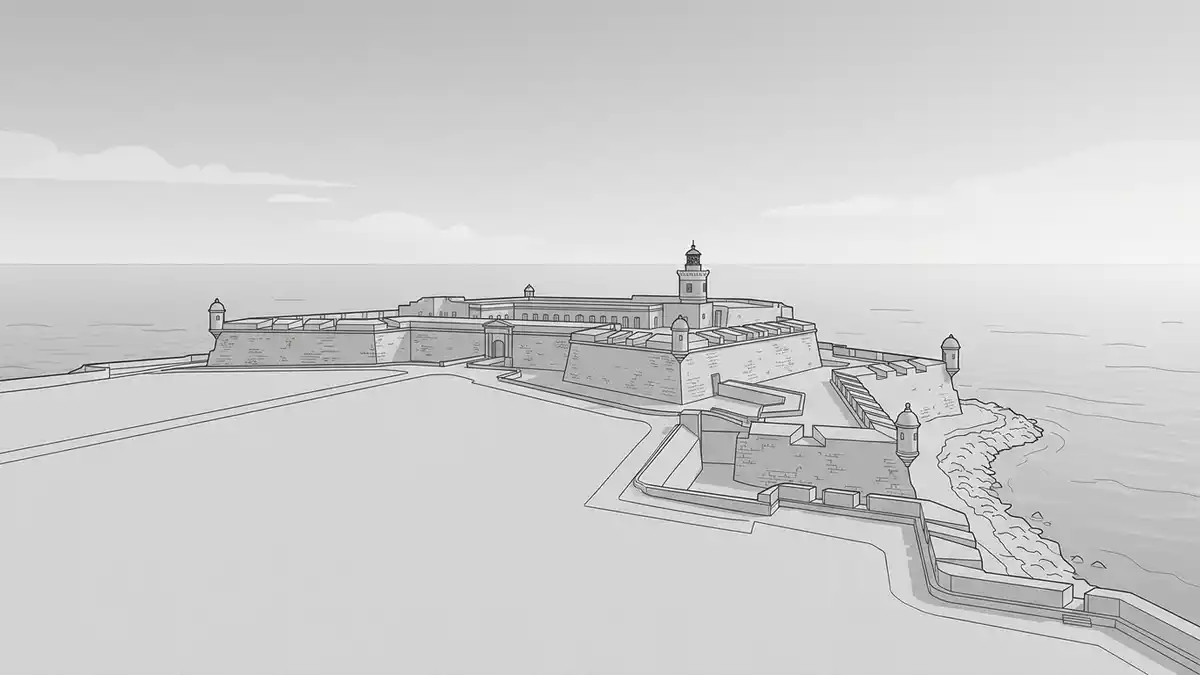
Castillo San Felipe del Morro rises above the entrance to San Juan Bay as a layered stone fortress, its six main levels stepping down towards the Atlantic along a rocky headland. Built by the Spanish Crown from 1539 into the late eighteenth century, it concentrates centuries of military architecture into one compact promontory overlooking the sea.
From medieval tower to bastioned Atlantic citadel
Construction of Castillo San Felipe del Morro began in 1539 under King Charles I of Spain, with an early fortified tower guarding the harbour entrance on the north-western tip of San Juan. Over the following generations it grew into a full citadel named for King Philip II, whose reign framed the transition from that first tower to a more complex coastal stronghold.Construction began in 1539 The fortress stands as part of San Juan National Historic Site, a protected ensemble of Spanish colonial defences that also includes the city walls and other forts around the old town.San Juan National Historic Site
The outline visible today took shape between the sixteenth and eighteenth centuries as Spanish engineers reworked the site into a bastioned coastal fortress facing the Atlantic. Italian military engineers Bautista Antonelli and Juan Bautista Antonelli played a defining role in this transformation in the late sixteenth and early seventeenth centuries, replacing the earlier tower layout with thick masonry walls and angled outer works designed to resist cannon fire.Italian military engineers Bautista Antonelli and Juan Bautista Antonelli By 1787 the six-level fortress was regarded as complete, the result of more than two centuries of continuous adaptation to changing forms of attack.Completed in 1787
Six levels stepping from lighthouse to surf
Seen from land or sea, Castillo San Felipe del Morro reads as a stack of stone platforms cut into a 140 m (459 ft) high promontory, each level aligned to cover a different approach to the harbour mouth.Promontory above the bay The uppermost level holds a courtyard, barracks ranges and the lighthouse that crowns the headland, while lower terraces carry gun batteries, vaulted storerooms and lookout posts facing the open ocean.Gun platforms and lighthouse
From the landward side, visitors cross a broad green glacis before reaching the main entrance and passing through stone gateways into the interior levels. Inside, spiral staircases and sloping ramps link the terraces, with long barrel-vaulted corridors leading towards casemates once used as barracks and storerooms. Along the seaward walls, sentry boxes project over the cliffs, marking positions where soldiers watched the approaches to San Juan Bay and the Atlantic horizon.
Battles, empires and a World Heritage designation
Castillo San Felipe del Morro formed the seaward keystone of Spain’s Caribbean defence system and saw repeated action against rival European powers. English forces under Sir Francis Drake attacked San Juan in 1595, followed by an assault led by the Earl of Cumberland in 1598, and Dutch forces again in 1625; in each case the fortress and its batteries played a central role in defending the harbour approaches.Assaults by Drake and Dutch forces During the Spanish-American War in 1898, United States Navy ships bombarded the fort and destroyed the lighthouse, which was subsequently rebuilt in a new form.Bombardment in 1898
After the end of Spanish rule, the fortress entered a new phase under United States control. In the twentieth century it formed part of Fort Brooke and gained an artillery fire control station during the Second World War, reflecting the strategic value of San Juan Bay in a different military era.World War II structures In 1961 responsibility passed to the National Park Service, which incorporated Castillo San Felipe del Morro into San Juan National Historic Site; the wider historic fortifications, including El Morro, were inscribed as a UNESCO World Heritage Site in 1983.UNESCO World Heritage Site in 1983
Visiting Castillo San Felipe del Morro: what travellers from Western Europe should know
- Castillo San Felipe del Morro stands on the north-western tip of Old San Juan, on a headland projecting between the Atlantic Ocean and the entrance to San Juan Bay.
- The approach from the old city crosses a large grassy slope before reaching the fort; inside, movement between the six levels involves staircases, ramps and uneven stone surfaces.
- The site forms part of San Juan National Historic Site in Puerto Rico, an unincorporated territory of the United States where the official languages are Spanish and English and the currency is the United States dollar.
- Entry requirements depend on your nationality; UK travellers can check the FCDO travel advice at gov.uk/foreign-travel-advice, Irish travellers the Department of Foreign Affairs at ireland.ie.
Searching for Castillo San Felipe del Morro on social platforms
These links open searches for Castillo San Felipe del Morro on each platform.
Frequently asked questions about Castillo San Felipe del Morro
Where is Castillo San Felipe del Morro located?
Castillo San Felipe del Morro stands on a high headland at the north-western end of Old San Juan, overlooking both the Atlantic Ocean and the entrance to San Juan Bay.
What can visitors expect inside the fortress?
Visitors enter through stone gateways into a sequence of six levels linked by ramps and staircases, with open courtyards, vaulted barracks, artillery terraces and sentry boxes above the sea.
What makes Castillo San Felipe del Morro distinctive among Caribbean forts?
Its long construction history from 1539 to the late eighteenth century, six-tier layout on a rocky promontory and role within San Juan National Historic Site give the fortress a particularly layered character.


