
Castillo San Felipe del Morro and the layered defences of San Juan
Published on 09/14/2026 at 18:29 | Editorial responsibility: Rafael Müller, Editor-in-Chief AD HOC NEWS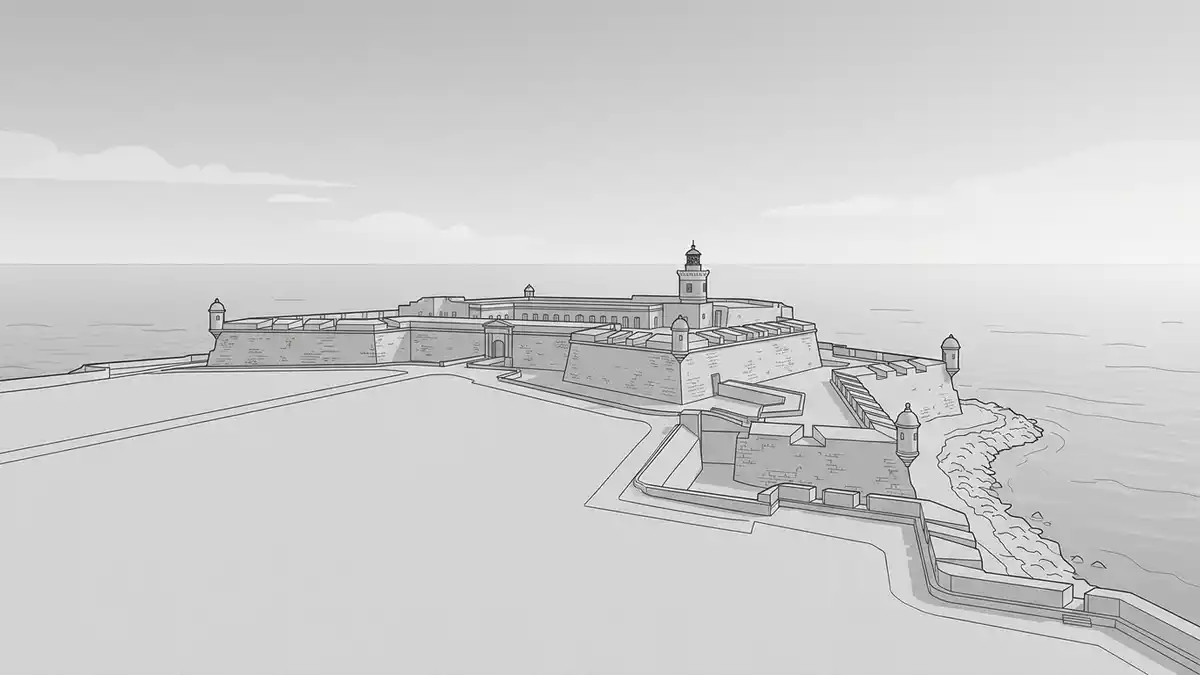
Castillo San Felipe del Morro rises above the entrance to San Juan Bay as a multi-level stone fortress, stacked in terraces that step down towards the Atlantic Ocean. Built under Spanish rule from the sixteenth century onwards, it anchors the western tip of Old San Juan and forms part of the San Juan National Historic Site, a UNESCO World Heritage property inscribed in 1983.
A promontory fortress shaped by Atlantic waters
The fortress occupies a rocky headland at the north-western edge of the San Juan Islet, where the Atlantic swell meets the mouth of the bay. From the outer lawns the stone mass appears as a layered rampart, its walls climbing from the shoreline to the upper platform where the main courtyard sitson the San Juan Islet. The position gave the fort its strategic character: batteries on successive levels face the open sea and the narrow channel, forming overlapping fields of fire that once guarded the harbour entranceover enemy ships approaching San Juan.
From the seaward side, El Morro’s walls present broad planes of masonry, tapering as they rise from a thick base into parapets and platforms. The main fortification spreads over several levels, connected by ramps and stairways that climb between gun terraces and lookout pointsacross its six tiers. Small domed sentry boxes known as garitas project from corners and bends in the upper walls, allowing guards to watch along the curtain walls and out to sea.
From sixteenth-century citadel to World Heritage site
Construction of the original fort began in 1539 under the Spanish Crown, as part of a wider effort to secure Caribbean trade routes and colonial centreswith a fortified entrance to the bay. Over the following centuries the structure was enlarged and reconfigured, with major works in the late eighteenth century giving El Morro much of its present formthrough extensive remodelling. The Italian engineer Juan Bautista Antonelli contributed redesigns in the late sixteenth century, introducing bastioned works and a more articulated defensive system.
In its completed form El Morro became the seaward cornerstone of a wider ensemble of walls and secondary forts enclosing Old San Juan. It repelled multiple attacks and sieges, including a Dutch assault in 1625 that damaged the town but left the improved landward defences standingfollowing additions to the hornwork. In the twentieth century the fort and its surrounding works were integrated into the San Juan National Historic Site, and in 1983 the ensemble, including Castillo San Felipe del Morro, was added to the UNESCO World Heritage Listas a colonial-era citadel.
Inside El Morro: ramps, courtyards and garitas
Entering the fortress, visitors move through a sequence of gates and sloping ramps that reveal successive defensive layers. The main courtyard occupies an upper terrace, framed by barracks and storage rooms set into the thick outer wallswithin the central enclosure. From here, tunnels and stairways lead down towards lower batteries closer to the water, where cannon once overlooked the sea channel and outer approaches.
Architecturally, El Morro combines functional military elements with the characteristic forms of Spanish colonial fortification. The stonework is predominantly cut masonry bonded with traditional mortars, giving the structure a solid, monolithic appearancein heavy sandstone walls. The garitas punctuate the outer profile, each a compact lookout chamber reached from the wall walk by a narrow passage. Their positions mark angles and corners where long views along the coastline and into the bay were most valuable.
Visiting Castillo San Felipe del Morro: what travellers from Western Europe should know
- Castillo San Felipe del Morro stands at the north-western tip of Old San Juan on the San Juan Islet, overlooking the entrance to San Juan Bay. It forms part of the San Juan National Historic Site administered by the U.S. National Park Service.
- The approach from Old San Juan leads across open lawns and paved paths before reaching the main gate. Inside the fortress, movement between levels involves sloping ramps, stairways and stone corridors, some of them narrow and with uneven surfaces.
- San Juan lies on the Atlantic coast of Puerto Rico, and the fort’s exposed position on a headland means wind, salt spray and strong sun can be present on the outer terraces.
- Spanish and English are both used around the site and in visitor information. The official currency is the United States dollar (USD).
- Entry requirements depend on your nationality; UK travellers can check the FCDO travel advice at gov.uk/foreign-travel-advice, Irish travellers the Department of Foreign Affairs at ireland.ie.
Searching for Castillo San Felipe del Morro on social platforms
These links open searches for Castillo San Felipe del Morro on each platform.
Frequently asked questions about Castillo San Felipe del Morro
Where is Castillo San Felipe del Morro located?
It stands on a headland at the entrance to San Juan Bay, on the San Juan Islet at the north-western end of Old San Juan in Puerto Rico.
What can visitors expect inside the fortress?
Inside El Morro are layered stone ramparts, a central courtyard, barrack rooms and gun terraces linked by ramps and stairways between several defensive levels.
What makes Castillo San Felipe del Morro distinctive?
Its multi-level Atlantic-facing batteries, thick masonry walls with projecting garitas, and its role within the Spanish colonial fortifications of San Juan give the site a distinctive character.


