
Castillo San Felipe del Morro and the layered defences of San Juan
Published on 08/21/2026 at 18:49 | Editorial responsibility: Rafael Müller, Editor-in-Chief AD HOC NEWS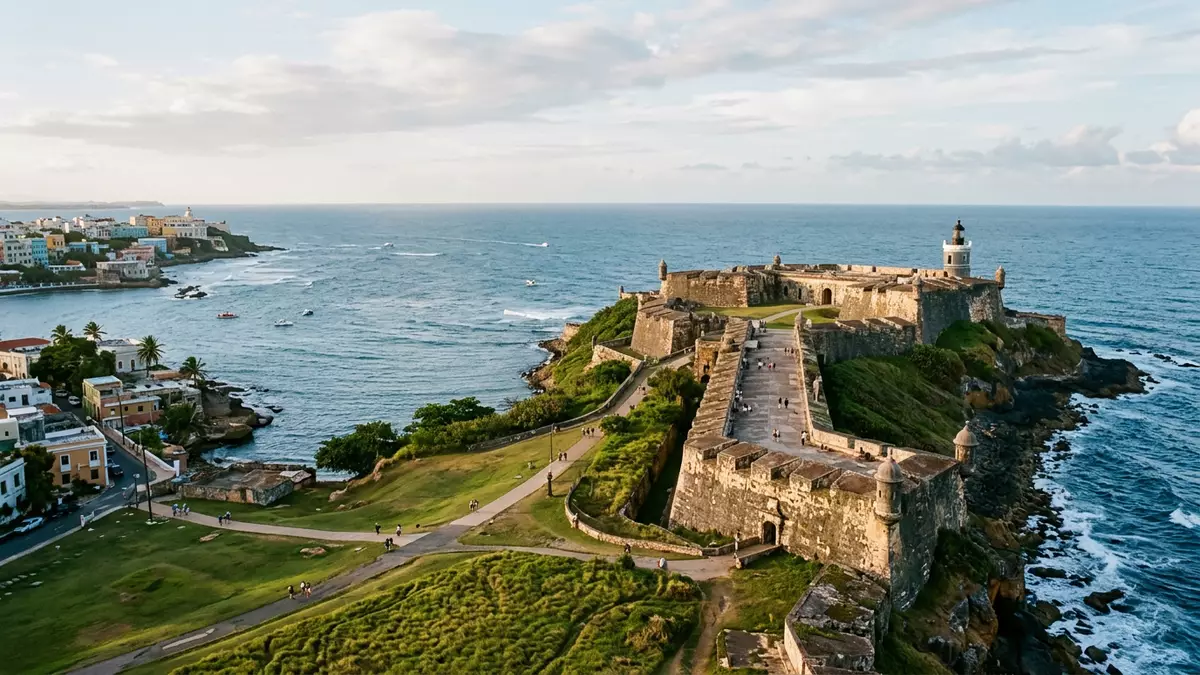
Castillo San Felipe del Morro in San Juan is a stepped stone fortress built on a headland above the Atlantic, where layered walls and terraces face the entrance to San Juan Bay. Its construction began under the Spanish Crown in 1539, and over the following centuries the complex grew into a multi-level bastioned stronghold with barracks, batteries and a lighthouse woven into the cliff.Construction of the fort began in 1539
Stone tiers above the Atlantic
El Morro occupies the north-western tip of Old San Juan, on a promontory that rises above the harbour mouth and the open ocean. Travellers approaching along the old city streets emerge onto a grassy esplanade, from which the fortress appears as a stack of masonry levels, each receding towards the lighthouse and upper ramparts.This massive sixteenth-century fortress The outward walls are high and thick, cut with batteries and defensive positions that face the channel and the Atlantic swells.
The architecture of Castillo San Felipe del Morro developed from an early fortified tower into a bastioned coastal citadel as military engineering advanced. Within the lower levels, stone ramps and passages connect platforms where cannon once covered the sea approaches, while higher terraces carry barracks, storerooms and the later lighthouse structure.Over the next 200 years El Morro continued to be developed The contrast between the exposed outer walls and the internal vaulted chambers is a defining spatial experience of the site.
Five centuries of fortification history
Work on the initial defence began under King Charles I of Spain in the sixteenth century, with the fort named in honour of King Philip II.Commissioned by King Charles I of Spain in 1539 In the late sixteenth and early seventeenth centuries, Italian military engineers Bautista Antonelli and Juan Bautista Antonelli reworked the site into a more complex bastion system, giving El Morro the thick masonry walls and angular outworks associated with early modern coastal forts.During the late 16th and early 17th century the distinguished Italian military engineers Bautista Antonelli and Juan Bautista Antonelli transformed El Morro
Over roughly two and a half centuries of construction and modification, the fortress acquired six main levels facing the Atlantic Ocean, each arranged to concentrate artillery fire on ships attempting to enter the bay.This fortress consists of 6 levels facing the Atlantic Ocean Its batteries and walls played a central role in the defence of San Juan during attacks in the late sixteenth and early seventeenth centuries, including assaults by Sir Francis Drake in 1595 and later by Dutch forces.The fort successfully repelled every major assault on San Juan The evolution of El Morro mirrors the broader history of Spain’s Caribbean strongholds and their role in Atlantic trade routes.
From Spanish citadel to heritage landscape
Castillo San Felipe del Morro remained a strategic military position into the nineteenth century, when the Spanish-American War brought bombardment from United States naval forces and damage to parts of the complex.After suffering severe damage during a US navy bombardment during the 1898 Spanish–American War Following the cession of Puerto Rico to the United States in 1898, the fort passed through further military use before being retired by the US Army in 1961 and transferred to the National Park Service as part of San Juan National Historic Site.In 1961, the US Army retired El Morro
El Morro’s significance is recognised through its inscription as a UNESCO World Heritage Site, alongside the wider fortifications of Old San Juan.It was declared a Unesco World Heritage site in 1983 The fortress grounds combine massive stone structures with open lawns, views across San Juan Bay and sightlines along the Atlantic coast, turning a former citadel into a landscape where military history, colonial architecture and the maritime setting are experienced together.
Visiting Castillo San Felipe del Morro: what travellers from Western Europe should know
- Castillo San Felipe del Morro stands at the north-western end of Old San Juan, on a headland that marks the entrance to San Juan Bay; the historic district is reached by road from the wider metropolitan area.
- Movement through the fortress involves climbing stone ramps and staircases between several levels, with some passages narrow and enclosed.
- The outer areas of the site are exposed to Atlantic weather, and the open lawns between the old city and the fort offer unobstructed views over the ocean and harbour.
- The official language is Spanish and the currency is the United States dollar.
- Entry requirements depend on your nationality; UK travellers can check the FCDO travel advice at gov.uk/foreign-travel-advice, Irish travellers the Department of Foreign Affairs at ireland.ie.
Searching for Castillo San Felipe del Morro on social platforms
These links open searches for Castillo San Felipe del Morro on each platform.
Frequently asked questions about Castillo San Felipe del Morro
Where is Castillo San Felipe del Morro located?
Castillo San Felipe del Morro stands on a promontory at the entrance to San Juan Bay, at the north-western edge of Old San Juan in Puerto Rico.
What can visitors expect when exploring the fortress?
Visitors move between several stone levels linked by ramps and staircases, passing batteries, barracks and vaulted chambers, with wide views over the harbour and the Atlantic.
What makes Castillo San Felipe del Morro distinctive among Caribbean forts?
Its long construction history from 1539 to the late eighteenth century, six-tiered Atlantic-facing design and later lighthouse mark it as a layered example of Spanish coastal fortification.


