
Castillo San Felipe del Morro and its layered Atlantic defences
Published on 08/27/2026 at 11:24 | Editorial responsibility: Rafael Müller, Editor-in-Chief AD HOC NEWS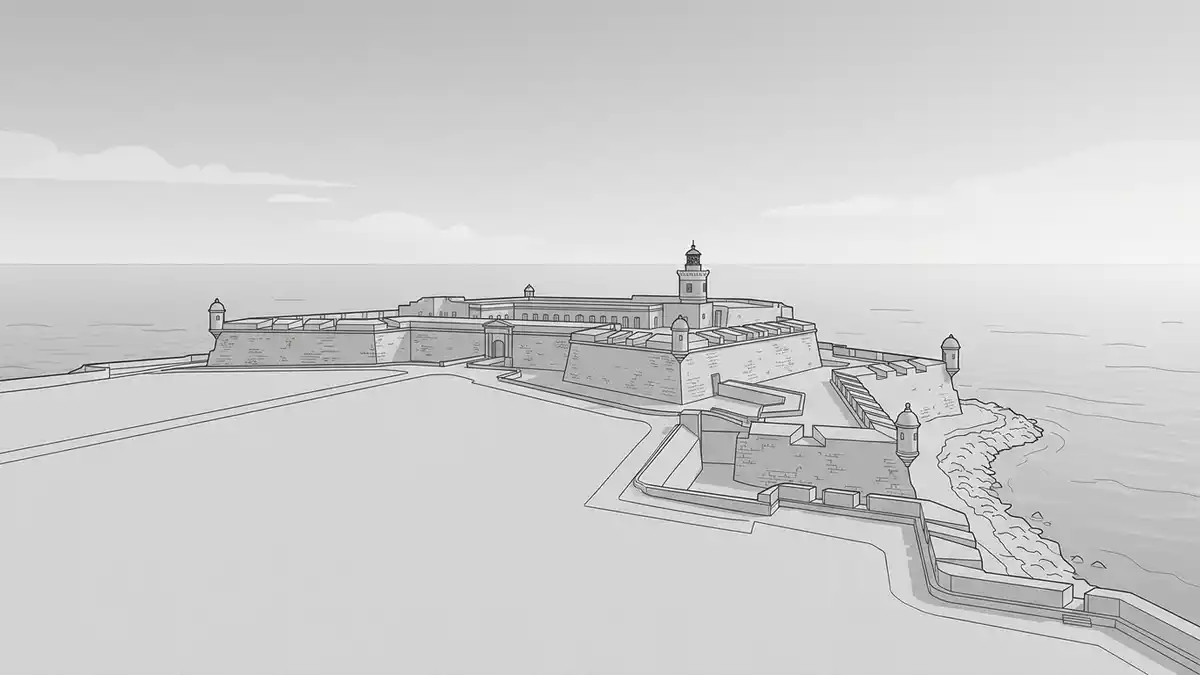
Castillo San Felipe del Morro rises above the entrance to San Juan Bay as a terraced stone fortress, its multiple levels stepping down towards the Atlantic on the edge of Old San Juan. Built under Spanish rule from the sixteenth century onwards and later absorbed into the United States National Park system, it condenses more than four centuries of coastal defence into one layered structure. The fort is part of the San Juan National Historic Site, which has been inscribed as a UNESCO World Heritage Site.
A headland fortress above the Atlantic
The fort stands on a high headland at the north-western tip of the San Juan Islet, where the waters of the Atlantic meet the narrow entrance to San Juan Bay.high promontory overlooking the entrance From the open lawns outside the walls, the outer profile reads as a stack of defensive platforms, each one edged by thick ramparts and punctuated by sentry posts. The masonry is predominantly pale stone, with long facades of weathered blocks that follow the contours of the rock beneath.
Castillo San Felipe del Morro consists of six principal levels facing the ocean, arranged as terraces stepping down towards the sea.six levels facing the Atlantic Ocean At the top, near the lighthouse, the upper works contain parade spaces and gun positions directed towards the harbour entrance. Lower down, batteries and platforms extend closer to the water, so that lines of cannon could cover ships approaching from different angles across the bay.
From sixteenth-century bastion to World Heritage site
Construction of Castillo San Felipe del Morro began in 1539 under the rule of Charles V of the Habsburg dynasty, just a few decades after the Spanish Crown established San Juan as a key Caribbean port.construction began in 1539 The initial fortification was gradually expanded over roughly two and a half centuries, as engineers adapted the design to changing artillery technology and to repeated assaults on the city. By the late eighteenth century, the fort had taken on much of the form visitors see, with multiple levels of batteries integrated into the headland.
In 1898, during the Spanish–American War, the fortress passed from Spanish to United States control, along with the rest of Puerto Rico.transfer to the United States in 1898 The site continued to have a military role into the twentieth century, before becoming part of the San Juan National Historic Site managed by the National Park Service. The wider fortification system, including Castillo San Felipe del Morro and the city walls, was placed on the World Heritage List in 1983 as an exceptional example of European military architecture in the Caribbean.World Heritage site in 1983
Details in stone: garitas, walls and the lighthouse
On the seaward side, visitors see lines of stone walls rising from close to the water up to the upper batteries, with surfaces marked by centuries of salt and spray. The main defensive walls reach substantial thickness at their base and taper towards the top, a form that helped them withstand cannon fire.walls built of cut sandstone Small projecting sentry posts known as garitas stand at intervals along the ramparts, their openings giving guards views along the faces of the walls.
Within the fort, stairways and ramps link the different levels, connecting open courtyards, artillery terraces and enclosed rooms that once housed soldiers and stores.multi-level citadel in Old San Juan Near the summit of the headland stands a lighthouse, rebuilt after earlier structures were damaged, which forms a vertical landmark above the horizontal spread of the batteries. Together, these elements give Castillo San Felipe del Morro a profile that is recognisable from both the sea and the streets of Old San Juan.
Visiting Castillo San Felipe del Morro: what travellers from Western Europe should know
- Castillo San Felipe del Morro stands at the north-western end of Old San Juan on the San Juan Islet, overlooking the entrance to San Juan Bay and facing the Atlantic Ocean. The main access for visitors runs along Calle Norzagaray from the historic centre of San Juan.
- The fort is arranged over several levels connected by ramps and stairways. Moving between the batteries and courtyards involves climbing and descending multiple flights, some of them relatively steep.
- The open lawns outside the fort form a broad exposed area between the town and the main walls. Crossing this space to reach the entrance involves walking over grass rather than paved streets.
- The official language is Spanish and the currency is the United States dollar. Entry requirements depend on your nationality; UK travellers can check the FCDO travel advice at gov.uk/foreign-travel-advice, Irish travellers the Department of Foreign Affairs at ireland.ie.
Searching for Castillo San Felipe del Morro on social platforms
These links open searches for Castillo San Felipe del Morro on each platform.
Frequently asked questions about Castillo San Felipe del Morro
Where is Castillo San Felipe del Morro?
The fortress stands on a headland at the north-western edge of Old San Juan, overlooking the entrance to San Juan Bay in Puerto Rico.
What should visitors expect inside the fort?
Visitors move through a series of stone terraces, courtyards and batteries on several levels, linked by ramps and stairways and framed by thick defensive walls.
What makes Castillo San Felipe del Morro distinctive?
Its stepped arrangement of six ocean-facing levels, early sixteenth-century origins and status as part of a UNESCO-listed historic site give it a distinctive character among Caribbean fortresses.


