
Castillo de los Tres Reyes del Morro above Havanna’s harbour channel
Published on 09/19/2026 at 20:38 | Editorial responsibility: Rafael Müller, Editor-in-Chief AD HOC NEWS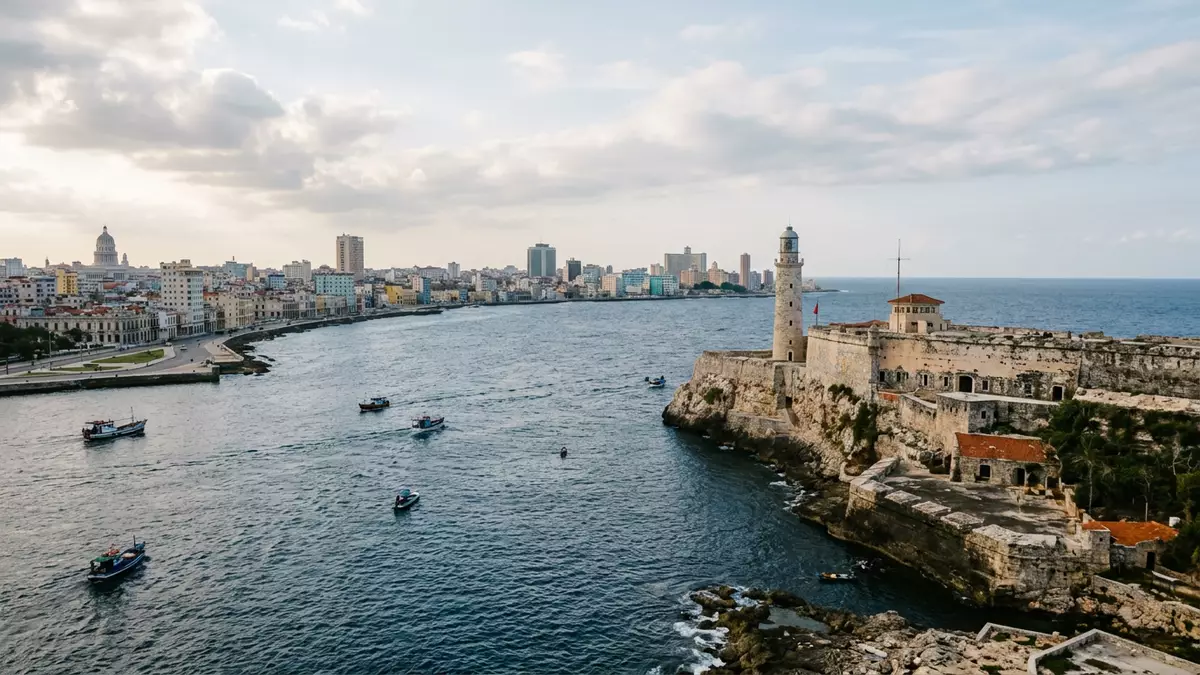
Castillo de los Tres Reyes del Morro stands on a rocky headland at the entrance to Havanna’s harbour, its stone ramparts and lighthouse forming a fixed point in the city’s historic skyline. Rising above the narrow channel into the bay, the fortress combines late sixteenth-century Spanish military engineering with the later nineteenth-century lighthouse tower that turns its rugged outline into a clear maritime landmark.
A stone fortress at the mouth of Havana Bay
Castillo de los Tres Reyes del Morro occupies a promontory on the eastern side of the channel leading into Havana Bay, directly opposite the historic centre of the city.rocky promontory at the entrance The site allows views across the water to the old town and along the coastline, underlining how closely the fortress is tied to Havana’s maritime geography. From the elevated terraces and platforms, the harbour, shipping lanes and urban fabric unfold in a wide panorama framed by gun positions and parapets.
The ground plan of the fortress follows the irregular outline of the rock on which it stands, creating an angular composition of bastions and curtain walls.irregular polygon ground plan Built of substantial masonry, the walls reach several metres in thickness in places, with casemated barracks, vaulted galleries and internal courtyards arranged behind them.massive defensive masonry Within the complex are cisterns, a chapel, officers’ quarters and storage spaces, all embedded into the fortified envelope in keeping with early modern coastal defence design.
Imperial engineering from the late sixteenth and early seventeenth centuries
The fortress belongs to the late Renaissance phase of Spanish imperial fortification, with construction beginning in 1589 under the reign of Philip II of Spain.construction began in 1589 Work continued into the early decades of the seventeenth century, giving Castillo de los Tres Reyes del Morro its characteristic bastioned profile by about 1630.completed in 1630 This places the castle firmly in the context of the Spanish Empire’s efforts to secure key ports in the Caribbean during the late sixteenth and early seventeenth centuries.
The design is attributed to the Italian military engineer Giovanni Battista Antonelli, who worked extensively on Spanish colonial fortifications across the region.Giovanni Battista Antonelli Antonelli’s plan for Castillo de los Tres Reyes del Morro integrated angled bastions, moats and layered batteries adapted to the site’s geology, and he is also connected with the roughly contemporary La Punta fortress on the opposite shore of the harbour entrance.La Punta Castle on the opposite shore Together with the Castillo de la Real Fuerza further inside Havana, these structures formed a defensive triangle protecting the harbour and colonial capital in the late sixteenth and seventeenth centuries.early defensive triangle of the city
From siege warfare to lighthouse landmark
Castillo de los Tres Reyes del Morro was tested in battle during the Seven Years’ War, when British forces besieged and captured Havana in 1762.captured by the British in 1762 The fortress endured sustained bombardment before its garrison surrendered, an episode that caused significant structural damage and exposed weaknesses in the existing harbour defences.damage during the British siege Following the Treaty of Paris in 1763, Havana and its fortifications returned to Spanish control, and reconstruction works restored Castillo de los Tres Reyes del Morro as part of a wider strengthening of the city’s military architecture.Treaty of Paris 1763 and reconstruction
In the nineteenth century a lighthouse tower was added to the existing fortress, turning its seaward face into a navigational reference for ships approaching Havana Bay.lighthouse erected in 1844 The combination of stone bastions and the later lighthouse has become one of the recognised visual symbols of Havana and Cuba, appearing in representations of the city’s waterfront and maritime heritage.symbol of Havana with its lighthouse Today, the complex is associated with historical interpretation and coastal views, with the battlements and lighthouse ensemble framing the approach to the harbour rather than commanding it militarily.
Visiting Castillo de los Tres Reyes del Morro: what travellers from Western Europe should know
- Castillo de los Tres Reyes del Morro stands on the eastern side of the entrance to Havana Bay, opposite the historic centre of Havanna and near the mouth of the harbour channel.
- The fortress occupies uneven rocky terrain above the sea, with ramps, internal courtyards and long flights of stone steps connecting the different levels of bastions and platforms.
- The surrounding area includes other historic fortifications such as La Punta and the extensive La Cabaña complex, with Castillo de los Tres Reyes del Morro forming part of this broader defensive landscape around the bay.
- The official language is Spanish and the currency is the Cuban peso.
- Entry requirements depend on your nationality; UK travellers can check the FCDO travel advice at gov.uk/foreign-travel-advice, Irish travellers the Department of Foreign Affairs at ireland.ie.
Searching for Castillo de los Tres Reyes del Morro on social platforms
These links open searches for Castillo de los Tres Reyes del Morro on each platform.
Frequently asked questions about Castillo de los Tres Reyes del Morro
Where is Castillo de los Tres Reyes del Morro located?
Castillo de los Tres Reyes del Morro stands on a rocky headland at the entrance to Havana Bay, on the eastern side of the harbour channel opposite Havanna’s historic centre.
What should visitors expect when exploring Castillo de los Tres Reyes del Morro?
Visitors encounter bastioned stone walls, internal courtyards, batteries and vaulted galleries arranged across uneven terrain, together with the later lighthouse tower that rises above the seaward side of the fortress.
What makes Castillo de los Tres Reyes del Morro distinctive among Havana’s historic sites?
The fortress combines late sixteenth- and early seventeenth-century Spanish military architecture by Giovanni Battista Antonelli with a nineteenth-century lighthouse, creating a long-standing symbol of Havana’s harbour entrance.


