

Castelvecchio, Verona’s brick-built medieval stronghold
Published on 08/28/2026 at 10:38 | Editorial responsibility: Rafael Müller, Editor-in-Chief AD HOC NEWS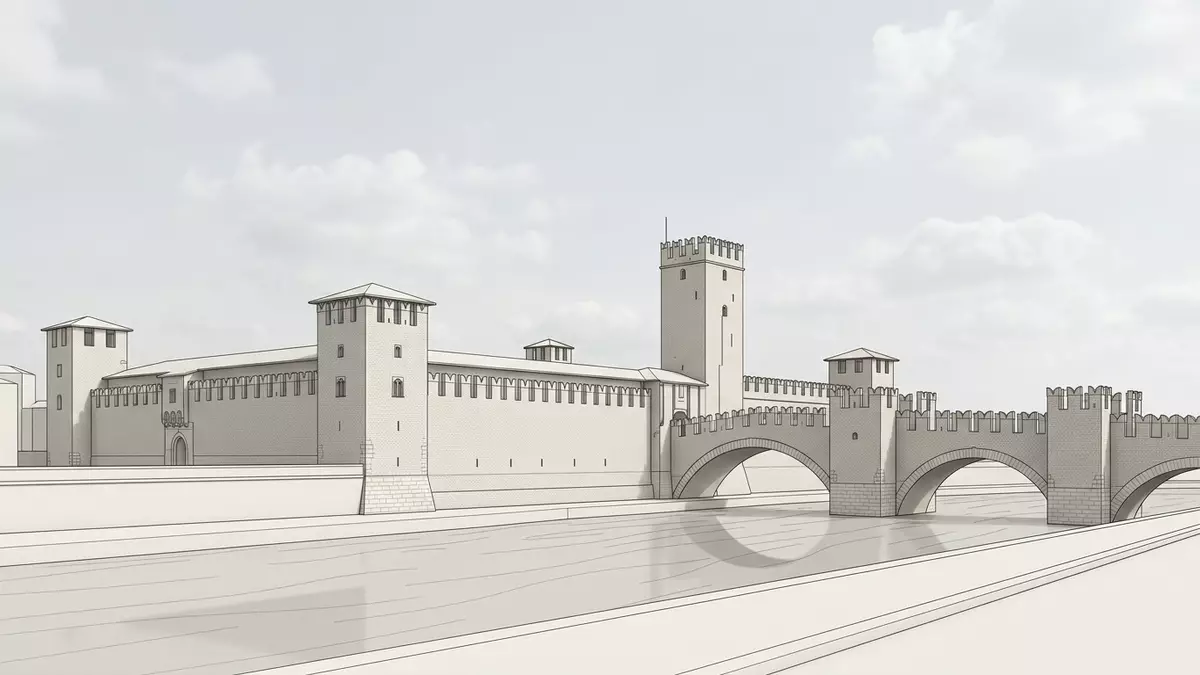
Castelvecchio in Verona is a red-brick medieval fortress on the Adige river that has become the city’s key civic art museum, bringing sculpture and painting into courtyards, towers and walkways. Built in the mid-fourteenth century under the Scaliger dynasty and later reshaped by architect Carlo Scarpa, it combines a defensive layout with carefully staged views of medieval and Renaissance works.
A Scaliger fortress on the Adige
Castelvecchio is a fortified castle on the right bank of the Adige in Verona, laid out as a compact brick complex whose walls rise above the river and the surrounding streets.fortified castle on the right bank It was built between 1354 and 1356 under Cangrande II della Scala, the Scaliger ruler who strengthened Verona’s defences and whose family gave the structure its character as a military stronghold.built between 1354 and 1356 The castle’s name, meaning “old castle”, distinguishes it from later fortifications in the city and anchors it in the medieval period.
The plan of Castelvecchio brings together walls, towers and a central keep around internal courts that once served as protected spaces for soldiers and supplies.central keep A series of towers punctuates the perimeter, giving high vantage points over the Adige and the approaches to Verona. The castle stands as the most important military construction of the Scaliger lords in the city, and its brick fabric, crenellated walls and river-facing bastions still read clearly as a medieval defensive work.most important military construction
From fortress to civic museum
In the twentieth century Castelvecchio took on a different role when Verona established it as the civic art museum, bringing together works from the Middle Ages through to the eighteenth century inside the former fortress.civic art museum The museum was created in the 1920s and filled the castle with paintings, sculpture, archaeological finds and historic objects drawn from the city and wider Veneto region.collections of medieval and Renaissance art Galleries within the former military wings now hold works by artists such as Pisanello, Andrea Mantegna, Giovanni Bellini, Paolo Veronese and Tintoretto, set against exposed brick and stone surfaces.
A major stage in this transformation came between 1958 and 1974, when Carlo Scarpa reworked the museum’s internal layout and exhibition structures.Carlo Scarpa reworked the museum Scarpa’s interventions introduced concrete platforms, carefully detailed metal fixings and new stairways that align views from one room to another, linking the artworks to the castle’s architecture without erasing its medieval character. Many sculptures are displayed on slender supports that lift them away from the walls, while paintings are hung so that fragments of battlements, arrow slits and wall textures remain visible around them.
The bridge that completes the ensemble
Castelvecchio is closely tied to Ponte di Castelvecchio, also known as the Scaliger Bridge, a fortified river crossing that extends from the castle across the Adige.Ponte di Castelvecchio Built in the same fourteenth-century phase as the fortress under Cangrande II della Scala, the bridge formed a protected link to the opposite bank and is constructed with three red-brick arches stepping across the river.three unequal arches made of brick The outer fortifications of the castle open directly onto the bridge, so that its battlements read as an extension of the defensive circuit.
The largest arch of the Castelvecchio Bridge carried one of the widest spans achieved in medieval bridge building, and its brick and stone construction has been reconstructed to restore the fortress-to-river relationship that defines this part of Verona.segmental arch span Walking along the bridge brings views back towards the castle’s towers and courtyards, and outwards along the Adige and towards other historic parts of the city.
Visiting Castelvecchio: what travellers from Western Europe should know
- Castelvecchio stands west of Verona’s historic centre on the right bank of the Adige, along Corso Castelvecchio, a short walk from Piazza Bra and the Arena.
- The complex includes exterior courtyards, interior stairways and towers, with uneven stone paving and sets of steps that require steady footing within the fortress and on the bridge.
- Ponte di Castelvecchio extends directly from the castle over the Adige, so a visit can combine time inside the museum with an outdoor walk along battlemented walls above the river.
- The official language is Italian and the currency is the euro.
Searching for Castelvecchio on social platforms
These links open searches for Castelvecchio on each platform.
Frequently asked questions about Castelvecchio
Where is Castelvecchio in Verona?
Castelvecchio stands on the right bank of the Adige along Corso Castelvecchio, west of the main historic squares and streets of central Verona.
What can visitors expect inside Castelvecchio?
Visitors encounter a medieval brick fortress adapted as a civic museum, with galleries, courtyards and towers displaying sculpture, paintings and historic objects from the Middle Ages onwards.
What makes Castelvecchio distinctive among Verona’s landmarks?
Castelvecchio is distinctive as a major Scaliger-era fortress combined with a museum designed by Carlo Scarpa, linked directly to the fortified Ponte di Castelvecchio across the Adige.


