
Castelvecchio in Verona, a fortress turned museum
Published on 09/15/2026 at 09:42 | Editorial responsibility: Rafael Müller, Editor-in-Chief AD HOC NEWS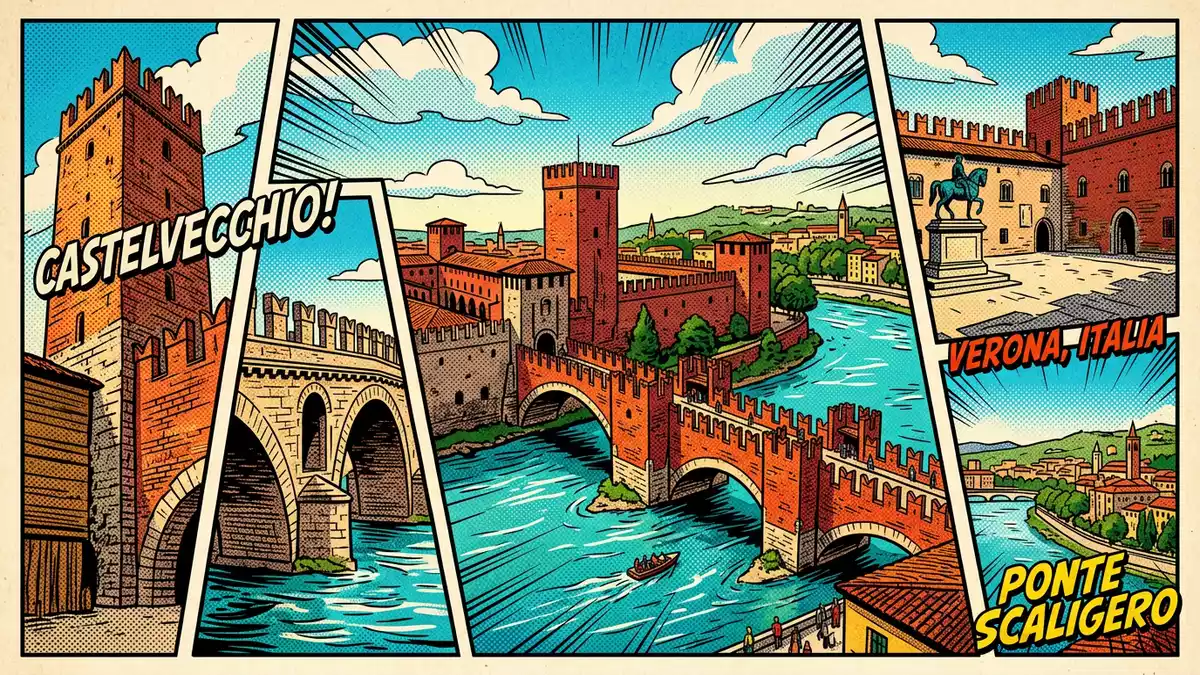
Castelvecchio in Verona is a medieval fortress on the Adige River whose battlements and inner courtyards now contain the city’s principal art museum. Built in the mid?fourteenth century for the Scaliger lords and reshaped in the twentieth century by architect Carlo Scarpa, it combines defensive walls, a fortified bridge and carefully composed galleries in a single complex.
A Scaliger stronghold on the Adige
Castelvecchio stands on the right bank of the Adige in Verona’s historic centre, aligned with Corso Castelvecchio and close to Corso Cavour, where its brick ramparts form a long, crenellated frontage towards the street.castle in Verona The fortress was constructed between 1354 and 1356 for Cangrande II della Scala, part of the Della Scala dynasty that governed Verona in the thirteenth and fourteenth centuries.built between 1354 and 1356 Its original name, Castello di San Martino in Aquaro, reflects a medieval dedication that long predates its present role as a civic museum.Castello di San Martino in Aquaro
The complex is organised around internal courtyards and a central keep. High walls with merlons run along the street and towards the river, punctuated by towers that allowed views over the Adige and the approaches to Verona. Within, the Corte della Reggia and Corte d’Armi divide residential and military areas, while the mastio – the main tower – rises above the ensemble and anchors the castle’s profile against the skyline.Corte della Reggia, Corte d’Armi and mastio
From fortress to museum of Veronese art
In the twentieth century Castelvecchio took on a new life as a museum, housing Verona’s civic collections of sculpture, painting and historic artefacts. A major programme of refurbishment between 1958 and 1974 under architect Carlo Scarpa reorganised the interior, placing medieval and Renaissance works in settings that engage with the existing fabric of brick, stone and timber.project of the architect Carlo Scarpa The civic museum occupies a sequence of twenty?nine rooms, ranging from vaulted spaces to upper?level galleries.
The collections trace Veronese art from medieval sculpture to paintings of the eighteenth century, alongside archaeological finds, historic weapons, ceramics, goldsmiths’ work and the city’s historic bells.important art collections Scarpa’s interventions include carefully detailed staircases, bridges within the courtyards and display structures that set individual statues or paintings against the fortress walls. Stone pieces may be mounted on slender brackets that lift them from their supports, while paintings hang in ordered sequences along plastered surfaces, creating a dialogue between historic material and twentieth?century design.
The fortified bridge and the river setting
One of Castelvecchio’s defining features is its direct link to the Adige via Ponte di Castelvecchio, also known as Ponte Scaligero, a fortified bridge that extends from the castle across the river. The bridge forms part of the defensive system and carries the same brick construction and battlements as the main walls.fortified bridge in Verona Its arches span the water in a bold sequence that has long been associated with fourteenth?century engineering.
From the bridge, views open along the Adige to other landmarks of Verona, while looking back reveals the stratified structure of Castelvecchio itself, from riverside fortifications to upper towers. The complex’s division into mastio, bridge and courtyards is clear from this vantage: military elements towards the river, residential and museum spaces within, and the street frontage forming a barrier to the city side.part of the fortress of Castelvecchio
Visiting Castelvecchio: what travellers from Western Europe should know
- Castelvecchio stands in central Verona on Corso Castelvecchio near Corso Cavour, directly beside the Adige River and connected to the opposite bank by Ponte di Castelvecchio.
- Inside the fortress, movement between levels involves staircases, historic passages and bridges in the courtyards, and the museum route extends through numerous rooms over a substantial area.
- The terrain combines cobbled courtyards, interior stone floors and the masonry structure of the bridge, so footwear suited to uneven historic surfaces is advantageous.
- English is widely used in visitor information, but the official language is Italian and the currency is the euro.
- Entry requirements depend on your nationality; UK travellers can check the FCDO travel advice at gov.uk/foreign-travel-advice, Irish travellers the Department of Foreign Affairs at ireland.ie.
Searching for Castelvecchio on social platforms
These links open searches for Castelvecchio on each platform.Frequently asked questions about Castelvecchio
Where is Castelvecchio located in Verona?
Castelvecchio is a medieval fortress on Corso Castelvecchio beside the Adige River, west of Verona’s historic centre and near Corso Cavour.
What can visitors expect inside Castelvecchio?
Visitors encounter fortification walls, courtyards and a museum route through numerous rooms displaying sculpture, paintings, archaeological material, weapons and decorative arts.
What makes Castelvecchio distinctive among Italian castles?
Castelvecchio stands out for its combination of fourteenth?century fortress architecture, the fortified bridge over the Adige and Carlo Scarpa’s twentieth?century museum design.


