
Castelvecchio in Verona: a fortress turned museum
Published on 08/31/2026 at 08:31 | Editorial responsibility: Rafael Müller, Editor-in-Chief AD HOC NEWS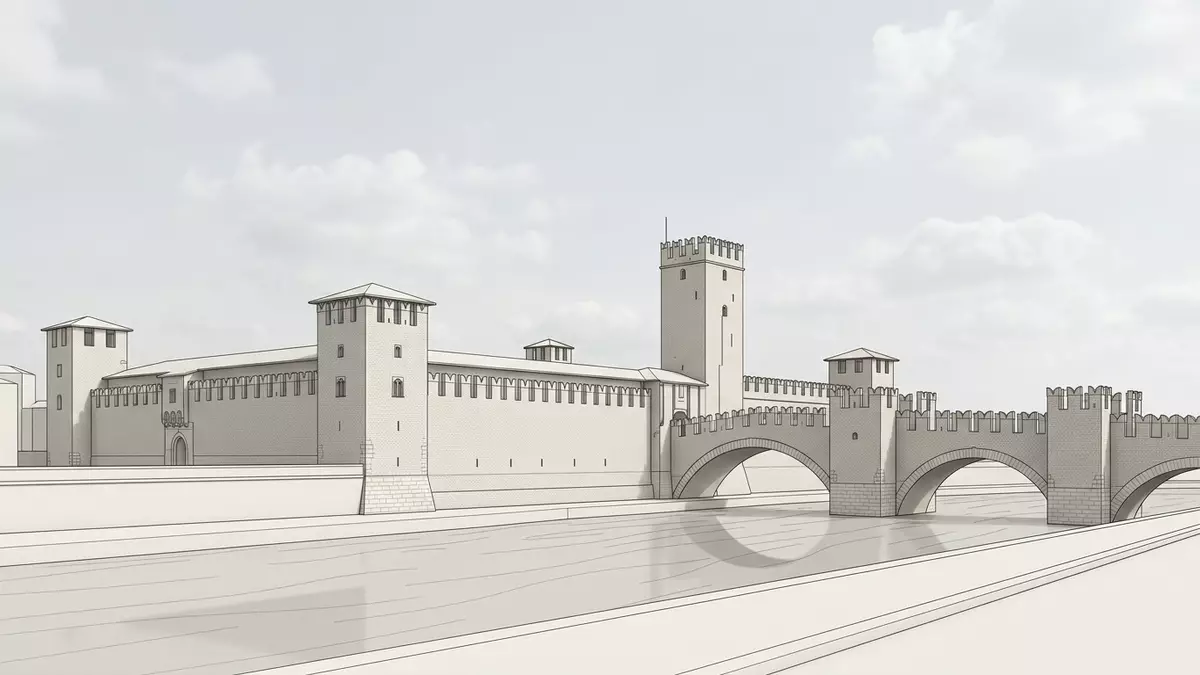
Castelvecchio in Verona is a medieval fortress on the Adige that has become one of the city’s central places to encounter its history, art and riverfront landscape. Built in the fourteenth century under the Scaliger dynasty and later transformed into a civic museum, it combines crenellated walls, internal courtyards and Carlo Scarpa’s twentieth-century museum design in a single complex.
A Scaliger stronghold on the Adige
Castelvecchio stands on the western edge of Verona’s historic centre, facing the Adige and backed by the line of the former city walls. The castle was erected in the fourteenth century as a fortified residence and stronghold of the della Scala family, known as the Scaligeri, who ruled Verona during much of that period.Castelvecchio Museum Its brick ramparts and towers form an angular mass that still reads as military architecture even after later alterations and restorations.
The fortress works together with the Ponte di Castelvecchio, also called the Scaliger Bridge, which projects from the castle over the Adige in a sequence of defensive arches.Castelvecchio Bridge Built between 1354 and 1356 under Cangrande II della Scala, this fortified crossing gave the lord of Verona a controlled route towards the countryside in times of internal conflict and a way to oversee movement along the river.bridge built between 1354 and 1356
From castle to civic art museum
By the twentieth century Castelvecchio had outlived its original military function and stood within a growing city rather than a medieval frontier. In 1926 it was designated as the seat of Verona’s Civic Museum, bringing painting, sculpture and other works of art into the former stronghold.seat of the Civic Museum in 1926 Galleries were laid out along existing wings and levels, and visitors began to move through rooms that once formed part of Scaliger residences and military quarters.
The museum’s collections trace a path from medieval Verona to the eighteenth century and extend into wider Venetian art. Works by artists such as Pisanello, Andrea Mantegna, Giovanni Bellini, Paolo Veronese and Tintoretto are displayed alongside medieval sculpture, frescoes and decorative objects.Venetian medieval and Renaissance art This sequence makes the building itself part of the story, as viewers encounter religious panels, civic portraits and sculpted figures inside walls first raised for a secular lord.
Carlo Scarpa’s layered restoration
In the second half of the twentieth century the museum did not simply receive new cases and light fittings; it underwent a substantial architectural reworking led by the Venetian architect Carlo Scarpa. Beginning in 1956 and continuing into the 1970s, Scarpa developed a restoration and installation project that treated the castle and its art as a single composition.restoration of Castelvecchio Museum His work created new circulation routes, staircases and display structures within the existing masonry.
Scarpa’s intervention is particularly known for the way his concrete, metal and timber elements sit against the older brick and stone without trying to imitate them.intervention at Museo di Castelvecchio Sculptures stand on precisely detailed plinths, paintings are hung on supports that reveal fragments of wall behind, and views are opened through the fabric of the building to show traces of different historical phases. The museum also preserves Scarpa’s own drawings for this work in a dedicated archive, underscoring the place of Castelvecchio in his wider career.Carlo Scarpa archive
Visiting Castelvecchio: what travellers from Western Europe should know
- Castelvecchio stands on Corso Castelvecchio on the west bank of the Adige, a short walk from Verona Arena and Piazza Bra, and can be reached on foot from Verona Porta Nuova railway station along Corso Porta Nuova.
The Ponte di Castelvecchio connects the fortress directly to the neighbourhood across the river. - The complex includes multiple levels, exterior ramparts and interior courtyards, with staircases between museum rooms and walkways on the bridge; footwear suited to uneven historic surfaces is advisable.
- The official language is Italian and the currency is the euro.
Searching for Castelvecchio on social platforms
These links open searches for Castelvecchio on each platform.
Frequently asked questions about Castelvecchio
Where is Castelvecchio located within Verona?
Castelvecchio stands on Corso Castelvecchio on the west bank of the Adige, close to Verona’s historic centre and linked to the opposite bank by its fortified bridge.
What can visitors expect on a visit to Castelvecchio?
Visitors encounter a medieval castle housing Verona’s civic art collections, moving through galleries, courtyards and ramparts and, in many cases, stepping out onto the Ponte di Castelvecchio over the river.
What makes Castelvecchio distinctive among Verona’s sights?
Castelvecchio combines a fourteenth-century fortress, a major museum of medieval and Renaissance art and Carlo Scarpa’s influential twentieth-century restoration within one interconnected architectural complex.


