
Castelvecchio and its fortress bridge in Verona
Published on 09/08/2026 at 22:25 | Editorial responsibility: Rafael Müller, Editor-in-Chief AD HOC NEWS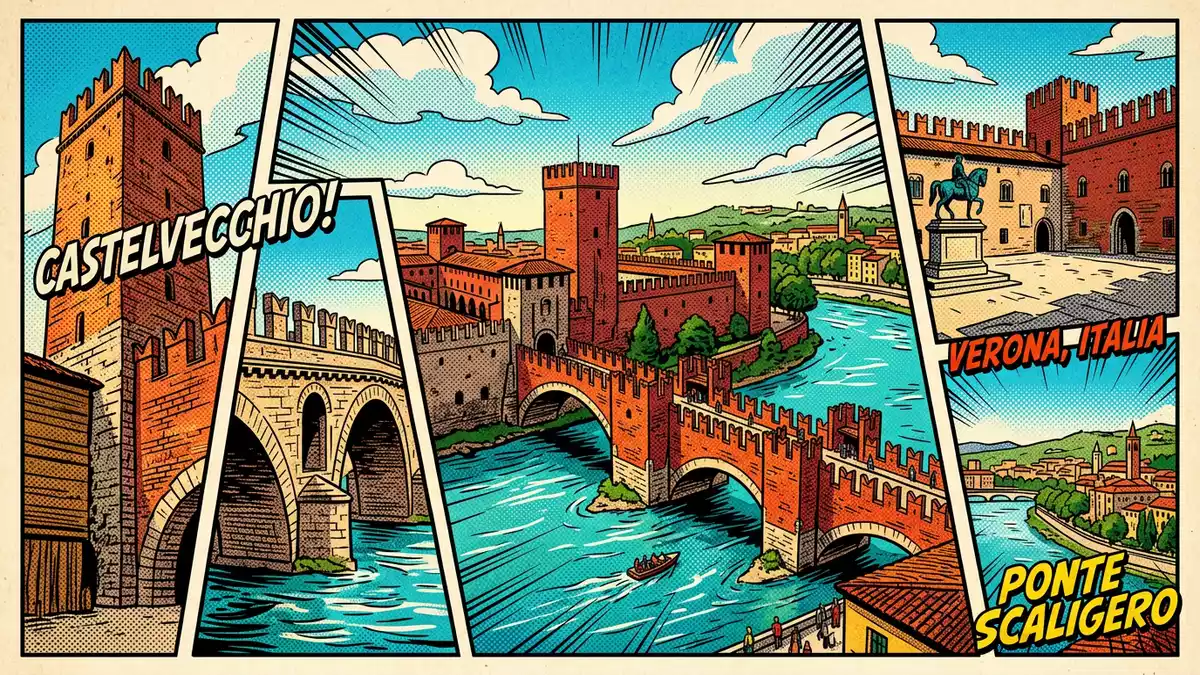
Castelvecchio is a medieval brick fortress on the Adige in Verona, built in the fifteenth century by the Scaliger dynasty and later transformed into a civic art museum. Its fortified bridge, the Ponte di Castelvecchio, carries the castle across the river in a sequence of powerful arches that still define this stretch of the city.
A Scaliger stronghold on the Adige
Castelvecchio stands on the right bank of the Adige, a short walk west of Verona’s historic centre, where its red brick walls and towers form a self-contained defensive compound. The fortress was constructed in the fourteenth century under the rule of the della Scala family, the lords of Verona who used it as a stronghold and residence during a period of uneasy power politics.Castelvecchio is the most important military monument of the Della Scala lordship The castle’s name, meaning “Old Castle”, distinguishes it from later fortifications in the city and has become tied to its role in Verona’s identity.Castelvecchio is a castle in Verona, northern Italy
The layout of Castelvecchio combines a rectangular main enclosure with projecting towers that control approaches along the river and into the medieval streets. Within the walls, courtyards open between ranges that once housed troops, storage and administrative spaces. The fortress is directly linked to the Adige by its own bridge, creating a guarded route towards the riverbank and, beyond it, towards the Adige valley.
From fortress to museum of Veronese art
After centuries of military use under successive regimes, Castelvecchio was turned into a civic museum in the early twentieth century, housing collections of art and sculpture from Verona and the wider Veneto. Since 1923 the building has served as the city’s main art museum, with galleries that trace local production from the Middle Ages to the eighteenth century.Seit 1923 beherbergt das Gebäude ein Museum Paintings, medieval statues, archaeological finds, armour and decorative arts occupy rooms that still show the fortress structure in walls, vaults and battlements.Castelvecchio is the most important museum in the city, displaying significant collections of medieval, Renaissance, and modern art
In the second half of the twentieth century, architect Carlo Scarpa reworked parts of Castelvecchio’s interior and courtyards, creating a museum route that sets individual works of art against carefully framed views of the historic fabric.The architectural restoration of 1958-1974 by Carlo Scarpa transformed the military spaces into exhibition environments Scarpa’s interventions, such as suspended display platforms, re-cut openings and sculptural staircases, highlight original masonry and defensive features while allowing visitors to move between galleries and open-air spaces without losing contact with the castle’s fortification character.
The Ponte di Castelvecchio, a fortified escape route
Linked to the fortress on its river side, the Ponte di Castelvecchio, also known as the Scaliger Bridge, is a fortified brick and stone bridge that strides across the Adige in three unequal arches.The powerful construction boasts 3 unequal arches made of brick and features fortifications and battlements Built between 1354 and 1356 under Cangrande II della Scala, it was conceived as an escape route from the castle towards the lands upstream, providing the ruling family with a secure way out if unrest or siege threatened Verona.Built between 1354 and 1356 by Cangrande II della Scala, the bridge connected the fortress to the opposite bank of the Adige
Seen from the riverbank, the bridge’s battlemented parapets and flanking towers read as an extension of Castelvecchio’s defensive line, with the largest central span leaping across the main channel of the Adige. The segmental form of its arches was an ambitious engineering choice for the fourteenth century, giving the bridge a long, low profile over the water.The Castel Vecchio Bridge is a fortified bridge in Verona, over the Adige River Within the castle, gateways open directly onto the bridge deck, making it part of the controlled internal circulation of the stronghold as well as a crossing point for the wider city.
Visiting Castelvecchio: what travellers from Western Europe should know
- Castelvecchio stands west of Verona’s central squares on Corso Castelvecchio, beside the Adige and close to major streets such as Corso Cavour.
- The fortress and bridge incorporate towers, ramparts and stairways; moving between galleries and the battlements involves level changes and stone steps.
- The Ponte di Castelvecchio is reserved for pedestrians, providing a traffic-free route over the Adige directly linked to the castle precinct.
- Verona lies in Italy, where the official language is Italian and the currency is the euro.
- Entry requirements depend on your nationality; UK travellers can check the FCDO travel advice at gov.uk/foreign-travel-advice, Irish travellers the Department of Foreign Affairs at ireland.ie.
Searching for Castelvecchio on social platforms
These links open searches for Castelvecchio on each platform.
Frequently asked questions about Castelvecchio
Where is Castelvecchio located in Verona?
Castelvecchio stands on Corso Castelvecchio on the right bank of the Adige, west of Verona’s historic centre and close to Corso Cavour.
What can visitors expect when visiting Castelvecchio?
Visitors encounter a medieval fortress containing the city’s main art museum, with galleries, towers, courtyards and direct access to the fortified bridge over the Adige.
What makes Castelvecchio distinctive among Verona’s sights?
The combination of brick fortifications, Carlo Scarpa’s museum design and the attached Scaliger Bridge gives Castelvecchio a layered character as both stronghold and cultural institution.


