
Castello di Miramare and the white castle above the Gulf of Triest
Published on 08/20/2026 at 09:39 | Editorial responsibility: Rafael Müller, Editor-in-Chief AD HOC NEWS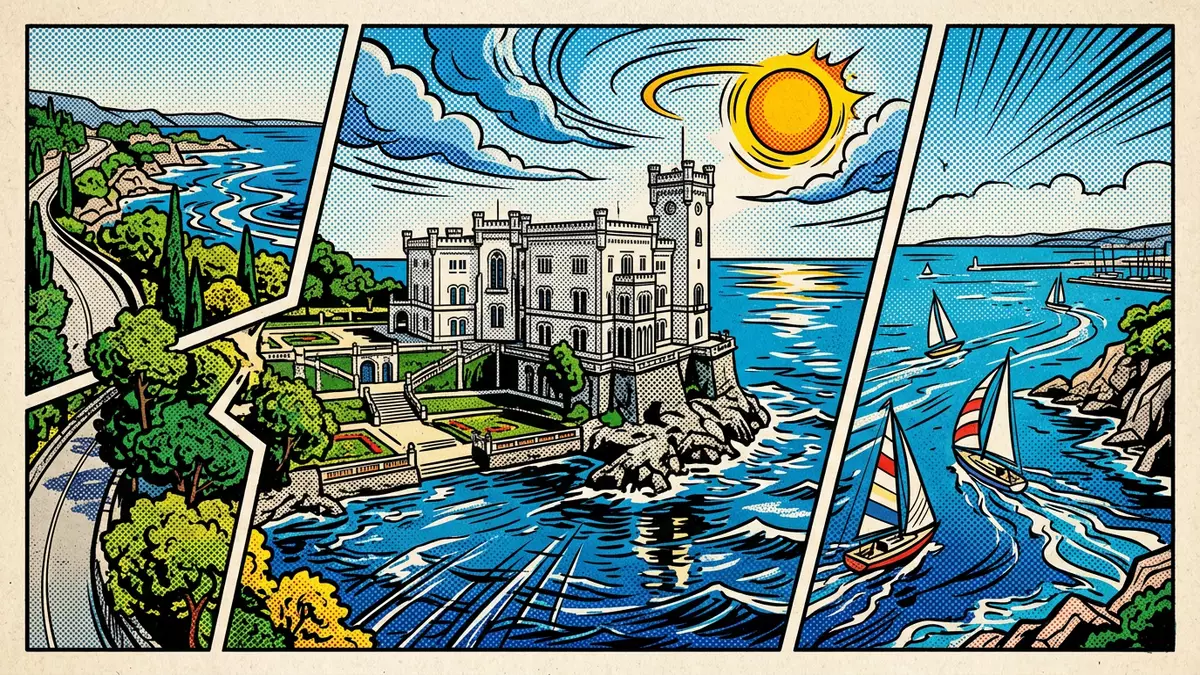
Castello di Miramare stands on the rocky promontory of Grignano just outside Triest, its white Istrian stone walls facing the Gulf of Trieste and the open Adriatic. Conceived in the nineteenth century as a seaside residence for Archduke Ferdinand Maximilian of Habsburg and his wife Charlotte of Belgium, it preserves a rare combination of castle, interiors and coastal park from a single period.
A Habsburg seaside residence in stone and sea light
The castle took shape between 1856 and 1860, when Archduke Ferdinand Maximilian, younger brother of Emperor Franz Joseph I, chose the Grignano headland as the site for a residence at the edge of the Habsburg world.The castle was built between 1856 and 1860 The foundation stone was laid in 1856 and the building was completed as a coherent project in the following years, with the couple moving into a residence that directly overlooked the water.
The design is associated with Carl Junker, an Austrian engineer and architect who worked closely with Maximilian to translate imperial taste into stone and plaster.Carl Junker designed the castle in an eclectic style The result is an eclectic nineteenth-century building that blends neo-Gothic and neo-Renaissance references, with battlemented outlines, towers and terraces arranged to step down towards the sea.
Eclectic architecture in white Istrian stone
Seen from the water or from the approach along Viale Miramare, Castello di Miramare reads as a compact ensemble of volumes finished in pale Istrian stone, a durable limestone quarried along the northern Adriatic coast.The walls are built in Istrian stone The main block rises above a sequence of terraces and parapets that step down towards the shoreline, while a taller tower volume marks the seaward side.
The architecture follows the nineteenth-century taste for historicism, combining medieval and Renaissance motifs into a romantic silhouette.The castle combines Gothic, medieval and Renaissance elements Pointed decorative elements, sculpted cornices and classical window surrounds coexist on the same facades, so that the building appears at once like a fortress and a seaside villa. From the terraces, the relationship between the stone architecture and the water is direct: the castle stands above the rocky shore, with views across the Gulf of Trieste towards the wider Adriatic.
A coastal park shaped around a nineteenth-century castle
Surrounding the castle is a landscaped park that extends across the Grignano promontory, laid out with paths, clearings and planted slopes that frame views of both the building and the sea.The castle and its park were created together under Maximilian The grounds include formal garden compartments nearer the residence and more wooded areas further out, giving a sequence of spaces from structured flower beds to shaded walks above the coast.
Within this park stands the smaller “Castelletto”, a secondary residence constructed in the same period, which reflects the main castle in reduced form.Carl Junker also designed the Castelletto and stables Paths descend from the castle towards the shoreline, where the rocky base of the promontory meets the water and where the castle’s sea-facing position becomes most evident. The combination of architecture and parkland, conceived as a single project in the mid-nineteenth century, gives Castello di Miramare a distinct character among coastal residences in Italy.
Visiting Castello di Miramare: what travellers from Western Europe should know
- Castello di Miramare stands on the Grignano promontory on the Gulf of Trieste, north-west of Triest, and is reached along Viale Miramare by road and public transport.
- The terrain around the castle involves sloping paths and stairways between the higher parkland and the lower terraces close to the shoreline.
- The castle and park lie outside the compact historic centre of Triest, so visiting involves a short journey along the coastal strip beyond the urban core.
- The official language is Italian and the currency is the euro.
- Entry requirements depend on your nationality; UK travellers can check the FCDO travel advice at gov.uk/foreign-travel-advice, Irish travellers the Department of Foreign Affairs at ireland.ie.
Searching for Castello di Miramare on social platforms
These links open searches for Castello di Miramare on each platform.
Frequently asked questions about Castello di Miramare
Where is Castello di Miramare located?
Castello di Miramare stands on the Grignano promontory on the Gulf of Trieste, north-west of Triest in north-eastern Italy.
What can visitors expect inside the castle and park?
Visitors encounter a nineteenth-century residence with furnished interiors and a coastal park laid out with formal gardens, wooded areas and paths above the Adriatic shore.
What makes Castello di Miramare distinctive among Italian coastal sites?
Its combination of white Istrian stone architecture, eclectic historicist style and a park created in the same nineteenth-century project gives Castello di Miramare a particular character on the Adriatic coast.


