
Castel Sant'Angelo in Rom, from imperial tomb to papal stronghold
Published on 08/26/2026 at 21:29 | Editorial responsibility: Rafael Müller, Editor-in-Chief AD HOC NEWS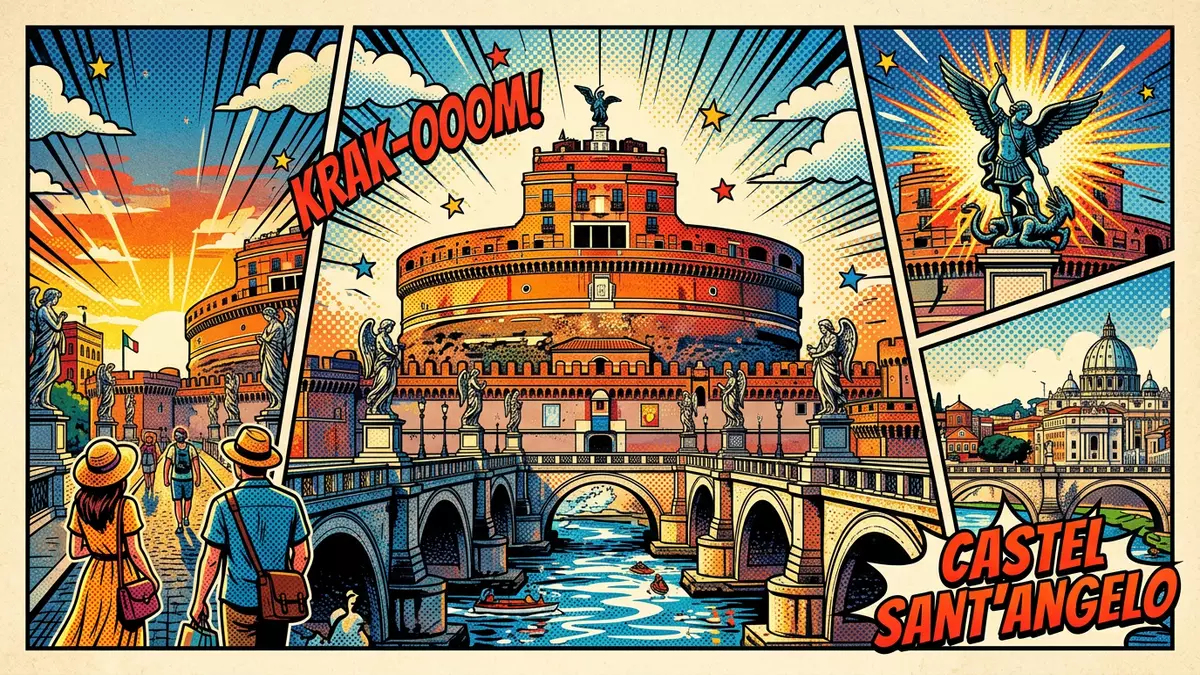
Castel Sant'Angelo on the right bank of the Tiber in Rom is a circular imperial mausoleum turned fortress, later adapted as a papal residence and today arranged as a museum. Built in the second century AD for Emperor Hadrian and his family, it anchors the riverfront opposite the historic centre and close to the Vatican, with the stone span of Ponte Sant'Angelo tying it directly to the city across the water.
An imperial mausoleum on the Tiber
The origins of Castel Sant'Angelo lie in the reign of Emperor Hadrian in the early second century AD, when a monumental mausoleum was commissioned in a suburban zone once known as Ager Vaticanus on the right bank of the river. Construction is recorded between 123 and 139 AD, with completion attributed to his successor Antoninus Pius, who ensured that the emperor and members of the Antonine dynasty were interred here. The structure is described as a towering rotunda, a vast cylindrical core rising from a square base, built in Roman concrete and faced with masonry to form a solid, compact mass above the riverbank.
In its first phase as the Mausoleum of Hadrian, the monument stood as one of the dominant pieces of imperial architecture in Rom, designed to house funerary chambers and internal passages within the cylinder. Accounts describe a circular plan enclosed by a square forecourt, with outworks at the corners and an inner mass that later held halls, chapels and apartments when its role changed. Even in a city dense with ancient monuments, this combination of a circular mausoleum and orthogonal enclosure gave the building a distinctive profile among Rome’s riverfront constructions.
From city wall bastion to papal refuge
With the decline of classical Rome, the mausoleum was absorbed into the defensive fabric of the city. Sources record that by the fifth century AD, under the Western emperor Honorius, the complex was incorporated into the line of the Aurelian Walls, and its commemorative purpose gave way to a strategic one. Thickened fortifications, battlements and courtyards reshaped the exterior into a citadel, giving the building the defensive character associated with the word “castel”. Later medieval interventions strengthened its connection with the bridge and surrounding districts, enhancing control over the approach to the Vatican area.
By the Middle Ages and into the Renaissance, the popes adopted Castel Sant'Angelo as a refuge and stronghold, developing apartments and ceremonial rooms within the robust shell. Medieval and papal authorities added towers, storage spaces and circulation routes, turning the ancient tomb into a multi-level fortress capable of guarding both the bridge and the nearby basilica precinct. Over centuries it also housed tribunals and prison cells, embedding the castle in the judicial and military history of the Papal States, while Renaissance decoration brought frescoes and stucco work into selected interior rooms to serve ceremonial and residential functions.
A castle linked to its bridge and riverfront
Castel Sant'Angelo forms a composition with Ponte Sant'Angelo, the Roman bridge that spans the Tiber from the historic centre to the castle’s forecourt. The bridge, originally known as Pons Aelius, was completed in 134 AD during Hadrian’s reign, creating a direct processional route between the mausoleum and the city. Built with stone arches and travertine facing to match the scale of the tomb, it established a permanent axis that still guides movement across the river. Later centuries introduced sculptural embellishments along the balustrades, but the underlying Roman engineering continues to carry foot traffic between the Centro Storico and the Borgo and Prati districts.
The shared name “Sant'Angelo” for both castle and bridge is tied to a legend recorded for the sixth century. During a plague in 590 AD, Pope Gregory I is said to have seen the Archangel Michael appearing above the mausoleum, sheathing a sword as a sign that the epidemic would end. The vision gave the tomb and its bridge the association with the angel that survives in their shared name and in the bronze figure of Michael now placed above the castle. Along the riverfront, the mass of Castel Sant'Angelo remains one of the most recognisable silhouettes in Rom, pairing ancient Roman construction with the later defensive crown around its upper levels.
Visiting Castel Sant'Angelo: what travellers from Western Europe should know
- Castel Sant'Angelo stands on the right bank of the Tiber in Rom, close to the Vatican area, with Ponte Sant'Angelo linking it directly to the historic centre across the river.
- The approach from the city side crosses Ponte Sant'Angelo on foot, then continues through courtyards and internal stairways inside the castle, with several levels connected by stone steps.
- The surroundings combine the river embankment with dense urban streets; the monument’s elevated terraces and upper platform look out over the Tiber, the dome of St Peter’s and the roofs of central Rom.
- The official language is Italian and the currency is the euro.
Searching for Castel Sant'Angelo on social platforms
These links open searches for Castel Sant'Angelo on each platform.
Frequently asked questions about Castel Sant'Angelo
Where is Castel Sant'Angelo located in Rom?
Castel Sant'Angelo stands on the right bank of the Tiber in Rom, near the Vatican area, connected to the city centre by Ponte Sant'Angelo across the river.
What can visitors expect inside Castel Sant'Angelo?
Visitors encounter layered spaces shaped by its history, including ancient structural cores, fortified passages, Renaissance-decorated rooms and elevated terraces overlooking the Tiber and central Rom.
What makes Castel Sant'Angelo distinctive among Rom’s monuments?
Its evolution from Hadrian’s cylindrical imperial mausoleum into a square-enclosed fortress and papal refuge beside Ponte Sant'Angelo gives the monument a rare combination of ancient tomb, castle and museum functions.


