
Castel del Monte: an octagonal vision above the Apulian hills
Published on 08/18/2026 at 13:31 | Editorial responsibility: Rafael Müller, Editor-in-Chief AD HOC NEWS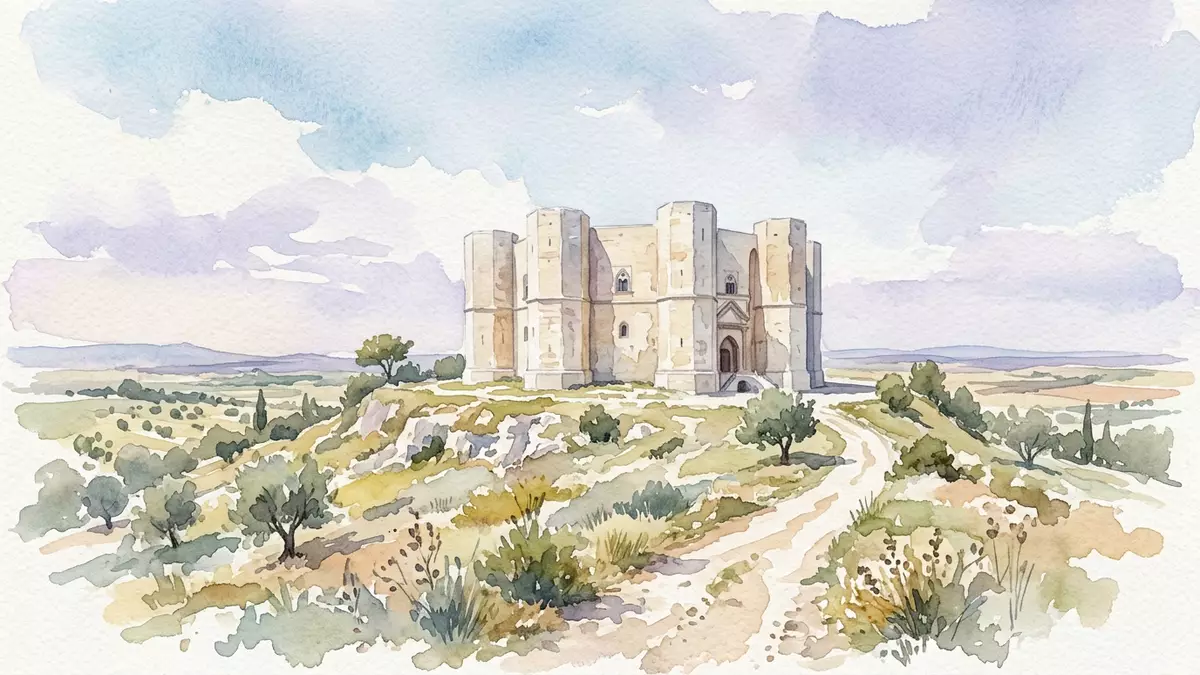
On a rocky rise in the hills above Andria in southern Italy, Castel del Monte turns fortified stone into an exercise in geometry. Commissioned in the thirteenth century by Holy Roman Emperor Frederick II of Swabia and later recognised as a UNESCO World Heritage Site, the castle’s strict octagonal plan makes it one of the most distinctive works of medieval architecture in Apulia.
An octagon in the Apulian landscape
Castel del Monte stands on a hill in the Murgia, the limestone plateau inland from the Adriatic coast, its pale walls visible across the surrounding countryside. The site lies within the municipality of Andria in the Apulia region of southern Italy, on a spur that rises above fields and scrub typical of the Alta Murgia National Park.located in the municipality of Andria The castle’s name, “Castle of the Mountain”, reflects this elevated setting rather than any dramatic peak, and the approach road climbs steadily to the isolated stronghold.
The building dates from the thirteenth century and is closely associated with Frederick II, who ruled Sicily and much of southern Italy from Apulia.a 13th-century citadel and castle The citadel is built in local stone, with façades that appear almost severe from a distance, but the more one studies it, the more the regularity of the plan becomes apparent. The castle rises to about 540 m (1,772 ft) above sea level on its hill, placing it high enough to dominate the surrounding terrain without occupying an alpine summit.Built by Frederick II on a hill 540 metres above sea level
Geometry in stone: plan and structure
The defining feature of Castel del Monte is its insistence on the number eight. The castle’s outer walls form a regular octagon, and at each corner rises an octagonal tower that repeats the form at a smaller scale.outer walls form a regular octagon At the centre, an inner courtyard follows the same eight-sided geometry, making the plan a nested pattern of octagons visible both from above and at ground level. This repetition gives the building a strong visual rhythm: wherever one stands, the angles and faceted towers frame the sky and the surrounding plateau in sharp, regular lines.
Despite its appearance as a fortress, the castle lacks some features typical of medieval defensive structures such as a surrounding moat. Its walls nonetheless convey solidity, and the towers house staircases and rooms that connect the two main storeys around the courtyard.capolavoro dell’architettura militare medievale, nonostante sia privo di alcuni elementi tipici come il fossato On the exterior, simple openings punctuate the walls; inside, the rooms are arranged in a ring on each level, following the octagonal outline and opening towards the courtyard and the landscape in measured sequence.
Medieval architecture with a global vocabulary
Castel del Monte was completed around 1240 and reflects the cultural breadth of Frederick II’s court, where influences from classical antiquity, the Islamic world and northern Europe met in southern Italy.completed in 1240 Its structural core is that of a medieval stone castle, but decorative elements and proportions draw on a wider repertoire. The building has been described as a blend of classical architecture, Arab decorative traditions and north European Gothic forms, integrated into a single, mathematically rigorous plan.harmonious blend of cultural elements from Northern Europe, from Muslim world and from classical antiquity
UNESCO added Castel del Monte to its World Heritage List in 1996, recognising its exceptional universal value and the precision of its design.named a World Heritage Site in 1996 The inscription highlights not only the castle’s state of preservation but also the way it embodies medieval architectural knowledge at a high level of abstraction, turning a defensive typology into an almost theoretical exploration of form. For travellers, this gives the site a double interest: a fortified residence of a powerful medieval ruler and, at the same time, a stone diagram of thirteenth-century ideas about geometry and harmony.
Visiting Castel del Monte: what travellers from Western Europe should know
- Castel del Monte stands on a hill in the Murgia inland from the Adriatic coast, within the municipality of Andria in Apulia; road approaches climb across open countryside to the castle.
- The hilltop site requires a walk on a steady gradient from the nearest parking areas, and the castle interior includes stairs within its towers between the two main levels.
- The surrounding landscape consists of a limestone plateau with fields and scrub typical of the Alta Murgia, so exposure to sun and wind on the approach is part of a visit.
- The official language is Italian and the currency is the euro.
Searching for Castel del Monte on social platforms
These links open searches for Castel del Monte on each platform.
Frequently asked questions about Castel del Monte
Where is Castel del Monte?
Castel del Monte stands on a hill in the Murgia near the Adriatic coast, within the municipality of Andria in the Apulia region of southern Italy.
What can visitors expect inside the castle?
Visitors find a ring of stone rooms arranged around an inner courtyard on two main levels, connected by staircases within the octagonal towers that follow the castle’s geometric plan.
What makes Castel del Monte distinctive among medieval castles?
Its strictly octagonal layout, with eight-sided outer walls, towers and courtyard, combined with influences from classical, Islamic and north European architecture, gives the castle a rare geometric character.


