
Casco Historico de Toledo, hilltop maze above the Tagus
Published on 08/27/2026 at 11:57 | Editorial responsibility: Rafael Müller, Editor-in-Chief AD HOC NEWS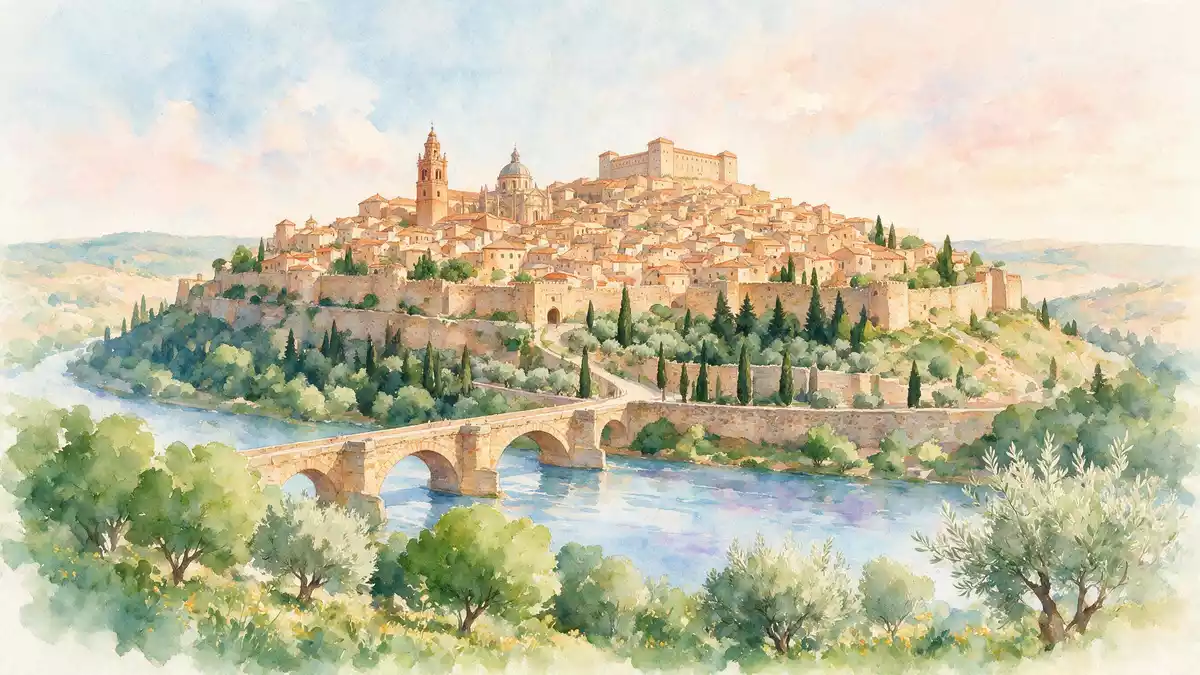
Casco Historico de Toledo, the historic centre of Toledo in central Spain, spreads across a rocky hill almost encircled by the Tagus River, its streets folding around churches, synagogues and stone walls in a tight urban maze. Recognised as the Historic City of Toledo by UNESCO since 1986, this compact quarter preserves more than 2,000 years of building, conquest and faith layered within its walls.
Hilltop city above the Tagus River
The Casco Historico de Toledo occupies a steep promontory rising above a wide bend of the Tagus River in the Castilla-La Mancha region of Spain, south of Madrid. The historic city is built on rock skirted by the river, and the old town covers around 260 ha, a figure that marks it out among Spanish historic centres of similar status.The Historic City of Toledo The medieval walls still trace the outline of the hilltop, with gates and towers marking former lines of defence and framing long views over the surrounding landscape.
The topography shapes the way the Casco Historico de Toledo feels underfoot, with narrow lanes climbing and dropping between terraces, small squares and fortified edges. Streets often follow the contours of the hill rather than any grid, a pattern that reflects successive periods of construction on the same terrain over many centuries.Casco Histórico municipal information
Layers of empire, faith and stone
Toledo has been a significant city since Roman times, later serving as a Visigothic capital and then an important centre in Muslim Al-Andalus before its capture by Christian forces in 1085.Toledo was a major city under the Romans, Visigoths and Moors Within the Casco Historico de Toledo, this long political history remains visible in foundations, reused walls and the mix of architectural styles on display. The city later formed part of the realms ruled from Toledo by Christian monarchs, giving the old town another layer of palaces, churches and administrative buildings.
The Casco Historico de Toledo is associated with the idea of a “City of Three Cultures”, reflecting the presence of Christian, Muslim and Jewish communities during the Middle Ages.coexistence of Christian, Jewish and Muslim cultures Synagogues built with Islamic-inspired arches, former mosques transformed into churches and Mudejar brickwork show how builders adapted forms across faiths. The painter El Greco, who worked in Toledo during the late sixteenth and early seventeenth centuries, gives the city another cultural thread, and his name appears in museums and house-museums within the historic core.El Greco and Toledo
Streets, squares and landmark buildings
Among the most prominent structures inside the Casco Historico de Toledo are the Gothic cathedral and the Alcázar, a fortress occupying one of the highest points of the hill. The cathedral, begun in the thirteenth century and continuing for several centuries, rises above surrounding streets with a tall tower and richly articulated stonework characteristic of Spanish Gothic architecture.the cathedral and the Alcázar The Alcázar has served in various roles over time, including as a royal residence and a military building, and its massive form anchors the skyline from many viewpoints along the river.
The urban fabric between these landmarks is dense, with paving underfoot, close facades and frequent small plazas where streets meet. Municipal information notes that the historic core extends over roughly 260 hectares and includes a large number of plazas, plazuelas and paseos, as well as more than 100 properties protected as Bienes de Interés Cultural, or heritage listings.the casco histórico with plazas and protected buildings Workshops and shops specialising in Toledo steel and other crafts line some of the streets, linking present-day commerce with long-standing local trades.
Visiting Casco Historico de Toledo: what travellers from Western Europe should know
- Casco Historico de Toledo stands in the city of Toledo in central Spain, in the region of Castilla-La Mancha, on a hill south of the Tagus River. Rail services connect Madrid with Toledo’s station beneath the historic quarter.
- The terrain inside the Casco Historico de Toledo is steep, with streets that climb and descend and some approaches involving steps between levels of the old town.
- The historic centre is enclosed by defensive walls with several historic gates, and some viewpoints along the perimeter offer wide views over the Tagus River valley.
- The official language is Spanish and the currency is the euro.
Searching for Casco Historico de Toledo on social platforms
These links open searches for Casco Historico de Toledo on each platform.
Frequently asked questions about Casco Historico de Toledo
Where is Casco Historico de Toledo?
Casco Historico de Toledo is the historic centre of Toledo in central Spain, in the Castilla-La Mancha region, on a hill almost encircled by the Tagus River.
What can visitors expect inside the historic centre?
Visitors encounter narrow paved streets, a Gothic cathedral, the Alcázar fortress, churches, synagogues and small plazas enclosed by medieval walls.
What makes Casco Historico de Toledo distinctive among Spanish historic towns?
The Casco Historico de Toledo combines a hilltop setting, extensive medieval fabric and visible traces of Christian, Muslim and Jewish heritage recognised through its UNESCO World Heritage inscription.


