
Casco Historico de Toledo, hilltop city of three cultures
Published on 08/29/2026 at 06:38 | Editorial responsibility: Rafael Müller, Editor-in-Chief AD HOC NEWS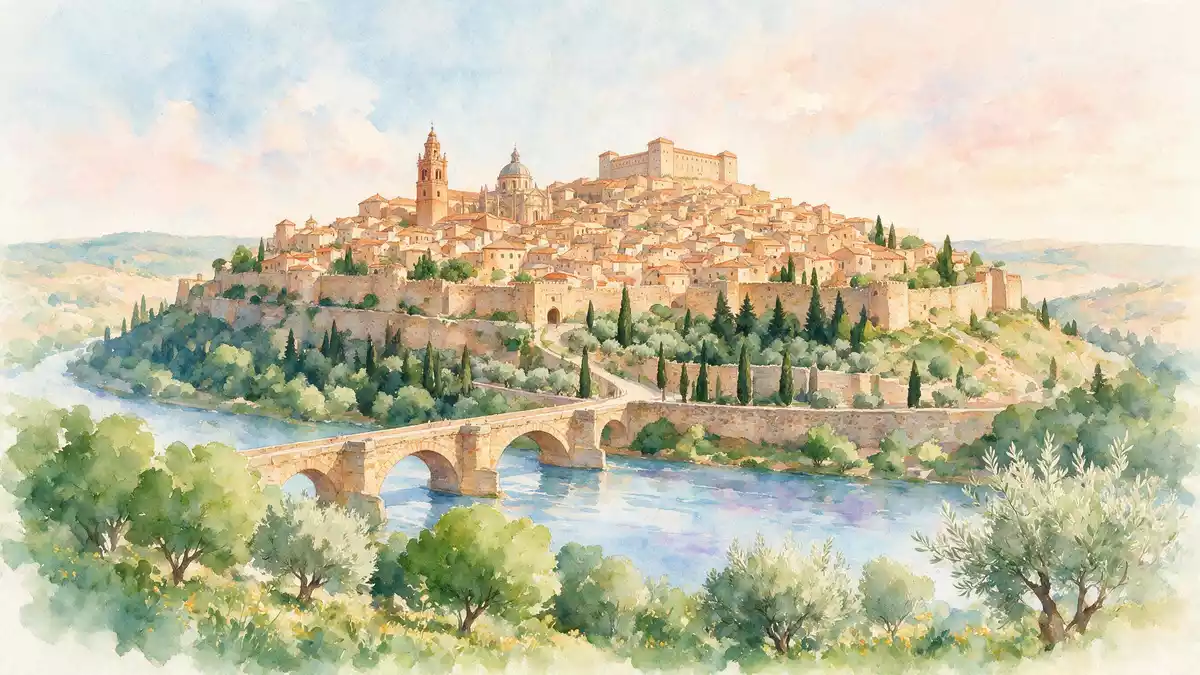
Casco Historico de Toledo, the historic core of Toledo in central Spain, occupies a rocky hill almost encircled by a deep bend of the Tagus River and enclosed by medieval walls. The quarter forms a compact old city where streets, plazas and monumental buildings reflect more than two millennia of continuous urban history, from Roman and Visigothic rule through Islamic and Christian periods and into the early modern Spanish monarchy.
A hilltop labyrinth above the Tagus
The defining feature of Casco Historico de Toledo is its topography: a steep crag rising from the Tagus, wrapped in fortifications and crowned with dense stone building. The hilltop position and the river loop give the historic centre a distinctive outline, described in UNESCO documents as a city “built upon a steep rock skirted by the Tagus River”, with the protected area covering about 260 ha.steep rock skirted by the Tagus River Within this perimeter, streets are narrow, often climbing or descending sharply, and many follow medieval alignments that pre-date the straight avenues of the modern districts beyond the walls.
Approaching from the newer parts of Toledo, the contrast is immediate: modern roads climb towards an older street pattern that concentrates around key spaces such as the Plaza de Zocodover near the north-eastern edge of the hill.Plaza del Zocodover The fabric inside the walls remains largely stone-built, with houses and civic buildings packed closely together, punctuated by towers, church fronts and fortified elevations. From many points on the perimeter, the view drops sharply to the river, reinforcing the sense of the old town as a self-contained historic city set above a water gorge.
Layers of Christian, Jewish and Muslim heritage
Casco Historico de Toledo is often described as the historic centre of the “City of Three Cultures”, referring to the Christian, Muslim and Jewish communities that left successive layers of architecture and urban fabric here.City of Three Cultures Toledo was a major city under the Romans and later the Visigoths, a stronghold of the Emirate of Córdoba, and after the Christian reconquest in 1085 it became a centre of learning where scholars of different faiths worked on translations and shared knowledge.major city under the Romans, Visigoths and Moors These political and intellectual roles left a dense range of buildings inside the historic quarter.
Within the Casco Historico de Toledo, religious architecture shows this mingled heritage clearly. Synagogues with Moorish-style decoration, mosques later converted to churches, Mudejar brickwork combining Islamic and Christian motifs, and the large Gothic cathedral form a catalogue of styles on a relatively small hilltop.synagogues built in Moorish style, mosques turned into churches, Mudejar brickwork, and a towering Gothic cathedral The coexistence and succession of these buildings over centuries make the historic centre one of Spain’s most intensely layered urban heritage areas, where street-level detail, from arches to decorative tiles, frequently signals the cultural mix that shaped Toledo.
Monuments and World Heritage recognition
Several large landmarks anchor Casco Historico de Toledo visually. On a high platform in the north-eastern part of the hill stands the Alcázar of Toledo, a massive fortress whose bulk dominates the skyline for travellers approaching from the surrounding plain.Alcázar von Toledo als massiver Festungsbau Nearer the geometric centre of the old town rises the Cathedral of Toledo, a Gothic great church that occupies a substantial block and asserts its presence through a high tower and richly articulated stone façades.the Gothic cathedral Together, these two structures signal the political and ecclesiastical authority that Toledo held in different periods.
The importance of Casco Historico de Toledo as a historic ensemble has been recognised formally. The wider Historic City of Toledo was declared a World Heritage site by UNESCO in 1986, underlining both its architectural concentration and the way its streets and buildings reflect long continuity of urban life on the hill.inscribed as a UNESCO World Heritage site in 1986 Toledo itself served as a capital at different moments, including during Visigothic rule and in the sixteenth century under Charles V, which reinforced investment in major civic and religious projects whose stone masses still structure the historic centre.repository of more than 2,000 years of history
Visiting Casco Historico de Toledo: what travellers from Western Europe should know
- Casco Historico de Toledo sits in Toledo, in the Castilla-La Mancha region of central Spain, on a hill almost encircled by the Tagus River; rail services link Madrid with Toledo’s station below the historic centre.
- Moving around the quarter involves gradients and steps: streets are narrow, can be steep, and many approaches to viewpoints or monuments use stone stairways rather than broad ramps.
- The Tagus river valley lies close below the walls, and several viewpoints on the edge of the historic centre look out over the water and towards the surrounding plateau.
- The official language is Spanish and the currency is the euro.
Searching for Casco Historico de Toledo on social platforms
These links open searches for Casco Historico de Toledo on each platform.
Frequently asked questions about Casco Historico de Toledo
Where is Casco Historico de Toledo located?
Casco Historico de Toledo is the historic centre of Toledo in Castilla-La Mancha, central Spain, occupying a hill almost encircled by a bend of the Tagus River.
What should visitors expect when walking through the historic centre?
Visitors encounter steep, narrow streets, stone-built houses, major landmarks such as the Alcázar fortress and Gothic cathedral, and viewpoints over the river valley from the old town’s edges.
What makes Casco Historico de Toledo distinctive among Spanish historic cities?
The quarter combines dense medieval fortifications, major Christian monuments and surviving Jewish and Muslim heritage, all preserved together within a UNESCO-listed hilltop city shaped across more than 2,000 years.


