
Casas Colgadas: Cuenca’s houses hanging over the Huécar gorge
Published on 09/08/2026 at 09:13 | Editorial responsibility: Rafael Müller, Editor-in-Chief AD HOC NEWS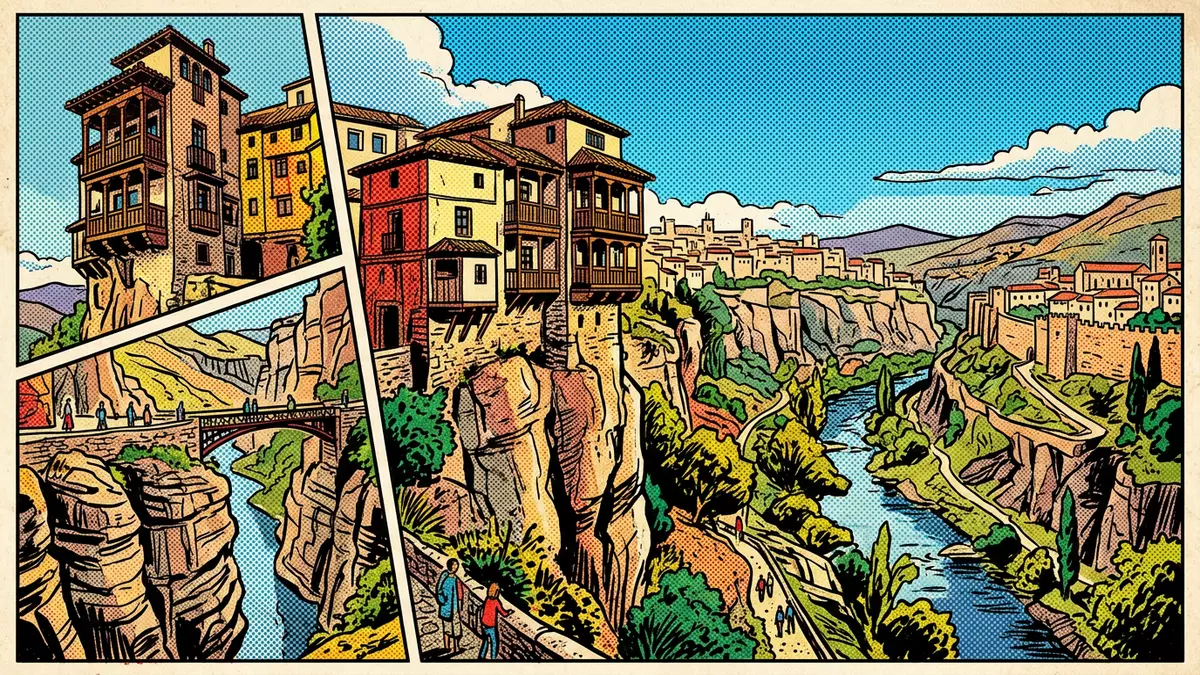
Casas Colgadas in Cuenca, Spain, are a compact group of medieval houses built on the edge of a limestone gorge, their wooden galleries projecting over the Huécar river far below. Dating to the late Middle Ages, these hanging houses combine practical urban housing with a dramatic relationship to the cliff, and today they form one of the most recognisable silhouettes of historic Cuenca.
Medieval houses suspended above the Huécar
Casas Colgadas are a small group of civil houses on the eastern edge of Cuenca’s old town, aligned along the rocky cornice of the Huécar gorge. Part of each house extends beyond the cliff line on timber construction, giving them the suspended appearance that has made the ensemble emblematic of the city’s historic skyline.the eastern edge of the old town The location places the houses directly above the narrow valley carved by the Huécar river, with rock and masonry forming a continuous vertical face.
The surviving group consists of several interconnected houses, historically known as the Casas del Rey and the Casa de la Sirena.Casas del Rey and Casa de la Sirena They rise multiple storeys above the gorge, with upper levels carried out over the void on projecting wooden structures fixed back into the stone wall. From the opposite side of the gorge their timber galleries appear to hang directly from the cliff, while the masonry parts of the houses merge visually with the pale rock.
From late medieval homes to a centre for abstract art
Documented references place Casas Colgadas in the fifteenth century, when Cuenca was a walled town in the region of Castile-La Mancha.a record from 1481 The houses were part of a band of popular, non-palatial dwellings that occupied this side of the old town. Built on difficult terrain above the gorge, they represent a form of Gothic-influenced domestic architecture adapted to a sharp change in level, with stacked floors and timber elements accommodating the vertical drop beside them.Gothic popular origin
The current ensemble preserves both masonry and timber from different phases, but it is in its present form as a cultural venue that Casas Colgadas are best known. Since the 1960s, two of the houses have contained the Museo de Arte Abstracto Español, an institution dedicated to Spanish abstract painting and sculpture, which occupies rooms that open towards the gorge through restored galleries.Museo de Arte Abstracto Español The Casa de la Sirena, adjoining them, houses a restaurant within the historic structure, using interior spaces framed by timber and stone.Casa de la Sirena restaurant Together, museum and restaurant bring contemporary uses into a medieval fabric without altering the hanging outline that defines the site.
Material, structure and views across the gorge
The houses of Casas Colgadas combine stone walls with extensive timber elements, especially in the projecting parts that face the Huécar gorge. The stone sections attach to the cliff and to the old town’s streets, while external timber galleries step outward above the vertical drop. These galleries feature stacked levels of wooden construction, and from the gorge side they read as layers of balcony projecting over the void.layers of wooden balconies Inside, wooden beams, floors and fittings remain visible, especially in those parts integrated into the museum.
Casas Colgadas stand close to Calle Canónigos, a street that traces the upper edge of the gorge, and they face the Puente de San Pablo, the footbridge that offers one of the clearest views of the ensemble.Puente de San Pablo viewpoint From this bridge, the rock wall, the masonry of the houses and the timber galleries form a continuous façade above the Huécar river. The position on the rim of the gorge also means that, from the interior of the museum and restaurant, windows and galleries look straight out over the valley and the opposite hillside, setting works of modern art and everyday activity against a landscape of cliffs and vegetation.
Visiting Casas Colgadas: what travellers from Western Europe should know
- Casas Colgadas stand on the eastern side of Cuenca’s old town in Castile-La Mancha, Spain, above the Huécar gorge and near Calle Canónigos and the Puente de San Pablo footbridge.
- The terrain includes steep streets and stairways leading to the rim of the gorge, and approaches involve walking along narrow historic routes beside drop-offs and stone walls.
- Cuenca is reached by road and rail from other parts of Spain; from the city centre, Casas Colgadas lie within the historic quarter that climbs above the river valleys.
- The official language is Spanish and the currency is the euro.
Searching for Casas Colgadas on social platforms
These links open searches for Casas Colgadas on each platform.
Frequently asked questions about Casas Colgadas
Where are Casas Colgadas located?
Casas Colgadas are on the eastern rim of Cuenca’s old town in Castile-La Mancha, Spain, above the gorge of the Huécar river.
What can visitors expect at Casas Colgadas?
Visitors encounter medieval houses built on a cliff edge, with timber galleries projecting over the gorge and interiors housing the Museo de Arte Abstracto Español and a restaurant.
What makes Casas Colgadas distinctive among Spanish historic houses?
Casas Colgadas are distinctive for their position on a gorge rim and for their projecting wooden galleries, which appear to hang directly above the Huécar river valley.


