
Casa di Giulietta in Verona and its balcony myth
Published on 09/14/2026 at 15:36 | Editorial responsibility: Rafael Müller, Editor-in-Chief AD HOC NEWS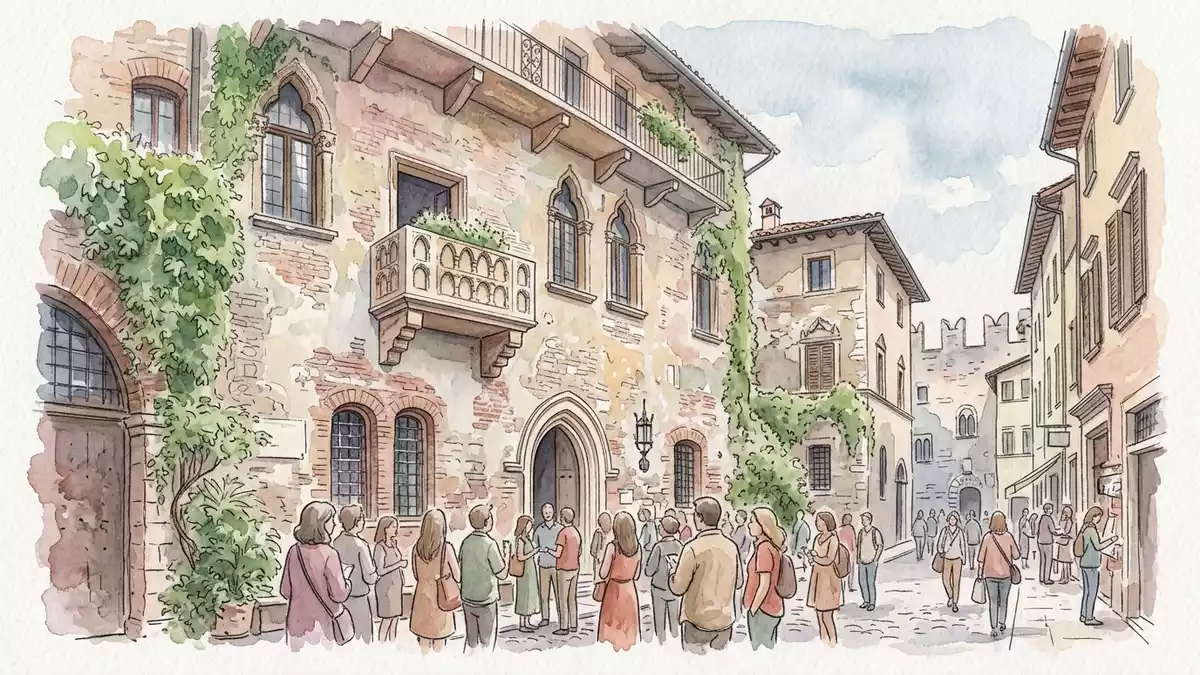
Casa di Giulietta in Verona is a medieval tower house that has become a focal point for the city’s association with the story of Romeo and Juliet, centred on a courtyard and a balcony added in the twentieth century. The building stands on via Cappello in the historic centre and has shifted from a medieval residence and inn to a civic museum shaped around the literary myth.
A medieval tower house behind the legend
The building known as Casa di Giulietta is a brick and stone tower house whose presence on via Cappello is documented in the mid fourteenth century. Civic records attest to a house on this site in 1351, when it functioned as an inn called “del Cappello”, linked to the Cappello family whose name still marks the street.documented since 1351 The Cappello coat of arms, featuring a carved headdress, is set into the inner arch of the courtyard and underpins the later association with Shakespeare’s Capulets.Cappello family coat of arms
The house itself dates to the thirteenth and fourteenth centuries and reflects the compact, vertical form typical of medieval tower dwellings in Verona’s centre.a medieval residential tower Over centuries it served both as a private residence and as lodging for travellers, long before the name Casa di Giulietta attached itself to the fabric. The current identification with Juliet’s family stems from eighteenth-century readings of Shakespeare, which linked the Cappello name and emblem with the fictional Capulets.Cappello name and Capulet legend
From Cappello inn to Casa-museo
In 1905 the Municipality of Verona acquired the property, taking the former Cappello house into public ownership as part of a wider programme of civic heritage management.purchased by the Comune in 1905 During the 1930s, under the direction of museum head Antonio Avena, the building underwent a substantial neo-medieval restoration that reshaped both its façade and interior. Avena treated the house as a kind of theatrical backdrop for the imagined lives of Romeo and Juliet, reworking walls, decorative painting and architectural details to evoke an idealised medieval setting linked to the literary narrative.neo-medieval restoration in the 1930s
The courtyard façade, facing inward from via Cappello, was modified during this restoration and the balcony that now draws visitors was installed as part of the scheme.balcony added between 1939 and 1940 Inside, rooms were furnished with sixteenth- and seventeenth-century pieces, Renaissance ceramics from Verona and wall paintings depicting scenes from the Romeo and Juliet story.furnishings and frescoes Later directors continued to refine this museum arrangement, and the house opened formally to the public as a Casa-museo in 1973, framing the building as both historic fabric and literary backdrop.
The courtyard, balcony and museum rooms
Approaching Casa di Giulietta from via Cappello brings visitors through an entrance passage into a compact courtyard enclosed by brick walls and the restored façade. The Cappello coat of arms sits above an inner arch, while the balcony projects from a first-floor opening and has become the visual emblem of the site.inner arch of the courtyard In the courtyard stands a bronze statue of Juliet by sculptor Nereo Costantini, installed in the early 1970s and positioned so that the figure looks towards the house.statue of Juliet in the courtyard
The museum rooms upstairs trace the layering of the Romeo and Juliet tradition. One space focuses on the sixteenth-century novella by Luigi da Porto, which first placed the lovers in Verona, while another references William Shakespeare’s late sixteenth-century play that fixed the balcony scene in theatrical history.from Luigi da Porto to Shakespeare Across the house, displays combine period furniture, domestic objects and interpretive material about the Cappello family, the evolution of the myth and the way this medieval building became identified with a fictional heroine.
Visiting Casa di Giulietta: what travellers from Western Europe should know
- Casa di Giulietta stands in Verona’s historic centre on via Cappello, a short walk from Piazza delle Erbe and the surrounding medieval streets.
- The approach leads through a passage into a paved courtyard, and access to upper rooms involves staircases within the former tower house.
- The official language is Italian and the currency is the euro; English is used in many museum labels and visitor materials.
Searching for Casa di Giulietta on social platforms
These links open searches for Casa di Giulietta on each platform.
Frequently asked questions about Casa di Giulietta
Where is Casa di Giulietta located in Verona?
Casa di Giulietta stands on via Cappello in Verona’s historic centre, close to Piazza delle Erbe and within the network of medieval streets.
What can visitors expect inside Casa di Giulietta?
Inside the former tower house, visitors find furnished rooms with period furniture, Renaissance ceramics, frescoes and displays about Romeo and Juliet and the Cappello family.
What makes Casa di Giulietta distinctive among Verona’s sights?
The house combines genuine medieval fabric on via Cappello with a twentieth-century balcony and museum arrangement built around the Romeo and Juliet legend.


