
Casa Batllo: Gaudí’s living sculpture on Passeig de Gràcia
Published on 09/16/2026 at 07:37 | Editorial responsibility: Rafael Müller, Editor-in-Chief AD HOC NEWS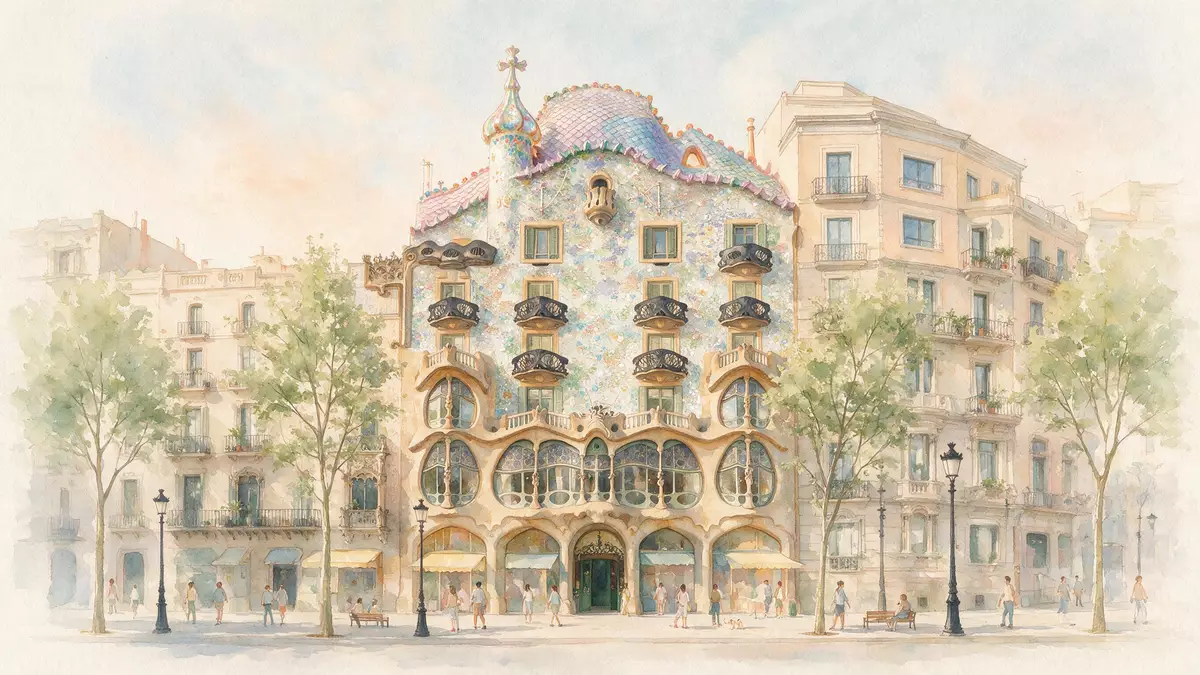
Casa Batllo on Barcelona’s Passeig de Gràcia is a former townhouse transformed by Antoni Gaudí into a flowing, sculptural façade and interior between 1904 and 1906. This Catalan Modernisme landmark rests on an earlier building completed in 1877, yet Gaudí’s renovation turned it into one of the most recognisable works of his mature period, where structure, decoration and everyday living merge into a single organic whole.renovation between 1904 and 1906
A nineteenth-century house reimagined by Antoni Gaudí
The building that underlies Casa Batllo was constructed in 1877 by architect Emili Sala Cortés, at a time when the Eixample district of Barcelona was filling with orderly apartment blocks.constructed in 1877 Textile industrialist Josep Batlló i Casanovas acquired the property later and commissioned Antoni Gaudí to carry out a comprehensive redesign, giving him considerable freedom to reshape the house while keeping its structural core.industrialist Josep Batlló i Casanovas
Between 1904 and 1906 Gaudí reworked the façade, roofline and interior, adding a further floor and reconfiguring rooms and circulation within the existing shell.between 1904 and 1906 The house is now recognised as a key work of Catalan Modernisme and is listed as part of the UNESCO World Heritage group “Works of Antoni Gaudí”, reflecting both its historical significance and its role in the evolution of Gaudí’s experimental approach to form and decoration.UNESCO’s World Heritage List
The marine façade and the “House of Bones”
From the street, Casa Batllo presents an undulating façade clad in sandstone and trencadís, the Catalan mosaic technique that uses broken ceramic fragments to create shimmering surfaces.sandstone covered with colorful trencadis Gaudí developed this front as a kind of marine landscape, with colours that move from bluish tones near the top to warmer hues lower down, evoking water and sunlight as they shift across the elevation.marine-inspired façade
A central feature on the main floor is a large balcony and window composition, where stone columns take on bone-like forms and are paired with stained glass and ironwork, lending the house its common nickname “House of Bones”.bone-like pillars and skull-like balconies Smaller balconies on the upper floors resemble masks, projecting slightly from the wall and punctuating the mosaic surface with pale, sculpted forms. The façade’s lower section incorporates slender stone supports with botanical ornament, while the upper section rises towards a roof that reads as the scaled back of a creature, completed in glazed ceramic tiles.roof surface covered in large ceramic tiles
Inside Casa Batllo: flowing rooms and a tiled courtyard
The interior continues Gaudí’s preference for curved lines and integrated detail. On the main level, rooms open one into another with gently arched ceilings and shaped timber doors, while light filters through stained-glass panes whose circular motifs echo the fluid forms of the façade.wooden doors and stained-glass windows The central staircase rises like a carved spine through the house, framed by smooth plaster surfaces and carefully placed openings that guide views towards the street and towards the inner courtyard.
To the rear, the courtyard elevation is treated as a vertical composition of glass, ceramic and iron, with blue tiles arranged to modulate light towards the lower floors.vertical garden of glass, ceramics, and iron Higher up, near the roof, service spaces sit beneath Catalan vaults finished in white, while the rooftop itself is occupied by groups of chimneys with sinuous, polychromatic surfaces and the tiled back sometimes referred to as the “dragon’s back”.four sets of chimneys with sinuous shapes
Casa Batllo on Passeig de Gràcia
Casa Batllo stands at Passeig de Gràcia 43 in Barcelona’s Eixample district, a broad boulevard lined with late nineteenth-century buildings and shops.Passeig de Gràcia 43 in Eixample It forms part of the row known locally as the Illa de la Discòrdia, a block where several Modernisme architects set contrasting façades side by side, including Casa Amatller by Josep Puig i Cadafalch and Casa Lleó Morera by Lluís Domènech i Montaner.Illa de la Discòrdia row of houses
The building’s combination of sculpted stone, trencadís, wrought iron and carefully shaped timber places it firmly within Gaudí’s wider body of work in Barcelona, alongside projects such as Casa Milà and the Sagrada Família. At Casa Batllo, the focus on a single townhouse makes the transformation particularly legible: a conventional urban shell reworked into what appears as a living organism, while still functioning as domestic and commercial space within the grid of the Eixample.
Visiting Casa Batllo: what travellers from Western Europe should know
- Casa Batllo stands on Passeig de Gràcia in the Eixample district of Barcelona, a short walk from central city transport hubs and other Modernisme landmarks.
- The house rises over several levels, with staircases, changes in floor level and rooftop terraces; visiting involves walking through rooms and climbing internal flights of stairs.
- Nearby, other Gaudí works such as Casa Milà on Passeig de Gràcia and the Sagrada Família further north in the Eixample expand the picture of Catalan Modernisme in the city.
- The official language is Spanish and Catalan and the currency is the euro.
Searching for Casa Batllo on social platforms
These links open searches for Casa Batllo on each platform.
Frequently asked questions about Casa Batllo
Where is Casa Batllo located in Barcelona?
Casa Batllo stands at Passeig de Gràcia 43 in the Eixample district of Barcelona, on a central boulevard lined with nineteenth-century buildings and shops.
What should visitors expect inside Casa Batllo?
Visitors walk through rooms with curved ceilings, stained-glass windows and carefully detailed woodwork, ascending staircases towards a tiled courtyard elevation and a rooftop with sculptural chimneys.
What makes Casa Batllo distinctive among Gaudí’s works?
Casa Batllo is distinctive for its undulating marine-inspired façade, bone-like balconies and roof tiled like a creature’s back, all applied to a single remade townhouse structure.


